
Do I Need an Advisory Board? A Practical Guide
More advice won’t fix a decision that nobody owns. If you’re asking, “do I need an advisory board for my business?”, start with the gap you’re trying to close: expertise, a trusted sounding board or consistent follow-through.
It’s reasonable to want experienced people around the table when the stakes are high. But advice can become another layer of discussion if nobody turns it into a clear decision and action. A formal advisory board may suit a business that needs targeted outside expertise. A facilitated peer group offers a different structure: business owners challenge and support one another. Sometimes the real issue is inside the business, where clearer responsibilities and stronger leadership execution are needed.
This guide will help you identify the decision-making gap, compare those options and choose a practical next step with clear expectations and accountability. You’ll see what separates an advisory board from a peer group, when internal execution deserves attention first, and how to avoid adding meetings without building momentum.
Key Takeaways
- Answer “do I need an advisory board for my business” by identifying whether the gap is outside expertise, peer challenge or stronger internal follow-through.
- Separate formal governance from structured external input and peer-based problem-solving. Each serves a different purpose.
- Use recurring decisions, reliable information and willingness to act as a practical test of readiness.
- Make meetings count by defining the decision, preparing evidence, assigning actions and reviewing progress.
- The Elev8 Boardroom Program is an ongoing facilitated peer group, not a formal company board. Max 4 seats per room; members are expected to arrive prepared and participate actively.
Do I need an advisory board for my business, or is another kind of support enough?
Advice is not the same as a decision, and a decision is not the same as follow-through. If you’re asking, “do I need an advisory board for my business?”, identify what’s missing: outside expertise, a clear decision owner, reliable information or the capacity to act.
An advisory board provides structured external input on a business’s direction or specific challenges. Members can bring experience and challenge assumptions, but they don’t automatically have authority to make decisions for the company. In Australia, an advisory board is distinct from a formal board of directors, which has legal responsibilities. The Advisory board overview explains the general distinction. A title alone isn’t a safeguard: if someone starts acting as a director in practice, their conduct may have legal consequences. A clear remit helps define the role and decision-making authority.
Useful board input sharpens the decision; it doesn’t make the decision for the business. Whether you need an advisory board depends on the decisions you face, the gaps inside the business and whether there’s a practical way to turn input into action.
What problem would an advisory board solve?
Name one strategic decision that keeps returning without resolution. It might be whether to enter a new market, change the business model or commit resources to a major investment. If you can’t state the decision clearly, you’re not ready to build a board around it.
Then diagnose the blockage. These problems can look similar from the owner’s chair, but they need different fixes:
- Missing expertise: You lack experience or perspective to assess the options. Structured external input may help.
- Missing time or capacity: The decision is understood, but nobody has room to progress the work. More advice won’t create implementation capacity.
- Missing information: You’re debating without the evidence needed to compare options. Improve the data before asking people to interpret it.
- Missing ownership: The leadership team hasn’t agreed who will decide and act. Clarify responsibility first.
Repeatedly reopening a consequential decision can stall priorities and consume leadership attention. That’s a practical cost, not proof that the business needs a formal advisory board. Identify the specific gap first, then choose support that addresses it.
Is a formal board the same as a peer group?
No. A formal governance structure and a facilitated peer discussion serve different purposes. An advisory board brings external input to the business. A peer group brings business owners together to test challenges and share perspectives, with participants learning from one another. Neither turns a group conversation into the company’s formal board.
The useful question is whether you need targeted expertise for your business or a disciplined forum to examine decisions with people who understand the weight of ownership. A peer group can offer challenge and accountability, but the owner still owns the decision and its execution. For a closer look at how this format works, see the executive peer advisory boardroom guide.
Advisory board, directors or peer group: which option fits your business?
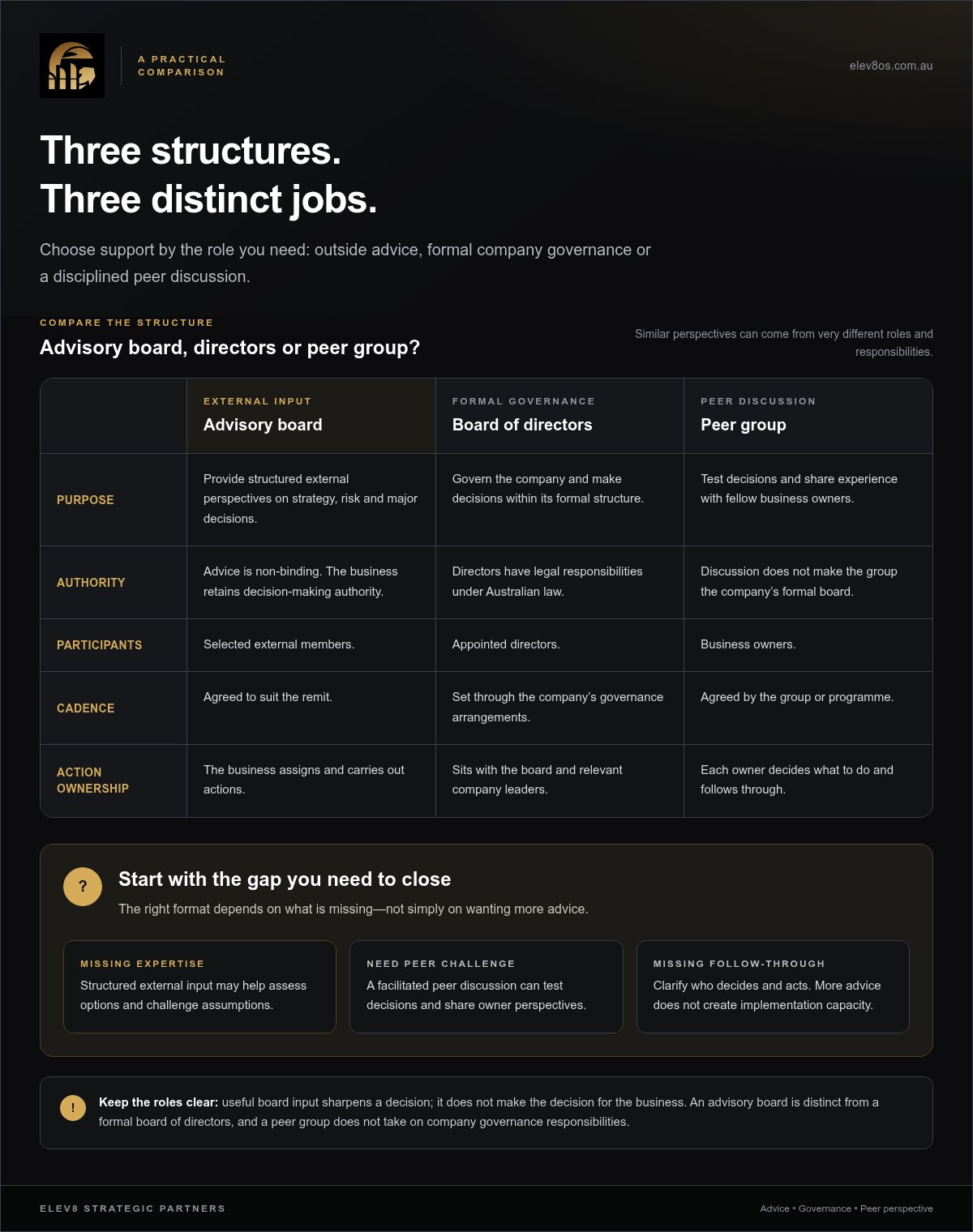
These formats can all bring more perspectives to a difficult decision, but they don’t do the same job. A director’s role in formal company governance differs from an advisory board’s external input. Both also differ from a peer group where business owners work through challenges together.
Advisory board: Purpose: provide structured external perspectives on strategy, risk and major decisions. Authority: advice is non-binding; the business retains decision-making authority. Participants: selected external members. Cadence: agreed to suit the remit. Action ownership: the business assigns and carries out actions.
Board of directors: Purpose: govern the company and make decisions within its formal structure. Authority: directors have legal responsibilities under Australian law. Participants: appointed directors. Cadence: set through the company’s governance arrangements. Action ownership: sits with the board and relevant company leaders.
Peer group: Purpose: test decisions and share experience with fellow business owners. Authority: discussion doesn’t make the group the company’s formal board. Participants: business owners. Cadence: agreed by the group or programme. Action ownership: each owner decides what to do and follows through.
This distinction matters. A peer group can sharpen a decision, but it doesn’t take on a company’s governance responsibilities. For a closer comparison of formats, explore these business owner peer group options.
What does a formal advisory board contribute?
An advisory board can bring relevant outside experience to choices the leadership team needs to make, such as assessing a growth plan, weighing a significant risk or challenging assumptions behind a major investment. Its value depends on a defined remit. Set out what the group can examine, what it can recommend and which decisions remain with the company. Practical guidance on key factors for effective advisory boards also stresses the importance of structure and purpose.
In Australia, an advisory board is not the same as a formal board of directors. Its input is generally non-binding, while directors have legal responsibilities. The label isn’t the whole story: if people take on decision-making roles in practice, legal questions can arise. Define the boundaries clearly and get appropriate legal advice if the structure or conduct is uncertain.
When might a peer group be the better fit?
A peer group may suit an owner who wants a regular, facilitated setting to test a decision with people facing comparable pressures, rather than a panel selected to provide specific expertise. Discussion can challenge assumptions and surface options; it doesn’t transfer authority or implementation to the group. You still need to prepare, participate and act on what you decide.
If the central gap is execution inside the business, more discussion may not be the answer. The strategic operations partner programme guide outlines a different kind of support focused on building execution capacity. Choose the format that addresses the actual constraint, not the one that simply adds another meeting.
How can you tell whether your business is ready for an advisory board?
Asking “do I need an advisory board for my business” is useful only if you test the need against how decisions actually move through your business. Don’t measure readiness by revenue, reputation or whether other businesses have a board. Look for a recurring decision that could benefit from outside perspective, then check whether your team can prepare for the discussion and act on its outcome.
Readiness means you can name the decision, prepare the facts and assign ownership for the next action. If one of those pieces is missing, deal with that gap before adding a standing meeting.
Use this checklist against a real decision, not a hypothetical one:
- The decision keeps returning. It’s consequential, repeatedly deferred or tested only with people who already share the same assumptions.
- You can state the question clearly. For example, “Which of these growth options should we fund?” is more useful than “How do we grow?”
- Relevant information is available. You can bring the evidence that helps others understand the options, constraints and likely trade-offs.
- Someone can own the next step. A named leader has the authority and capacity to carry an agreed action forward.
- You’ll listen and respond. You’re prepared to hear direct feedback, challenge your assumptions and change course if the evidence supports it.
Signals that structured external input could help
Outside input may be useful when a high-stakes choice keeps circling back without a decision, or when the leadership team lacks a perspective needed to assess the options. You don’t need perfect information, but you do need enough to explain the question and make a grounded discussion possible. Before inviting others in, identify who inside the business will assess the input and move the next step forward.
That last point matters. A meeting can clarify the choice, but it can’t create implementation capacity by itself. If the likely action has no owner, no time and no authority behind it, the business isn’t ready to use the input well.
Signals to fix before adding a board or group
Pause if the objective is vague, the information is inaccessible or no one is accountable for acting. More meetings won’t repair those conditions, and a prestigious name on the agenda won’t either. First define the decision, assemble the information and settle who will carry the work once the discussion ends.
Readiness for external input is also different from readiness for formal governance. You may need a structured sounding board for a specific strategic issue without changing the company’s governance arrangements. Equally, formal governance needs should be considered on their own terms, not treated as a status upgrade or replaced by a peer discussion.
Make the call practical: write down the decision, the information you can share and the person who will own the next action. If you can do all three, you’re better placed to make outside input count. If you can’t, fix the missing piece first. Build the conditions for useful challenge before you build another meeting into the calendar.
How do you make an advisory board useful after the meeting ends?
A sharp discussion can still amount to nothing if it ends without a decision, an owner or a review point. Build a simple rhythm that carries the work from the agenda into the business. Keep routine operational updates out of the main discussion unless they directly affect a consequential choice.
Board value shows up in decisions implemented and reviewed, not in the number of ideas raised. Use this four-step process:
- Define the decision. State what needs to be decided, why it matters now and what a useful outcome would look like. Frame the agenda around choices and trade-offs, not a general progress report.
- Prepare the evidence. Gather the relevant facts, constraints and options already considered. Share enough context for participants to challenge assumptions without burying them in background material.
- Assign the actions. Record each agreed next step, the person accountable, the due point and what evidence will show it’s complete. “Review the proposal” is vague; specify what will be reviewed and what decision or output is expected.
- Review progress. At the next discussion, check what was completed, what remains open and what blocked progress. Decide whether to remove the barrier, change the action or revisit the original decision.
What should owners prepare before each discussion?
Send participants the decision required, the facts that bear on it, any material constraints and the options already considered. Be clear about where you want scrutiny. For example, ask the group to challenge the assumptions behind a proposed expansion, rather than simply reassure you that it’s a good idea. Preparation gives the discussion something solid to test.
Keep the agenda tight. If an operational update doesn’t change the decision or expose a material risk, it probably belongs elsewhere. Preparation is not paperwork for its own sake; it lets participants use their time to examine the real choice.
How should decisions and actions be reviewed?
Use one simple action log, not a reporting system that takes more effort to maintain than the work itself. Capture the decision, accountable person, next action, due point, review date and evidence of completion. At the next session, start with completed actions and unresolved barriers. Close the loop before adding fresh commitments.
If an action hasn’t moved, find out why. The owner may lack authority, time or information, or the decision may need to change. Record the actual barrier and agree a practical response. Don’t quietly roll unfinished actions forward meeting after meeting.
Accountability should improve decisions, not create meeting theatre. For business owners who want structured peer discussion alongside clear expectations to prepare and participate, explore the Elev8 Boardroom.
Could the Elev8 Boardroom Program suit you better than creating a formal board?
If you want a disciplined place to test decisions with other business owners, a peer group may fit better than establishing a formal company board. The Elev8 Boardroom Program is a facilitated, ongoing peer forum. It is not a company board, and it does not take on formal governance responsibilities or make decisions for your business.
Josh Lawrence facilitates the programme and provides direct access. Members are expected to show up prepared and participate actively. The value comes from bringing real work to the group, hearing how others examine it and being accountable for what you choose to do next. It isn’t a passive seat where you collect opinions and leave execution to someone else.
Commitment: Ongoing. Max 4 seats per room. That room limit is specific to the Boardroom Program. It is separate from Elev8’s Tier 1 client rule: only one active Tier 1 client is allowed per industry vertical at any time.
What does the Elev8 Boardroom Program offer?
The programme creates a facilitated setting for peer discussion, challenge around business issues, accountability and access to Elev8 frameworks. Bring a decision or obstacle that matters, explain the facts and trade-offs, and engage with the perspectives in the room. Then take responsibility for deciding what applies and putting it into practice.
That distinction is important if you’re still asking, “do I need an advisory board for my business?” A peer forum can provide structured challenge and shared experience, but it doesn’t replace a formal board where one is required or appropriate. Nor does it execute the owner’s decisions. Its purpose is to strengthen how you examine and act on the work.
Elev8’s wider operating principles are embedded over advisory, outcomes over tenure, honest over comfortable, and one industry at a time. For Tier 1, Elev8 works from inside the business rather than offering advice from a distance; Josh Lawrence provides direct access. Success is measured by delivered outcomes, not length of engagement. The engagement concludes when agreed outcomes are delivered and the business is positioned to grow without Elev8. Elev8 tells clients what they need to hear, not simply what they want to hear. The one-industry-at-a-time rule means only one active Tier 1 client is allowed per industry vertical at any time. The Boardroom Program itself is a peer-group format, not embedded delivery.
What is the next step if you are considering a peer group?
Start with a diagnostic conversation about the decisions you’re facing and the kind of support that would help. The Discovery Call is a 30-45 minute video call with Josh Lawrence, not a sales presentation. There’s no pitch deck or slide presentation. It’s a direct conversation to understand the situation and assess whether a peer-group format makes sense.
Tier 2 pricing is discussed only after the call. If you’re ready to examine whether this kind of structured peer forum fits your needs, book a diagnostic Discovery Call.
Make the next decision count
The question “do I need an advisory board for my business” doesn’t need a grand answer today. It needs an honest one: what decision is stuck, what kind of input would move it forward, and who will own the next step?
Start there. Write down the decision you need to make and the support you believe would help. If a peer forum could give you the challenge and accountability you’re missing, use a diagnostic conversation to test that fit before committing to a new structure.
A diagnostic Discovery Call with Josh Lawrence is a direct conversation about your business and the support you’re considering. It’s a 30-45 minute video call, without a pitch deck or slide presentation. Book a diagnostic Discovery Call and take a clear next step towards decisions that move into action.
Frequently Asked Questions
Is an advisory board legally required for a small business in Australia?
No. An advisory board isn’t a mandatory structure for Australian small businesses. It provides input by choice, not because the company must establish one. This is separate from the legal requirements that may apply to a company’s formal governance and directors. If you’re unsure what your business structure requires, check current guidance from ASIC or get advice specific to your circumstances before making governance decisions.
Can an advisory board make decisions for my company?
No, an advisory board’s recommendations don’t automatically authorise it to make company decisions. For example, its members may assess a proposed supplier contract, but the decision to sign should remain with the person who holds authority in the business. Set decision boundaries in writing, including who approves spending, commits the company and carries out agreed actions. If the arrangement gives members decision-making power in practice, get legal advice about its implications.
How much does an advisory board cost?
There’s no single standard fee. The cost depends on how you structure the arrangement, the experience you seek, the work required between discussions and whether members receive cash, equity or another form of compensation. Before setting a budget, define the board’s purpose and expected contribution, then decide how you’ll assess whether that investment is worthwhile. For the Elev8 Boardroom Program, Tier 2 pricing is discussed only after the Discovery Call.
Can a regional Australian business benefit from a peer advisory group?
Yes. A regional location doesn’t prevent an owner from getting value from a structured peer discussion, particularly when local market knowledge and practical experience matter. Business owners in Tamworth, Newcastle, Armidale, Coffs Harbour, Port Macquarie and Moree can consider whether the group’s format gives them a useful way to test decisions. Think about how the meeting format fits your schedule and whether participants understand the conditions in which your business operates.
What should I look for before joining a business peer group?
Look for a clear purpose, well-defined participation expectations and ground rules for handling sensitive business information. Check whether sessions focus on real decisions or drift into general conversation, and whether members are expected to contribute as well as receive input. Consider the mix of experience in the room and whether you can bring a current business challenge without needing to disguise its commercial details.
How do I know whether an advisory board is producing value?
Agree on a few signs of progress before the first meeting. For instance, track whether a long-standing decision is resolved, whether the business tests a new risk control or whether a strategic priority moves forward. Review those signals against the board’s original purpose at an agreed point. If discussions aren’t changing decisions or advancing priorities, revisit the membership, remit or meeting approach rather than measuring value by attendance alone.
Can I join a peer group instead of setting up a formal advisory board?
Yes, if your main need is to discuss business challenges with peers rather than bring selected external expertise directly into your company. A peer group can be a separate support choice, but it doesn’t become your company’s formal governance structure or take responsibility for decisions. Keep any formal governance obligations separate, and choose a peer group for the specific perspective, challenge or accountability you want from other owners.