
Executive Peer Advisory Boardroom Australia: A Practical Buyer’s Guide
What’s the value of a room full of peers if nobody challenges your decision or follows up on what you said you’d do? When comparing an executive peer advisory boardroom Australia has to offer, the real test isn’t member count. It’s whether discussion sharpens your judgement and creates accountability.
Important decisions can be hard to test inside your own business. A peer group that feels like networking, without structure or follow-through, is unlikely to help. The right forum brings relevant perspectives, helps clarify priorities and gives you a practical way to keep action in view.
This guide explains what a strong boardroom should deliver and how to compare decision quality, peer fit, facilitation and format. It also considers how regional location can affect participation. You’ll see how The Elev8 Boardroom supports senior-level problem-solving and accountability, and how it differs from Elev8’s Strategic Business Partner Programme. The aim is to help you choose support that fits your leadership responsibilities and business needs.
Key Takeaways
- Assess an executive peer advisory boardroom Australia option by the quality of its challenge and follow-through, not the size of its membership.
- Use a clear discussion sequence to frame an issue, test assumptions and identify practical next actions.
- Compare peer forums with coaching and advisory boards by who contributes, how discussions are structured and what follow-through looks like.
- Match the group’s seniority, peer relevance and facilitation to the decisions you need to make.
- The Elev8 Boardroom’s curated peer discussions support collaborative insight, accountability and high-level decision-making.
What executive peer advisory boards in Australia should do
An executive peer advisory boardroom is a structured forum where leaders examine business challenges and test decisions with people who bring relevant experience. It isn’t a substitute for a formal board, and it doesn’t take responsibility for decisions. The leader remains accountable for what happens next.
An executive peer advisory boardroom gives you a place to put a live business decision under informed peer scrutiny, then leave with a clearer view of what to do. That’s the standard to look for in an executive peer advisory boardroom Australia-wide: useful challenge, relevant perspectives and actions you can take back into the business.
The word “boardroom” can sound more formal than the work itself. An Advisory board provides advice and perspective; a peer forum brings leaders together to question one another’s thinking. Neither should blur who holds executive responsibility. Peers can surface risks or options you may have missed, but you decide what suits your business and own the outcome.
How a peer advisory boardroom differs from networking
Networking centres on introductions, referrals and open conversation. A peer boardroom focuses on a business issue that needs attention. You might bring a decision about entering a new market, changing the leadership structure or addressing a persistent delivery bottleneck. The group examines the issue rather than simply exchanging contacts or offering easy reassurance.
Accountability gives the discussion a practical edge. You identify an action to take back into the business, such as testing an assumption with customers or setting a decision deadline. At a later discussion, you can revisit progress. This doesn’t guarantee a result, but it makes follow-through part of the conversation.
Who benefits from an executive peer group
Established business owners and senior leaders may benefit when a decision affects people, customers, cash flow or business direction. The pressure is often greatest when the decision-maker has plenty of internal information but few independent people who can challenge their interpretation of it.
An outside peer perspective can help reveal blind spots: a growth plan resting on an untested assumption, a leadership issue being mistaken for a process problem, or a decision stalled because nobody has set a clear threshold for acting. Different experience can widen your options, but relevance matters. The most useful peers understand the scale and significance of the challenge, even if they work in a different market.
Look for substance over social activity. A well-run peer forum gives leaders room to think clearly, hear direct challenge and take a sharper decision back into the business. The decision still belongs to you.
How executive peer advisory boardroom discussions turn challenges into clearer decisions
A useful peer discussion starts with a decision that needs to be made, the commercial stakes and the constraints shaping the options. That could mean clarifying what happens if a decision is delayed, which resources are available and what risks need to be managed. Specifics give the conversation a firm edge.
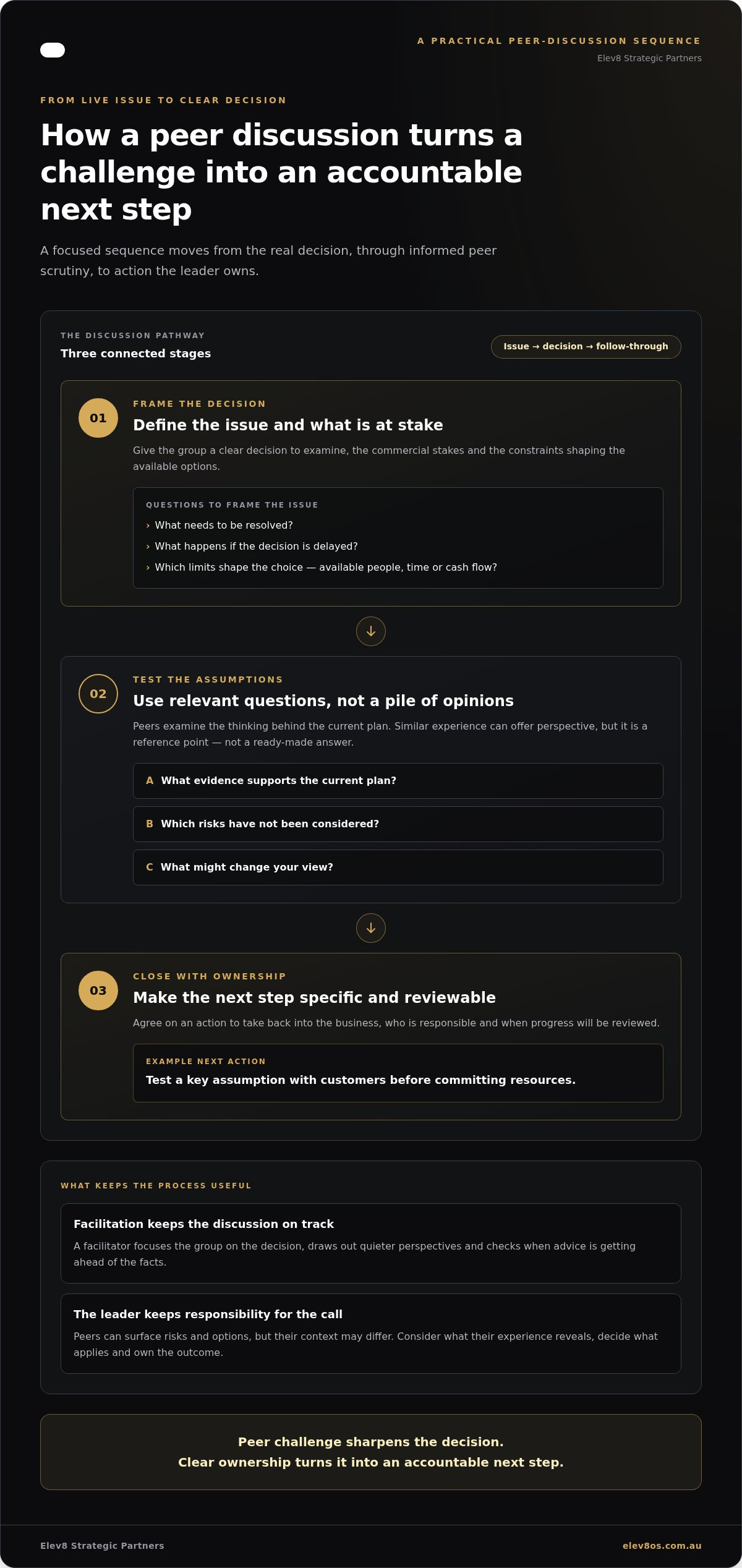
The sequence below is a practical way to assess how a group works through an issue. For anyone considering an executive peer advisory boardroom Australia option, the test is whether the discussion moves from the real decision to a next step the leader can own.
A practical sequence for working through a business issue
First, frame the decision. What needs to be resolved? What happens if it’s delayed? Which limits, such as available people, time or cash flow, shape the choice? Naming these factors helps the group focus on the right problem.
Next, test the assumptions. Peers can ask what evidence supports the current plan, which risks haven’t been considered and what might change your view. Relevant questions are more useful than a pile of opinions. A peer who has faced a similar challenge can offer a helpful perspective, but their experience is a reference point, not a ready-made answer.
Then close with ownership: agree on a next action, who is responsible and when progress will be reviewed. For example, you might test a key assumption with customers before committing resources. Without a clear next step, even a sharp discussion can disappear into the week’s workload.
What makes peer feedback useful rather than distracting
A facilitator helps keep the discussion focused on the decision, draws out quieter perspectives and checks when advice is getting ahead of the facts. The facilitator guides the process; the leader remains responsible for the call. Clear boundaries around the issue, time and purpose also help prevent one person’s story from taking over.
Constructive challenge is direct, but it isn’t pressure to copy another business. A peer’s context may differ in customers, capability or risk. Consider what their experience reveals about your assumptions, then decide what applies to your operation.
For a broader view of how peer groups can support executive thinking, Vistage on Peer Advisory Groups discusses their potential value. The practical standard is simple: peer challenge sharpens the decision; clear ownership turns it into an accountable next step.
The Elev8 Boardroom is an executive peer advisory community focused on collaborative insight, accountability and high-level decision-making. Explore The Elev8 Boardroom to see how its curated peer discussions support leaders working through complex business issues.
Compare an executive peer boardroom with coaching, roundtables and advisory boards
These formats can all help leaders think, but they do different jobs. Compare who contributes, how discussion is structured and what happens afterwards. Choose a format based on the work you need done, not just the name.
| Format | Purpose | Who contributes | Structure and follow-through |
|---|---|---|---|
| Peer advisory boardroom | Test a leader’s live business decisions and challenges. | The presenting leader and peers drawing on their experience. | Usually focused on a specific issue. Follow-through depends on clear actions and accountability built into the group. |
| Executive coaching | Develop an individual leader’s thinking, capability or effectiveness. | The leader and coach. | One-to-one questioning and development work, with progress tied to the leader’s goals. |
| Facilitated roundtable | Enable discussion and shared learning around a topic or challenge. | Participants, with a facilitator guiding the conversation. | Format and follow-through vary. A session may produce useful ideas without ongoing peer accountability. |
| Formal board of directors | Provide governance and oversight for an organisation. | Appointed directors acting within their formal responsibilities. | Operates through formal governance processes. It is not interchangeable with a peer discussion group. |
| Informal network | Build relationships, exchange introductions or share general insight. | Professional contacts and network members. | Conversation is generally less structured, and follow-through is usually informal. |
Peer advisory versus executive coaching
A peer group draws on shared experience, so members can challenge an assumption from different operating perspectives. Coaching centres on one leader’s development, using focused questions to help them examine their approach and choices. You might value peer challenge for a complex commercial decision, coaching for an individual leadership pattern, or both for different needs. For support focused on strategic alignment and execution, explore the Strategic Business Partner Programme guide.
Peer boardroom versus a formal board or informal network
A peer discussion can inform a decision, but it doesn’t give the group authority to make that decision for the business. A formal board of directors has distinct governance responsibilities. Don’t treat peer advice as formal approval, a substitute for governance or a replacement for legal, financial or other professional advice.
An informal network can be valuable for introductions and quick perspectives, but may not give a live issue the focus or accountability of a structured peer forum. Judge an executive peer advisory boardroom Australia-wide by this distinction: does it create focused challenge and meaningful follow-through, or only conversation?
How to choose an executive peer advisory boardroom that fits your leadership context
A strong fit depends on the decisions you need to work through, not a group’s profile on paper. Compare peer relevance, facilitation, discussion discipline, accountability and purpose. Then weigh those qualities against your leadership responsibilities and the realities of your business.
Questions to assess peer fit and discussion quality
Use these prompts to judge whether the structure suits your needs:
- Peer relevance: Does the group bring experience that relates to the scale and complexity of the decisions you face?
- Purpose: Are discussions built around live business challenges, or broad topics that may not address your priorities?
- Facilitation: Is challenge constructive and focused, with space for different perspectives?
- Accountability: Is there a clear way to turn discussion into actions and revisit progress?
- Seniority: Do members have leadership responsibilities aligned with the decisions you need to test?
These criteria help distinguish a serious peer forum from a room that offers conversation without a clear purpose. The right level of challenge should expose assumptions without pushing you to copy another business’s answer. You remain responsible for deciding what applies.
Regional access and practical participation across Australia
For regional leaders, peer quality is only part of the equation. Travel time and scheduling affect whether participation fits around business responsibilities. Consider these practicalities alongside the value of the discussion and the relevance of the peers.
Elev8 Strategic Partners works with business leaders in Tamworth, Newcastle, Armidale, Coffs Harbour, Port Macquarie and Moree. If you’re based in one of these regional centres, consider how peer discussions fit with your location, schedule and leadership workload.
Before choosing an executive peer advisory boardroom Australia option, use this short checklist:
- Can the peer experience help test the decisions currently on your desk?
- Will discussion stay focused and make room for candid challenge?
- Is accountability part of the group’s purpose?
- Can participation fit your location, schedule and leadership workload?
The Elev8 Boardroom is an exclusive executive peer advisory community focused on collaborative insight, accountability and high-level decision-making. Its curated board-level discussions help members work through complex business challenges. Explore The Elev8 Boardroom as you assess how its purpose fits your leadership needs.
The Elev8 Boardroom: peer challenge and accountability for Australian business leaders
The Elev8 Boardroom is an exclusive executive peer advisory community for leaders who want more than a sounding board. It focuses on collaborative insight, accountability and high-level decision-making, with curated board-level discussions to help members work through complex business challenges.
Consider what you need from the group. Are you looking for informed peer perspectives to test a consequential decision, examine the assumptions behind it and strengthen your thinking? Or do you need support focused on building and executing strategic priorities? These needs are related, but call for different kinds of support.
What Elev8 brings to a peer advisory conversation
The Boardroom brings peer discussion and accountability together. Leaders can draw on others’ perspectives to examine a difficult business issue, consider what may be missing and weigh possible next steps. The value lies in the quality of the challenge and its relevance to the decision, not in collecting opinions for their own sake.
The Boardroom suits leaders seeking collaborative insight and a structured peer forum for complex challenges. It complements rather than replaces your judgement: the decision remains yours. Its purpose is peer advisory support, while strategic execution is the focus of Elev8’s separate Strategic Business Partner Programme.
For leaders weighing an executive peer advisory boardroom Australia option, The Elev8 Boardroom offers a distinct model: an exclusive community centred on curated discussion, high-level decisions and accountability. Explore The Elev8 Boardroom to see how it aligns with the decisions you need to work through.
Choose the support that matches the work
The Elev8 Boardroom and Elev8’s Strategic Business Partner Programme serve separate purposes. The Boardroom is a peer advisory community for collaborative insight and accountability. The Strategic Business Partner Programme focuses on strategic alignment and execution, connecting leadership goals with operational strategy.
Be clear about the gap you need to close. If you want peers to challenge your thinking on a complex business decision, the Boardroom is designed for that purpose. If your priority is strategic execution, the Strategic Business Partner Programme is the relevant support. For regional leaders across Tamworth, Newcastle, Armidale, Coffs Harbour, Port Macquarie and Moree, also consider how participation fits your business responsibilities.
Choose the support that matches the work in front of you. For a closer look at execution-focused support, review Elev8’s strategic partnership approach.
Choose the peer challenge that moves your decisions forward
A strong executive peer advisory boardroom Australia option should do more than bring leaders together. Look for relevant perspectives, focused discussion and accountability that helps you take clearer priorities back into the business. The decision remains yours, but informed challenge can help you see it from angles you may have missed.
The Elev8 Boardroom is an exclusive executive advisory community, with curated board-level discussions focused on collaborative insight, accountability and high-level decision-making. Elev8 Strategic Partners works with business leaders across regional New South Wales, including Tamworth, Newcastle, Armidale, Coffs Harbour, Port Macquarie and Moree.
Be clear about the support you need. Choose peer discussion when you want to test complex decisions with other leaders. Choose strategic execution support when your priority is aligning plans and action. The Elev8 Boardroom and the Strategic Business Partner Programme address these distinct needs.
If peer challenge and accountability match what you’re looking for, explore The Elev8 Boardroom and take the next step towards more considered business decisions.
Frequently Asked Questions
Is an executive peer advisory boardroom the same as a formal company board?
No. A peer advisory boardroom is a forum for leaders to discuss business challenges and receive non-binding perspectives from peers. It doesn’t have the formal governance role of a company board or make decisions on the company’s behalf. Directors retain their responsibilities for the organisation. Treat peer insight as one input to your judgement, not as formal approval or a replacement for governance or professional advice.
Who should join an executive peer advisory group in Australia?
Established business owners and senior leaders facing consequential decisions are likely to get the most from a peer group. It can help when you need experienced perspectives to test a growth plan, challenge an assumption or examine a complex leadership issue. When assessing an executive peer advisory boardroom Australia-wide, consider whether the group’s experience and purpose match the decisions you’re responsible for making.
How does peer advisory differ from executive coaching?
Peer advisory draws insight from a group of leaders, while executive coaching centres on one leader’s development through focused one-to-one discussion. Peer challenge can help you test a business decision against different experiences. Coaching may suit work on your own leadership approach or effectiveness. Some leaders value both, but the right choice depends on whether your immediate need is broader business perspective, individual development or a combination.
What happens during an executive peer advisory boardroom discussion?
Formats differ, but a structured discussion can begin with a leader setting out a specific business issue and the decision they need to make. Peers ask questions, test assumptions and raise risks or options to consider. The conversation should stay focused on the issue rather than drift into general advice. A useful close identifies a practical next action for the leader to take back into the business.
Can regional Australian business leaders participate in a peer advisory boardroom?
Regional leaders can take part in peer advisory groups, with practical participation shaped by travel and scheduling. Those considerations matter alongside peer fit. Elev8 Strategic Partners works with business leaders in Tamworth, Newcastle, Armidale, Coffs Harbour, Port Macquarie and Moree, bringing regional context to its work with business leaders.
How can I tell whether a peer advisory boardroom is producing useful outcomes?
Look for better-informed decisions and follow-through, not just engaging conversation. After a discussion, you should be clearer about the issue, the assumptions to test and the next action to take. Over time, review whether agreed actions are being carried into the business and whether peer challenge is helping you address important decisions. These are practical signs to assess, not guaranteed results.
Is a peer advisory group useful if my business already has an advisory board?
It can be, because the two may serve different purposes. An advisory board can provide strategic perspectives for the business, while a peer group gives you a forum to examine your own decisions with other leaders. Consider whether you need additional challenge or accountability beyond your existing board’s role. Keep the boundaries clear: peer discussion informs your thinking, but doesn’t replace governance, professional advice or your responsibility to decide.