Business Owner Peer Group Australia: Compare the Options That Fit
A crowded networking room can leave you with more contacts but no clearer next move. Choosing a business owner peer group Australia-wide takes more than finding people to talk to. The group needs to understand your stage, challenge your thinking and help you carry decisions through to action.
If networking feels broad and follow-through is thin, it makes sense to look more closely. It can be difficult to judge facilitation, confidentiality and member fit from the outside, especially when you lead a business outside a major capital city.
This guide compares Australian peer group formats using practical criteria: who they suit, how sessions work, what accountability looks like and whether the format is accessible to you. You’ll also see how a peer group differs from a formal board, and how to assess whether members face challenges relevant to yours.
We’ll examine the Elev8 Boardroom Program as a structured option. It includes monthly facilitated half-day sessions, hot-seat challenge work and peer accountability. The standard is simple: useful discussion should sharpen a decision, set an action and make follow-through harder to avoid.
Key Takeaways
- Separate structured peer problem-solving from networking, referral exchanges and social events before choosing a group.
- Compare Vistage, Inspiration Café, Leaders for IMPACT and Elev8 Boardroom Program by audience, format and fit, not by a universal ranking.
- Use four checks to narrow your options: define the issue, identify the challenge you need, assess the structure and test your commitment.
- A useful business owner peer group Australia-wide should bring together leaders with comparable stakes, even if their businesses and industries differ.
- Assess whether Elev8’s monthly half-day sessions, facilitated by Josh Lawrence, suit you. Each room has a maximum of four seats, and members must arrive prepared and participate actively.
What Does a Business Owner Peer Group in Australia Do?
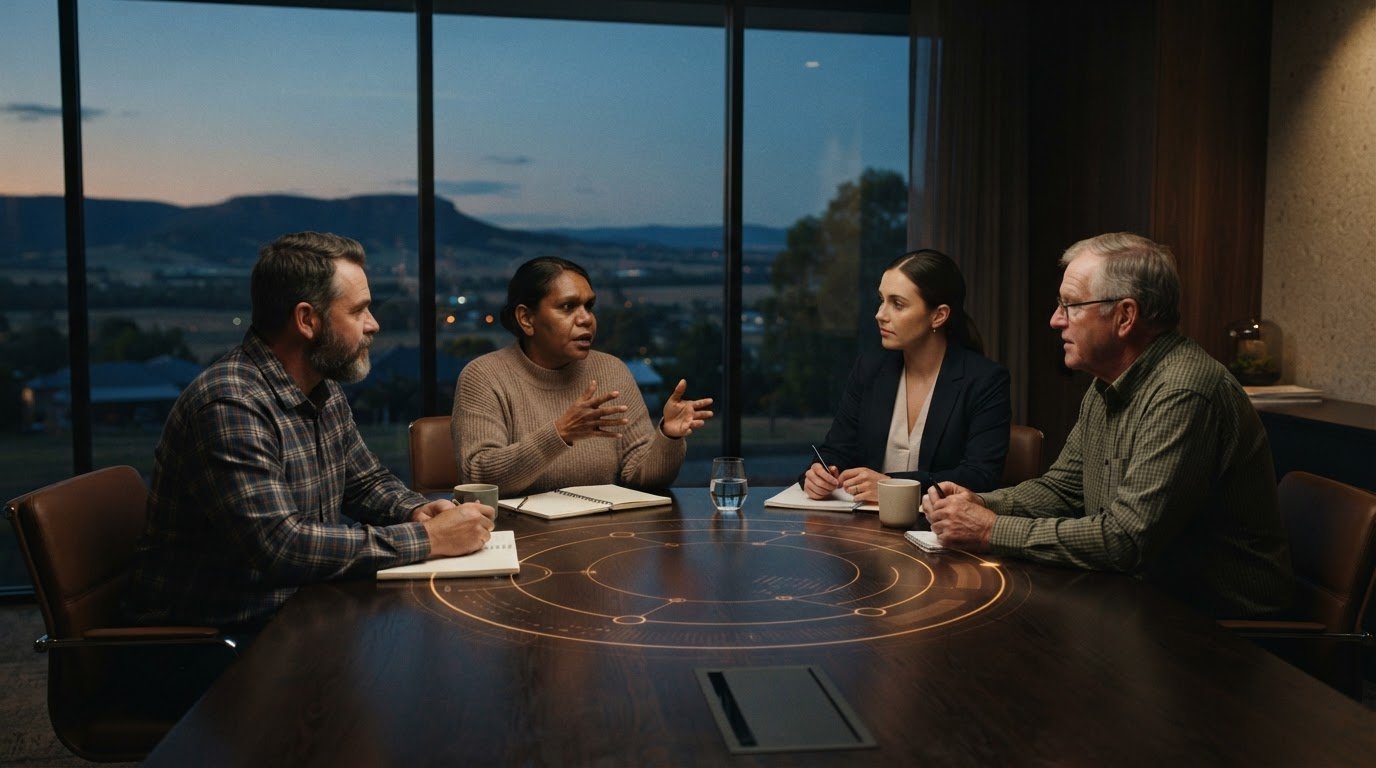
A business owner peer group gives leaders a structured place to test a live decision with people who understand the weight of running a business. Rather than asking staff who may be affected by the decision, or keeping the question to yourself, you put the issue in front of peers and hear how they assess it.
A business owner peer group is a recurring, structured forum where business leaders challenge one another’s thinking and turn discussion into considered next steps. The idea draws on peer support: people with relevant experience offer perspective, questions and practical insight. That can expose assumptions you’ve missed and help you see your options more clearly. It doesn’t guarantee a solution, business growth or profit.
Structure matters. A useful group has a clear purpose, a process for working through issues and expectations for participation. The executive peer advisory boardroom guide explores how boardroom formats differ, providing useful context before you compare specific options.
Peer group, networking event or formal board: what is the difference?
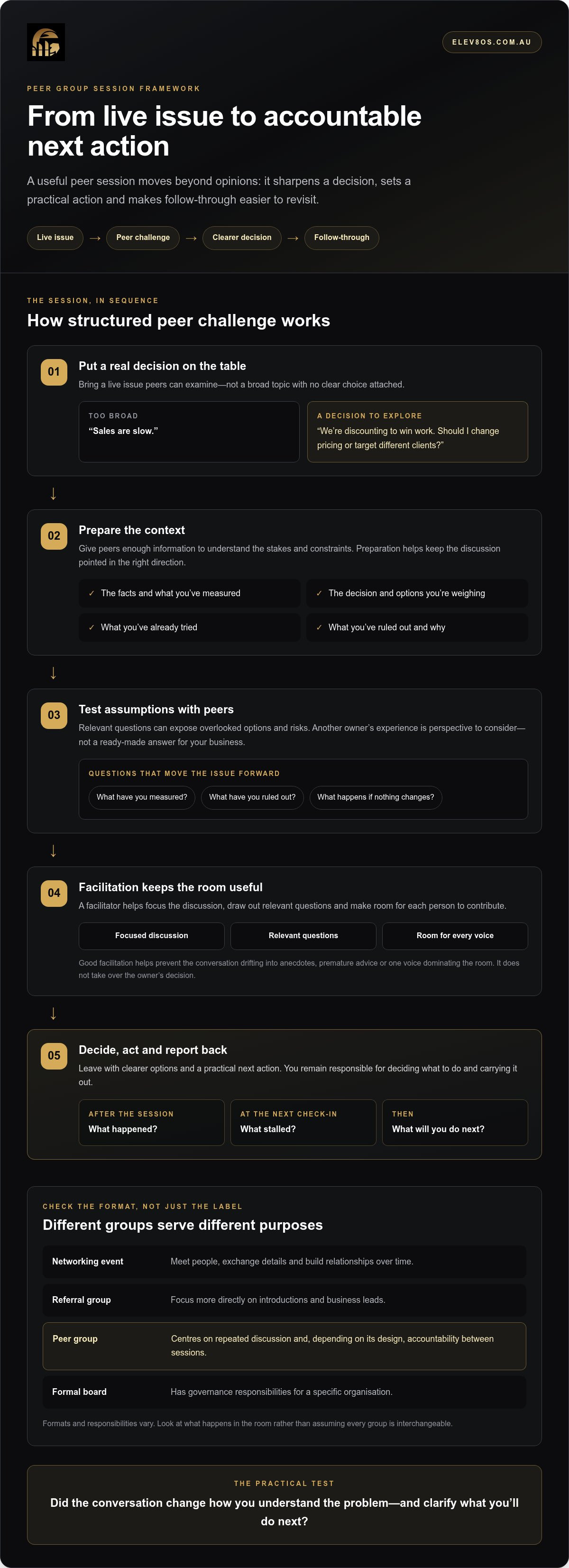
A networking event is usually open-ended: you meet people, exchange details and may build relationships over time. A referral group focuses more directly on introductions and business leads. Neither format necessarily gives you a recurring process for examining a difficult decision or reporting back on what you did.
A peer group centres on repeated discussion and, depending on its design, accountability between sessions. A formal board has a different role, with governance responsibilities for a specific organisation. Formats and responsibilities vary, so don’t treat every group as interchangeable. Look at what happens in the room, not just what the group calls itself.
What should a member leave a session with?
Useful discussion should leave you with clearer options, informed challenge and a practical next action. For example, if a key role keeps becoming a bottleneck, peers might question whether the problem lies in the role’s design, its decision rights or your own delegation. The point is not to accept every suggestion. It’s to test your assumptions against experience beyond your own business.
Feedback isn’t a fix delivered for you. You remain responsible for deciding what to do and carrying it out. Preparation makes the discussion more useful: bring the facts, the decision you face and what you’ve already tried. Follow-through matters just as much. Return with what happened, what stalled and what you’ll do next.
That discipline is what makes time away from daily operations worthwhile. A session should move an issue forward, not simply give it airtime. Before joining a business owner peer group Australia offers, look for a format that makes room for candid questions and expects members to act on their commitments. The value lies in the quality of the thinking and what you do with it afterwards.
How Australian Peer Groups Create Challenge, Candour and Follow-Through
A strong session doesn’t stop at “That’s an interesting idea.” It moves from a live issue to a clearer decision, then identifies what the owner will do next. The agenda varies between groups, but the test is consistent: did the conversation change how you understand the problem, or just add more opinions?
Structured accountability turns peer discussion into a commitment you can revisit; exchanging opinions leaves follow-through entirely optional.
How facilitated peer challenge works
The member presenting an issue needs to put the real decision on the table. “Sales are slow” is too broad to work with. “We’re discounting to win work, and I’m unsure whether to change our pricing or target different clients” gives peers something specific to examine.
Useful questions probe the facts and assumptions: What have you measured? What have you ruled out? What happens if you leave the current approach in place? Another owner may spot an option you’ve missed or a risk you haven’t weighed. That doesn’t make their experience a ready-made answer for your business.
A facilitator helps keep the discussion focused, draws out relevant questions and makes room for each person to contribute. Good facilitation isn’t about taking over the decision. It’s about preventing the conversation from drifting into anecdotes, premature advice or one voice dominating the room. Vistage Australia is one example of a provider describing a structured peer group approach. Meeting processes differ, so assess each format on its own terms.
Why preparation and participation change the value
Peers can’t challenge what they can’t see. Bring enough context to explain the stakes, the options you’re weighing and what you’ve already tried. You don’t need to share every detail, but leaving out a key constraint can send the discussion in the wrong direction.
Participation means more than presenting your own issue. Listen closely when others bring theirs. Ask direct, respectful questions. Offer relevant experience without assuming your solution will fit their circumstances. A room works best when members contribute as well as receive.
The Elev8 Boardroom Program sets that expectation plainly: members must arrive prepared and participate actively. Its facilitated half-day sessions include hot-seat challenge work and peer accountability. Preparation and contribution aren’t extras; they’re part of the work.
Confidentiality also needs clarity. A group may set expectations about keeping discussions private, but don’t treat the word “confidential” as an automatic guarantee. Look for explicit ground rules covering what members can share outside the room, how sensitive information is handled and what respectful challenge looks like. Shared standards give members a firmer basis for speaking candidly.
To judge follow-through, look beyond how energised people feel after a meeting. A useful close identifies the action, the person responsible and when the group will revisit progress. At the next session, members should be able to say what moved, what didn’t and why. That makes avoidance visible and turns good intentions into work the group can examine.
When assessing a business owner peer group Australia offers, look for more than an engaging discussion. The format should make commitments visible and give members a reason to return with an honest account of what happened. A business owner peer group Australia-wide can create that discipline when members show up, contribute and follow through.
Business Owner Peer Groups in Australia: Compare These Four Options
There’s no universally best group. The useful comparison is whether its audience, discussion format and level of structure match the decisions you need to make. The table summarises each provider’s stated public description. It isn’t a ranking, and details can change.
| Provider | Audience or focus | Stated format | Useful fit signals |
|---|---|---|---|
| Vistage | CEOs and business owners | Peer advisory groups, with a Chair and information about meetings | You want a Chair-led setting for strategic discussion with other leaders. |
| Inspiration Café | Business owners and leaders working through growth or specific business challenges | Peer groups covering broad and focused business themes | You’re looking for discussion relevant to a particular stage, issue or project. |
| Leaders for IMPACT | A curated, cross-sector leadership network | Facilitated monthly sessions | You value perspectives from leaders outside your own sector. |
| Elev8 Boardroom Program | Business owners seeking a structured peer group | Monthly facilitated half-day sessions, hot-seat challenge work and peer accountability | You want a small room, direct facilitation and action-focused peer discussion. |
What the provider descriptions show
These descriptions point to different ways of shaping peer discussion. Vistage describes groups for CEOs and owners, meeting information and a Chair role. Inspiration Café presents peer groups through examples that span growth and focused business challenges. Leaders for IMPACT describes a curated network across sectors, with facilitated monthly sessions.
That gives you a starting point, not a verdict. A broad leadership network and a group centred on a specific business challenge may serve different needs. Compare the stated audience and structure against the issue you want to work on, rather than assuming every peer group works the same way.
Where Elev8 Boardroom Program fits
The Elev8 Boardroom Program includes monthly facilitated half-day sessions, hot-seat challenge work and peer accountability. Josh Lawrence facilitates the program and is a direct access point for members. The program also includes an annual business review.
Each room has a maximum of four seats. That is a capacity limit, not an industry-exclusivity rule. The distinction matters: room size describes how many seats are available, while industry rules are separate and shouldn’t be inferred from group capacity.
When comparing a business owner peer group Australia-wide, look beyond the label. Consider who contributes, how discussion is facilitated and whether the format makes room for meaningful challenge. Then consider your own working style: a structured session requires you to bring an issue, listen closely and take responsibility for what happens after the conversation.
How to Choose a Business Owner Peer Group That Fits Your Situation
The right group is not the one with the biggest name or the most polished promise. It’s the one where the discussion fits your actual decisions, members challenge you usefully, and the structure helps you follow through. Use this four-step check before committing.
- Define the issue. Name the decision or pressure you need help thinking through. Is it a strategic choice, owner accountability, a growth constraint or a sector-specific challenge?
- Identify the challenge you need. Do you need candid questions, relevant experience from other leaders or focused learning about a particular issue? “More perspective” is too broad to guide your choice.
- Assess the structure. Compare the group’s stated purpose, peer mix, facilitation and meeting rhythm. Look for a format that can work on your issue, not just deliver generic motivation.
- Test your commitment. Consider whether you can prepare, attend consistently, contribute to other members’ discussions and act on what you commit to doing.
Choose the group where your participation can be candid, consistent and followed by action; the label matters less than the work members do together.
Match the group to the business problem
Different problems call for different rooms. A broad cross-sector group can bring fresh angles to a strategic decision, while an issue-based group may suit an owner working through a defined challenge. Neither is automatically better. The question is whether the agenda and mix of experience can move beyond surface-level discussion of your situation.
Peers don’t need identical businesses or industries. They do need enough in common in the stakes they carry: leading people, managing risk, making decisions with incomplete information or being accountable for results. If the gap in business stage or responsibility is too wide, the discussion may not meet the demands you face. When choosing a business owner peer group Australia-wide, assess relevance by the quality of the questions members can ask, not whether they share your job title.
Assess commitment, confidentiality and regional practicality
Be honest about the demands of the format. Preparation takes time. Attendance needs to fit your operating rhythm. Meaningful participation means listening as well as putting your own issue forward. If you want ideas without being questioned or held to your next steps, a structured peer group may not suit how you want to work.
Confidentiality deserves the same scrutiny. Look for clear expectations about what stays in the room and how members handle sensitive information. Don’t assume every group uses the same rules. Clarity helps people contribute openly, but it shouldn’t be mistaken for an automatic guarantee.
Regional NSW adds a practical test. Weigh travel against session frequency, duration and the value of attending in person. If a group describes another format, consider whether it gives you enough room to contribute and build trust. Don’t assume every Australian group offers online or regional participation. Think about whether the setup is workable through busy periods, not just on an ideal week.
Make the final call based on evidence of fit: a relevant peer mix, a clear structure and commitments you’re prepared to keep. That’s what turns time in the room into forward movement.
Elev8 Boardroom Program: A Structured Peer Group and Clear Next Step
For owners comparing a business owner peer group in Australia, the Elev8 Boardroom Program offers a defined structure: monthly facilitated half-day sessions, hot-seat challenge work and peer accountability. It’s designed for active participation, not passive attendance. Each room has a maximum of four seats, and Josh Lawrence facilitates the program and is a direct access point for members.
The group also includes an annual business review. Its value depends on members acting on commitments and carrying decisions forward. That calls for honest challenge, including feedback that may be uncomfortable but needs to be heard.
What participation in Elev8 Boardroom Program involves
This is an ongoing monthly commitment, with 30 days’ written notice to exit. Members are expected to arrive prepared and participate actively. In hot-seat challenge work, a member brings a live business issue for focused peer discussion. Accountability keeps attention on the actions agreed, not just the conversation.
Josh Lawrence facilitates the sessions, and members have direct access to him. The annual business review provides a dedicated opportunity to examine the business. These are elements of the program’s structure, not promises of a particular business result.
Three principles set Elev8’s operating standard. Embedded over advisory means Elev8 works from inside a client’s business rather than relying on recommendations from the sidelines. The Boardroom Program itself is a peer group, not embedded delivery. Outcomes over tenure means success is measured by delivered outcomes, not the length of an engagement. In Elev8’s embedded engagement, the work concludes when agreed outcomes are delivered and the business is positioned to grow without Elev8. Honest over comfortable means telling clients what they need to hear, not simply what they want to hear.
One industry at a time is another operating principle: Elev8 allows only one active Tier 1 client per industry vertical at any time. This rule applies to the Tier 1 engagement, not Boardroom Program membership. The Boardroom’s maximum of four seats per room is a separate capacity limit, not an industry-exclusivity rule.
Take the next step through a diagnostic conversation
If you’re weighing up the Boardroom Program, the Discovery Call is a diagnostic 30-45 minute video conversation about your current position and fit. It is not a sales call. There’s no pitch deck or slide presentation. The discussion covers your current state, goals, past attempts and operational constraints, then considers fit. Pricing for the Boardroom Program is discussed only during the Discovery Call.
Bring the decisions on your desk, the constraints you’re facing and what you want a peer group to help you examine. That gives the conversation something real to work with. Book a diagnostic Discovery Call to assess whether this format fits your business and your willingness to prepare, contribute and follow through.
Choose the Room That Moves Your Next Decision Forward
The right peer group won’t make the hard call for you. It should help you see the decision clearly, test your reasoning and take responsibility for what comes next. Before you commit, write down the business issue you want to bring into the room, what you’ve already tried and what kind of challenge would genuinely help.
That short exercise gives you a practical measure of fit. Can you speak candidly about the issue? Are you ready to hear a direct response, even if it unsettles your preferred answer? Will you make room to act on what you decide? Your answers matter as much as the format when choosing a business owner peer group Australia can offer.
If you’re ready to examine whether the Elev8 Boardroom Program fits the decisions in front of you, take the next step with a diagnostic conversation. Book a diagnostic Discovery Call and bring the issue you most need to move forward. A sharper decision starts with being willing to put it under the light.
Frequently Asked Questions
Is a business owner peer group the same as a networking group?
No. Networking usually centres on meeting people, building connections and sometimes finding referral opportunities. A peer group sets aside recurring time to examine business challenges with other leaders. The purposes can complement each other: a useful contact may come from networking, while a peer discussion can help you test a decision. When comparing options for a business owner peer group Australia offers, look past the label and assess facilitation, participation and follow-through.
Can a peer group help if I already have a leadership team?
Yes, if you need perspective from people who aren’t involved in your day-to-day decisions. Your leadership team knows the business from within and may have a stake in the outcome; peers can bring different experience and question assumptions from outside it. For example, you could test a proposed restructure before discussing implementation with your team. A peer group doesn’t replace that team or formal governance. Its value depends on what you bring and act on.
How much does a business owner peer group in Australia cost?
Fees and membership inclusions vary by provider, so a general market price range wouldn’t tell you what a particular group costs. For the Elev8 Boardroom Program, pricing is discussed only during the Discovery Call. It’s a diagnostic 30-45 minute video conversation about your current position and fit, not a sales call. There’s no pitch deck or slide presentation. Use the conversation to understand the program and whether its structure suits your needs.
How often do business owner peer groups meet?
Each program sets its own meeting rhythm, so compare frequency alongside the time needed to prepare and act on commitments between sessions. The Elev8 Boardroom Program holds monthly facilitated half-day sessions. A regular meeting can create a useful point to revisit decisions, but frequency alone doesn’t tell you whether the group is effective. Consider whether the schedule gives you enough time to bring meaningful issues and make progress before the next discussion.
Is it safe to discuss sensitive business issues in a peer group?
It depends on the group’s ground rules and how members follow them. Before sharing sensitive details, understand what members agree to keep private, how they handle information discussed in sessions and what boundaries apply to sharing outside the group. Don’t assume every program offers identical protections. You can also frame an issue without disclosing names, customer details or figures that aren’t necessary for peers to understand the decision.
Can regional Australian business owners join a useful peer group?
Regional owners can weigh travel, session format, peer relevance and the time away from daily operations. Elev8 Strategic Partners serves regional NSW locations including Tamworth, Newcastle, Armidale, Coffs Harbour, Port Macquarie and Moree. Don’t assume every provider runs online sessions or has a group in every region. Consider whether the practical commitment is manageable and whether the other members understand the operating realities behind the decisions you bring.
Do I need to arrive prepared for a peer group session?
Yes. Preparation gives other members the context they need to respond to the actual issue rather than guess at its causes. Bring a specific decision, the key facts that shape it and the options you’re weighing. Be ready to listen and answer direct questions. Elev8 Boardroom Program members are required to arrive prepared and participate actively. Those expectations support focused discussion, but they don’t guarantee a particular business result.