
Strategic Operations Partner Programme: Complete Guide
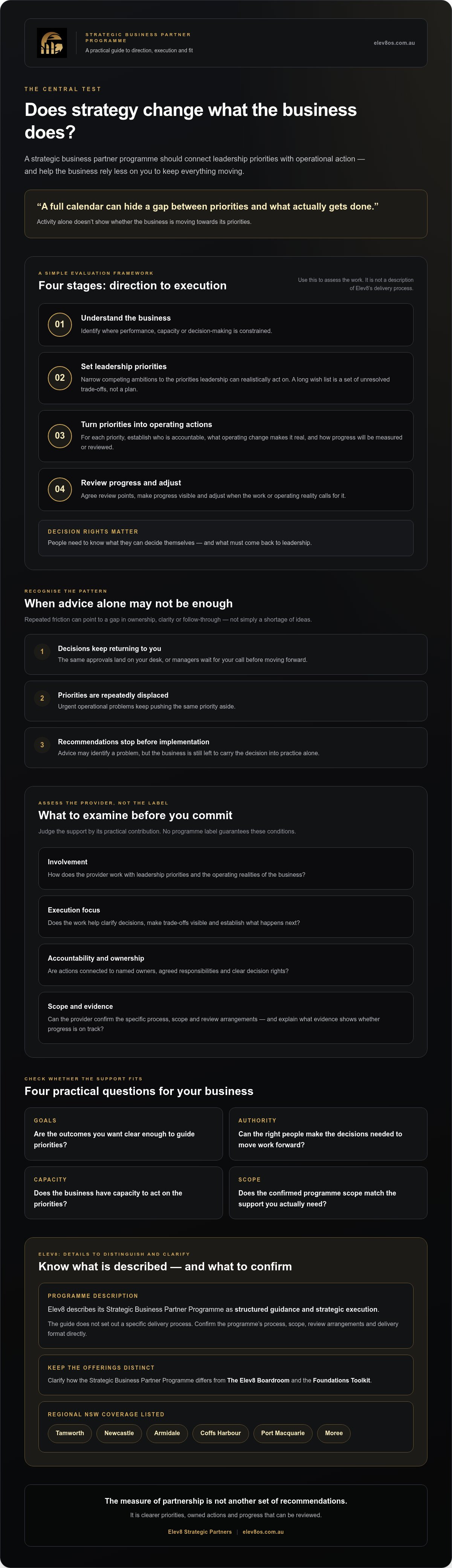
Your strategy doesn’t need another set of slides. It needs to shape the decisions and actions that move the business forward. That’s the test of a strategic business partner programme: does it help turn leadership priorities into consistent operational execution?
If every decision still comes back to you, or past advice hasn’t made it into practice, it’s reasonable to question what “partnership” means. It should involve more than good conversations. It should connect direction with action and help the business rely less on you to keep everything moving.
This guide explains what a strategic business partner programme should do, how to assess whether it fits your business and leadership responsibilities, and what to clarify before committing. You’ll also see how Elev8 Strategic Partners describes its programme as structured guidance and strategic execution, and how it differs from The Elev8 Boardroom and Foundations Toolkit. The aim isn’t to sign up for more advice. It’s to make a clear decision about the support your business actually needs.
Key Takeaways
- A full calendar can hide a gap between leadership priorities and what gets done. Look for support that connects strategic direction to operational action.
- Assess a strategic business partner programme by how it links business diagnosis, leadership priorities, operating actions and review.
- Judge the provider by their involvement, execution focus, accountability, scope and evidence, not by the programme label alone.
- Before committing, check that your goals, decision-making authority, available capacity and required scope are a practical fit.
- Elev8 lists coverage in regional NSW, including Tamworth, Newcastle, Armidale, Coffs Harbour, Port Macquarie and Moree. Clarify delivery format and programme details, and distinguish the programme from The Elev8 Boardroom and Foundations Toolkit.
What a strategic business partner programme should solve for a business owner
A full calendar can look like progress. It can also mean you spend each day clearing decisions, fixing hand-offs and answering questions that shouldn’t need your input. Activity alone doesn’t show whether the business is moving towards its priorities.
A strategic business partner programme should address the gap between what leadership wants to achieve and how the business operates. It’s structured support intended to align leadership goals with operational strategy. A practical test is whether it helps clarify decisions and establish disciplined action, rather than simply producing another set of recommendations.
Partnership means working towards a shared business priority, not offering encouragement from the sidelines. The broad idea is reflected in What is a strategic alliance: organisations work together towards objectives while remaining distinct. For a business owner, the relevant question is how leadership direction connects with the operating realities that determine whether the business can act on it.
What does strategic business partnership mean in practice?
It starts with a clear view of the business and the priorities competing for leadership attention. From there, strategy needs to connect to practical operating actions, named owners and agreed review points. If a decision keeps returning to the owner, for example, get specific: what decision is stuck, who should own it, and what needs to change so that person can act?
That’s a general way to assess the work, not a description of a particular provider’s process. Elev8 describes its Strategic Business Partner Programme as structured guidance and strategic execution. Before deciding whether it fits, confirm its specific process, scope and review arrangements directly.
When does a business owner need more than advice?
Look for patterns. The same approvals keep landing on your desk. The same priority gets pushed aside by urgent operational problems. Managers wait for your call before moving forward. These signs may point to more than a shortage of ideas. They can indicate a lack of ownership, clarity or follow-through.
Advice can help identify a problem, but if the work stops at a recommendation, you’re still left to carry the decision into the business alone. Useful strategic support should test assumptions, make trade-offs visible and help establish what happens next. For an established operator, that means examining how the business works, rather than seeking generic motivation or early-stage startup support.
Judge the value by what becomes clearer: which priorities matter, who is responsible for action, and when progress will be reviewed. No programme label guarantees those conditions. Ask how the provider works with leadership priorities and operational realities, and what process details they can confirm before you commit.
How a strategic business partner programme connects direction to execution
A strategy earns its place when it changes what the business does. To assess whether support can make that connection, use a simple four-stage framework: understand the business, set leadership priorities, turn those priorities into operating actions, then review progress and adjust.
This is an evaluation framework, not a description of Elev8’s delivery. The University of Washington’s overview of the role of a strategic business partner discusses the shift from tactical work towards strategic contribution. For a business owner, the practical question is how that contribution connects to decisions and execution.
From leadership priorities to an operating plan
Start by identifying where performance, capacity or decision-making is constrained. Then narrow competing ambitions to the priorities leadership can realistically act on. A long wish list isn’t a plan. It’s a set of unresolved trade-offs.
Give each priority three anchors: a person accountable for moving it forward, an operating change that makes it real, and a measure or review point to show whether it’s on track. Decision rights matter too. People need to know what they can decide themselves and what must come back to leadership.
Hypothetical example: If customer hand-offs are delaying work, a leadership priority might be to improve the process. The operating plan could assign a responsible manager, define a change to the hand-off process and review whether delays are reducing. This illustrates the logic, not a promised result.
Accountability without another layer of meetings
A useful review focuses on movement, obstacles and decisions, rather than becoming a reporting exercise. Ask what has changed, what’s blocking progress and what decision is needed now. If there’s no obstacle or decision to address, a lengthy update may add little value.
Clear ownership across the leadership team stops every issue flowing back to the owner. It also makes gaps visible: an action without an owner is unlikely to happen reliably, while an owner without authority may be unable to act. Accountability means making those conditions explicit and addressing them.
Before committing to a programme, ask how it connects priorities to actions and review. Confirm Elev8’s specific cadence, tools, deliverables and scope directly. To understand Elev8’s stated focus on alignment and execution, explore its strategic partnership focus, then ask how the approach would apply to your business.
Strategic business partner programme or consultant: how to judge the difference
A programme label doesn’t prove you’ll get a hands-on partnership. The word “consultant” doesn’t tell you exactly how a provider works either. Judge the arrangement itself: who gets involved, what happens after recommendations are made, how responsibility is shared, and what evidence supports the provider’s claims.
These labels can describe different approaches, but providers’ scopes vary. Focus on the work you need, not a neat category. The U.S. Small Business Administration’s SBA Mentor-Protégé program is one formal US example of businesses working together for defined purposes. It’s a different context, not a benchmark for what an Australian programme should include.
Questions that reveal whether support goes beyond recommendations
Ask who will work with your leadership team, how decisions become owned actions, and what the provider expects you to do between discussions. Request a clear explanation of the process and examples of relevant evidence. Examples can help you understand the approach, but they don’t guarantee the same results for your business.
| What to assess | Question to ask |
|---|---|
| Involvement | Who will work with our leaders, and in what capacity? |
| Execution focus | How are recommendations turned into actions with clear owners? |
| Accountability | How will we surface stalled decisions or obstacles? |
| Scope | What’s included, and what sits outside the programme? |
| Evidence | What can you show us about your process and relevant experience? |
Then check whether the answers are specific enough to guide a decision. If the provider can describe the discussion but not what happens afterwards, clarify how follow-through works before committing. Judge the strategic business partner programme by its stated scope and working relationship, not by promises the provider can’t substantiate.
How a strategic partner differs from a peer advisory group
A strategic partnership and a peer advisory group are different support formats. A peer group centres on discussion and perspectives from other leaders. A strategic partnership is framed around alignment between leadership priorities and operational strategy. Neither label tells you the precise level of involvement, so check the format and scope.
Keep related offerings distinct, too. The Elev8 Boardroom is a separate option, not an assumed component of the Strategic Business Partner Programme. A dedicated guide to executive peer advisory boardrooms can help you assess that format separately. No verified page URL is available here, so a link hasn’t been added.
How to assess programme fit for a regional NSW business
A strategic business partner programme can only help if your leadership team is ready to make decisions and act on them. Before comparing providers, define the business problem you need to address and check whether the people responsible can give it sustained attention.
A readiness checklist for owners and leadership teams
Use these questions to test your readiness and make provider conversations more useful:
- Goal: Can you name the main operational constraint and the change you want to see?
- Authority: Are the decision-makers involved, and can they make or approve the decisions needed to move priorities forward?
- Capacity: Can the relevant leaders make time to act between discussions, rather than treating the work as an extra item for later?
- Scope: Can you explain what you want support with, and what sits outside the need?
- Evidence: What would show that action is progressing? Identify information you can access, such as relevant operational measures, decision records or feedback from the people involved.
If the goal is vague, authority is unclear or no one can own the work, pause before committing. A provider may help clarify the challenge, but your leadership team still needs to make decisions and carry agreed actions into the business.
What regional NSW leaders should clarify before engaging
Location is one part of fit. Ask how communication and programme delivery work for your business, what format is available, and whether support can be accessed from your location. Don’t assume that listed regional coverage means local sessions or a particular delivery method.
Elev8 lists regional NSW coverage across Tamworth, Newcastle, Armidale, Coffs Harbour, Port Macquarie and Moree. If your business operates in Tamworth, Newcastle or Armidale, ask whether the Strategic Business Partner Programme is available to your business and how it would work in practice. Do the same for Coffs Harbour, Port Macquarie or Moree where relevant.
Before deciding, clarify eligibility, scope, inclusions, delivery format, cadence and current fees. Ask what evidence the provider can share about its approach, and separate confirmed details from assumptions. Those answers will help you judge whether the arrangement fits your goals, authority and capacity.
If the fit looks plausible, ask Elev8 about the Strategic Business Partner Programme and confirm the practical details for your business and location before taking the next step.
How to explore the Elev8 Strategic Business Partner Programme
Elev8 Strategic Partners describes its Strategic Business Partner Programme as structured guidance and strategic execution for established business leaders. Its stated focus is aligning leadership goals with operational strategy. That gives you a starting point, not a substitute for checking how the programme works in practice.
Use an initial discussion to test whether the scope matches the work your business needs. Bring specifics, not just a broad ambition to grow or improve. Explain where decisions stall, what needs to change and who will be responsible for acting. That makes it easier to discuss whether the support fits the challenge.
What to prepare before speaking with Elev8
Set out your current priorities, recurring operational bottlenecks and decisions that remain unresolved. Note which leaders need to participate, what authority they hold and what changes your team could realistically put into action. This helps distinguish a genuine need for structured strategic support from a problem that first requires clearer internal ownership.
Then ask direct questions. Confirm who the programme is designed for and whether your business is eligible. Clarify delivery format, cadence, scope, inclusions and current fees. Ask how progress is assessed and what you and your leadership team would need to contribute. Confirm these details with Elev8 rather than inferring them from the programme name.
Listen for answers clear enough to inform a decision. If an element is still undefined, ask what can be confirmed before you commit. A broad promise of support isn’t a substitute for a shared understanding of responsibilities, boundaries and measures of progress.
Choosing the right Elev8 support option
Choose based on the support you’re seeking. The Strategic Business Partner Programme is the primary option to explore if you need structured guidance focused on aligning leadership goals with operational strategy and supporting execution.
The Elev8 Boardroom is a separate option, described as an executive peer advisory group. It shouldn’t be assumed to be part of the programme. The Foundations Toolkit is also separate, with practical frameworks, templates and systems. These are distinct choices, not automatic programme inclusions.
Before choosing, ask which option best matches the work you want to do and confirm its scope directly. If the Strategic Business Partner Programme appears relevant, contact Elev8 to discuss the programme and clarify the practical details before deciding on a next step.
Turn your priorities into deliberate action
A strategic business partner programme should connect leadership priorities to operational action, with clear ownership and a way to review progress. The programme label alone isn’t enough: check the provider’s involvement, scope, expectations and evidence before committing.
Elev8 describes its programme as structured guidance and strategic execution for established business leaders. It lists regional NSW coverage across Tamworth, Newcastle, Armidale, Coffs Harbour, Port Macquarie and Moree. Confirm the delivery format, eligibility, cadence, inclusions and current fees directly, and make sure the approach fits your team’s capacity to act.
If you’re ready to explore whether the programme fits your business, discuss the Strategic Business Partner Programme with Elev8. Bring the decisions that keep stalling and the priorities you want to move forward. Contact Elev8 to discuss the programme and clarify the practical details for your business.
Frequently Asked Questions
What is a strategic business partner programme?
A strategic business partner programme is structured support that helps align leadership goals with operational strategy and execution. Rather than stopping at ideas, the work should help leaders clarify priorities, decisions and responsibilities. The exact approach varies by provider, so check the scope and what participation involves. Elev8 Strategic Partners describes its programme as structured guidance and strategic execution for established business leaders.
How is a strategic business partner different from a business consultant?
The difference depends on the provider’s actual involvement, not the title. Some advisory work centres on assessing a problem and making recommendations. A strategic partnership is generally framed around connecting leadership priorities with operational action. Ask who works with your team, how decisions become owned actions, what follow-through is expected and how progress is reviewed. Don’t assume a programme label guarantees hands-on involvement or accountability.
Who is a strategic business partner programme for?
A strategic business partner programme may suit established business leaders whose priorities aren’t translating into consistent operational action, or who remain the default decision-maker for too much. The leadership team needs to be willing to make decisions, assign ownership and act on agreed priorities. If the main goal or decision authority is unclear, clarify those points before assessing programme fit. Confirm any provider-specific eligibility criteria directly.
What happens in a strategic business partner programme?
There’s no universal format. As a general way to assess the work, look for a connection between understanding the business, setting leadership priorities, defining operational actions and reviewing progress. Ask who is responsible for actions, what decisions leaders need to make, and how the provider tracks obstacles or changes in direction. For Elev8’s programme, confirm the specific process, cadence, tools, scope and inclusions rather than assuming them.
Is a strategic business partner programme the same as a peer advisory board?
No. A strategic business partnership is framed around aligning leadership goals with operational strategy and supporting execution. A peer advisory group centres on discussion, shared perspectives and accountability among leaders. The formats may address related business challenges, but they’re not interchangeable. Elev8’s Boardroom is a separate offering from its Strategic Business Partner Programme. Ask what each option includes and which format matches the support you need.
How much does a strategic business partner programme cost?
There’s no single standard fee, and Elev8’s current programme pricing isn’t specified here. Don’t use unrelated providers’ prices as an estimate of what Elev8 charges. Ask for the current fee and clarify what it covers, including scope, inclusions, delivery format and any other costs. Compare the fee with the work proposed, the responsibilities expected of your team and how progress will be assessed.
Can a regional NSW business join the Elev8 programme?
Elev8 lists regional NSW coverage in Tamworth, Newcastle, Armidale, Coffs Harbour, Port Macquarie and Moree. That listing doesn’t confirm programme eligibility, local sessions or a particular delivery method. If your business is in one of these locations, ask Elev8 whether the Strategic Business Partner Programme is available to you and how delivery and communication work. Confirm the format and scope directly before deciding whether it fits.