
How to Build Scalable Business Systems Without Becoming the Bottleneck
Your business can’t scale if every routine decision still has to pass through you. If you’re searching for how to build scalable business systems, start with a practical test: can your team deliver consistent work without you acting as the routing layer? If not, growth is adding pressure, not capacity.
You may recognise the signs: the same questions keep coming back, the same task gets done three different ways, and more work brings more rework. The answer isn’t to document every move or strip judgement from the job. It’s to make expectations clear and give people authority to act within them.
This article shows you how to build practical systems around the work that matters. You’ll learn how to set repeatable processes, clarify who owns decisions and performance, and leave room for sound judgement. The goal is reliable delivery as the business grows, without every decision depending on the founder.
Key Takeaways
- Recognise when routine questions, approvals and interruptions show that growth still depends on the owner.
- Learn how to build scalable business systems by linking a clear priority to an accountable owner, repeatable workflow and useful performance measure.
- Separate practical systems from paperwork by testing whether capable team members can handle routine work without founder interpretation.
- Build in sequence: choose a recurring constraint, define the outcome, map the work, assign ownership, then document and test the process.
- Elev8 Strategic Partners embeds a Strategic Operations Engineer inside the business, tells owners what they need to hear and works with only one active client per industry vertical. Success is measured by delivered outcomes, not engagement length. Engagements conclude when agreed outcomes are delivered and the business is positioned to grow without Elev8 Strategic Partners.
Why Scalable Business Systems Matter When Growth Starts Relying on You
More customers should mean more work the business can deliver, not more questions landing on your desk. Yet as demand grows, approvals pile up, customer issues escalate and routine decisions wait for the founder. You become the routing layer between the team and the work. That’s not a capacity problem solved by longer hours. It’s a system problem.
Adding people increases the number of hands available, but without clear ways of working, it can also add handovers, interpretation and rework. Software can record a process, but it won’t settle who owns the decision or what a good outcome looks like. Scaling means increasing the work the business can handle without relying on you to coordinate every step or sacrificing consistency.
What is Scalability? The broad idea is the ability to handle growth in demand. For a founder-led business, the practical test is whether work can move through the team without every question circling back to the owner.
A scalable business system is a repeatable way for a clearly responsible role to produce an agreed outcome, with enough guidance to support consistent work and sound judgement. That’s the foundation for how to build scalable business systems: make the work clear enough to repeat, assign ownership, and keep the result visible.
Consider customer onboarding. If each new customer requires you to explain what happens next, confirm who follows up and resolve missing information, the process exists only in fragments. A working system makes the handover and expected result clear, while leaving room for the team to handle reasonable differences between customers.
What makes a business system scalable?
The right role needs clear steps, standards and authority to carry out routine work. Ownership answers who is responsible; decision boundaries show what they can decide without approval. A useful measure, such as whether an agreed handover is completed, makes performance visible without creating a reporting exercise.
A system should guide judgement, not script every conversation. Set the standard for normal cases and define when an exception needs escalation. That gives capable people room to act while keeping important decisions and outcomes accountable.
Signs your current systems depend too much on you
Look for approvals that queue in your inbox, customer escalations that only you can resolve, and routine questions that interrupt focused work. If two team members handle the same task differently, the standard may be unclear or hard to find.
Undocumented work also creates fragile handovers. Someone leaves, takes a day off or gets busy, and the next person has to reconstruct the steps. The result is often avoidable rework. Treat these patterns as signals to strengthen system design, not as evidence that the team doesn’t care or can’t perform.
The Building Blocks That Turn Business Processes into Scalable Systems
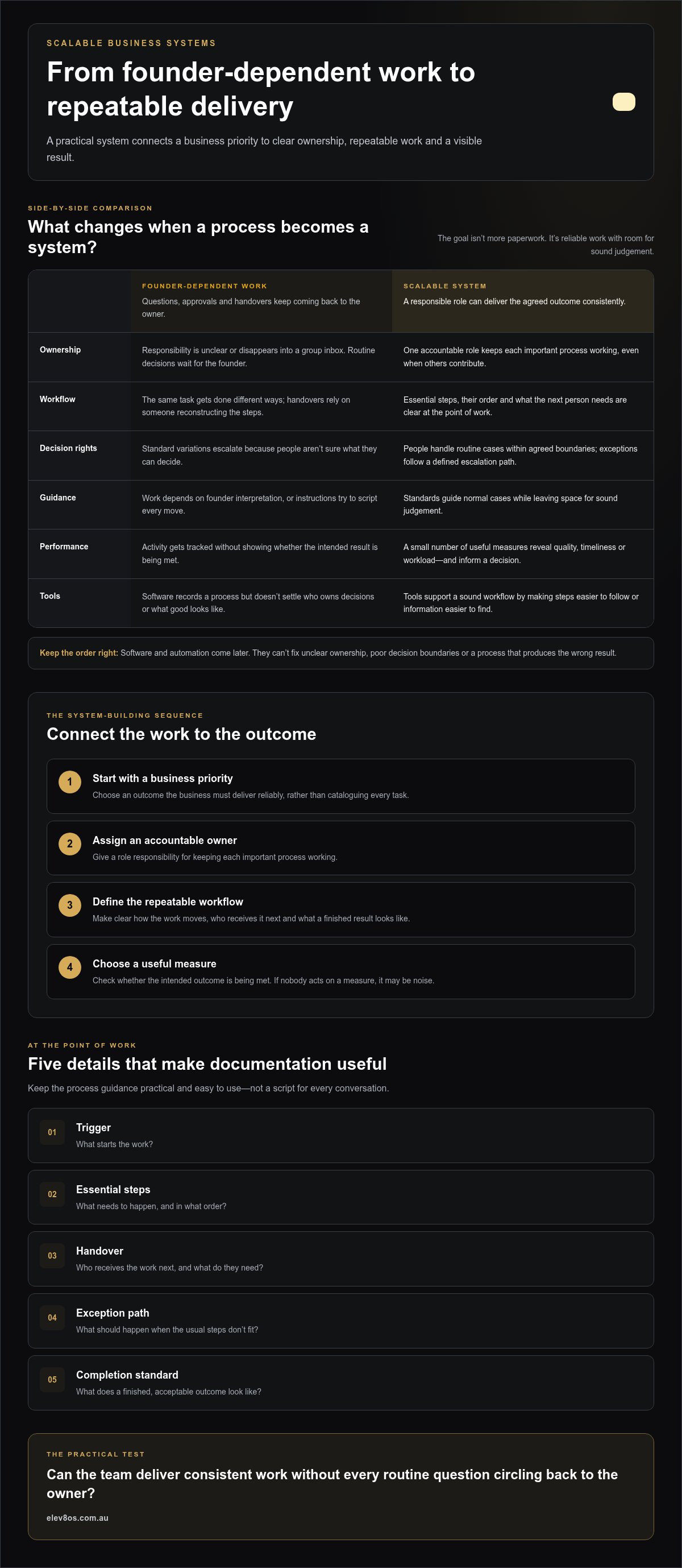
A process becomes dependable when its parts connect. Start with a business priority, assign an accountable owner, define a repeatable workflow, then measure whether it delivers the intended result. Get the order wrong and you can end up documenting low-value tasks or tracking activity that says little about performance.
This sequence gives you a practical answer to how to build scalable business systems. Decide what the business must deliver reliably. Give a role responsibility for maintaining the process, spell out how the work moves, and choose a measure that shows whether the outcome is being met.
Connect business priorities to process ownership
Don’t start by cataloguing every task. Start with the outcomes that matter to the business, such as fulfilling customer orders accurately or delivering a consistent service. Identify the processes that make those outcomes possible, then assign one accountable role to keep each important process working. That role can involve others, but responsibility shouldn’t disappear into a group inbox.
Make decision rights explicit. For example, a team member might resolve a routine service issue within agreed boundaries, while an unusual case follows a defined escalation path. The founder sets the boundaries and handles decisions that genuinely require their authority, not every standard variation.
Choose documentation, measures and tools that support the work
Keep process documentation useful at the point of work. For each process, record:
- Trigger: what starts the work.
- Essential steps: what needs to happen and in what order.
- Handover: who receives the work next, and what they need.
- Exception path: what to do when the usual steps don’t fit.
- Completion standard: what a finished, acceptable outcome looks like.
Then choose a small number of measures that reveal quality, timeliness or workload. If customer handovers are the priority, measure whether the required information is complete when the next person receives it. A measure should point to a useful decision. If nobody acts on it, it may be noise.
Software and automation come later. They can support a sound workflow by making steps easier to follow or information easier to find. They can’t fix unclear ownership, poor decision boundaries or a process that produces the wrong result. Automating that process only helps the problem travel faster.
The SOE Framework describes the connection as Strategy, Operations, Execution. Strategy sets the priority, Operations shapes the roles and workflow, and Execution turns them into consistent work. Each element relies on the others. A process without an owner is not an operating system; it’s a set of instructions waiting for someone to take responsibility.
Founders building this structure can explore Elev8’s operational frameworks as a practical next step.
How to Tell Whether a Business System Is Scalable or Just More Paperwork
A thick procedure manual proves nothing. The useful test is whether the process helps capable people deliver the agreed result without waiting for the founder to interpret each step. If growth brings more handovers, rework or variation in quality, the system may be recording work without making it easier to do.
A system scales when the team can produce consistent outcomes without the founder routing each task. Test it on routine work, not the unusual case that genuinely needs senior judgement. Give a capable team member the process and observe where they pause, ask for approval or have to fill gaps from memory.
What to compare | Useful system | Bureaucracy
Ownership | One role is accountable for the process and its result. | Responsibility is spread across people, or every issue returns to the founder.
Steps | Instructions cover the essential work and handover. | Extra checks and forms add effort without improving delivery.
Exceptions | Clear boundaries let the team handle routine variations and escalate genuine exceptions. | Every variation triggers another approval, even when the risk is low.
Outcomes | The process supports consistent quality and makes problems visible. | Completion is measured by whether the paperwork was followed, regardless of the result.
Then look at what happens as volume rises. Do more jobs move through the same workflow without avoidable extra handovers? Does quality stay steady? Or do tasks bounce between roles, get corrected later, or require you to step in? Those patterns show where the design needs work. They aren’t proof that your team lacks commitment.
What does good process documentation look like?
Match the detail to the task’s risk, frequency and cost of inconsistency. A recurring customer handover may need a short checklist: confirm the required information, record the next action, identify who owns it, then confirm the recipient has what they need. Keep mandatory standards clear, but leave room for judgement where the situation can reasonably vary.
If the document takes longer to use than the task itself, or people work around it, simplify it. Ask a team member who hasn’t heard the latest explanation to follow the instructions. Their pauses and questions show what the process still leaves unstated.
When should a process be automated or redesigned?
Understand the actual workflow before automating it. Map where work starts, changes hands and gets stuck. Remove steps that create repeat work, obscure ownership or demand approvals that don’t protect quality. Then assess whether a tool reduces friction for the team and gives the owner useful visibility. A faster broken process is still broken.
That practical test is central to how to build scalable business systems. Keep what improves delivery, change what blocks it, and discard steps that exist only because nobody has questioned them.
How to Build Scalable Business Systems in a Practical Sequence
Don’t try to systemise the whole business at once. Start with one frequent or consequential process that still depends on you, then build and test a better way of working with the people who do the job. This keeps the effort tied to a real constraint, not a pile of documents no one uses.
Use this sequence to turn the current work into a process the team can own:
- Identify a recurring constraint. Choose work that regularly stalls for your approval, triggers avoidable customer escalations or needs you to step in to keep it moving. Pick a process where improving consistency would matter to the business.
- Define the outcome. Describe what “done well” looks like from the perspective of the customer or the next person in the workflow. Make the completion standard observable, such as a handover containing the agreed information and a clear next action.
- Map the current work. Follow the process as it happens now, from its trigger through each role, decision and handover. Include exceptions. Don’t design the future version before you’ve found where work stalls, repeats or returns to you.
- Assign ownership. Give one role accountability for maintaining the process and making sure it delivers the agreed outcome. Clarify which routine decisions that role can make, and which exceptions need escalation.
- Document and test. Write down the essential steps, handovers, decision boundaries and completion standard. Pilot the workflow with the people performing it, note where they hesitate, then revise before rolling it out more widely.
Map one high-impact workflow before documenting it
Walk through the work with the team rather than relying on how you think it happens. Ask where information goes missing, which steps get repeated, and what questions bring the task back to you. Separate necessary checks from habits that have accumulated over time. Before writing instructions, agree on the finish line: what must be true for the process to count as complete?
For practical ways to structure this work, use these business frameworks and templates as a related resource.
Test the system, train the team and improve it
Have the process owner run the documented workflow without founder prompts. Stay available to observe, but don’t rescue the process at the first pause. Record confusion, missing information and exceptions, then improve the instructions or decision boundaries. Treat friction as feedback about the system, not a reason to blame the person following it.
Name who maintains the process and set a review rhythm that fits its frequency and importance. Revisit it when the work changes or the same problem keeps recurring. If you’re ready to build operating systems that reduce owner dependency, explore how Elev8 works inside founder-led businesses.
How Elev8 Embeds Scalable Systems That Work Beyond the Founder
Knowing how to build scalable business systems is one thing. Putting them into practice while the business keeps running is another. Elev8 embeds a Strategic Operations Engineer inside the business to build and execute operating changes with the people responsible for the work. The focus isn’t on handing over recommendations and leaving the owner to carry implementation alone.
That work follows four clear principles:
- Embedded over advisory. Build and implement systems inside the business, alongside the team doing the work.
- Outcomes over tenure. Measure success by agreed outcomes delivered, not time spent in an engagement.
- Honest over comfortable. Tell owners what they need to hear, not only what they want to hear.
- One industry at a time. Only one active Elev8 client per industry vertical is allowed at any time.
What embedded execution changes
A process can be clearly described and still fail if no one drives the change into daily work. Embedded execution connects the design to the handovers, decisions and accountability that make it work in practice. It helps owners act on changes they already know are needed, rather than leaving those changes on a task list while routine pressure takes over.
The aim is not to create a business that depends on Elev8 instead of its founder. An engagement concludes when agreed outcomes are delivered and the business is positioned to grow without Elev8. The work should leave clear ownership and operating discipline behind, not a new dependency.
For a closer look at related resources, explore the Foundations Toolkit for Business guide and the Strategic Operations Partner Programme guide.
A diagnostic next step for established owner-led businesses
This approach is designed for established founder-led businesses with an operational foundation. If ownership, execution and accountability still run through you, a Discovery Call is the first step to discuss the operating challenge and whether the work is a fit.
Build a Business That Can Move Without You
The next step isn’t to redesign everything. Choose one decision or handover that keeps pulling you back in, then give the team a clearer way to move it forward. That’s where how to build scalable business systems becomes practical: turn owner-dependent work into a capability the business can carry.
For established founder-led businesses ready to strengthen that capability, Elev8 embeds a Strategic Operations Engineer inside the business to build systems, structure and accountability. The work is grounded in direct communication: you’ll hear what you need to hear, not only what you want to hear. Only one active Elev8 client per industry vertical is allowed at any time. Success is measured by delivered outcomes, not engagement length, and the engagement concludes when agreed outcomes are delivered and the business is positioned to grow without Elev8.
Growth shouldn’t require the founder to remain the answer to every question. If you’re based in Tamworth, Newcastle, Armidale, Coffs Harbour, Port Macquarie or Moree, take the next step towards operating systems your team can own and use. Read more about Elev8’s approach to operational frameworks, then book a Discovery Call.
Frequently Asked Questions
What is a scalable business system?
A scalable business system helps a business handle more work without requiring the founder to coordinate every routine instance. It gives the team a reliable way to achieve the intended result while making it clear when a situation needs different judgement. A shared document or software tool isn’t a system by itself. The real test is whether the work still gets done properly as demand and team involvement increase.
How do you systemise a business without slowing the team down?
Keep the process proportionate to the work. For a straightforward task, a short checklist or a clear example may be enough; reserve detailed instructions for work where mistakes carry greater consequences. Ask the people doing the task which steps help and which create delays. Remove duplicate checks and unclear approvals, then trial the revised approach during normal work before making it the standard.
Which business processes should you systemise first?
Start with work that happens often, causes costly disruption when it goes wrong, or repeatedly needs the owner’s input. For example, if job scheduling keeps changing because key information arrives late, examine how that information is gathered and passed on. A less frequent task may still deserve attention if an error has a serious impact. Choose one process with a visible problem, not the longest list of tasks.
How do you know when a business process is ready to automate?
Automate only when the team can explain how the process works and handle its common variations consistently. Check whether the trigger, required information and completion result are clear, and whether exceptions have a sensible route. If staff still need to chase missing details or ask who owns the next step, fix those gaps first. Automation is more suitable when the workflow is stable and the tool can reduce manual effort without hiding errors.
Can a small business build scalable systems without new software?
Yes. A small business can begin with a written checklist, a shared spreadsheet or a simple handover note, provided the team knows where the current version lives and who maintains it. Use tools you already have to make responsibilities and next actions visible. For example, a shared job list with an owner and status can expose stalled work before you invest in another platform.
How do you get employees to follow new business systems?
Involve the people who perform the work before setting the process in stone. Explain what problem it is meant to solve, demonstrate it in the actual work setting and give the team a clear way to flag steps that don’t fit. A process that conflicts with real conditions will be bypassed, however polished the document looks. Review feedback with the process owner and update instructions when the work genuinely changes.
When should a founder bring in embedded operational support?
Consider it when the business has an operating foundation but essential changes keep slipping behind daily demands. Elev8 embeds a Strategic Operations Engineer inside the business, tells clients what they need to hear and works with only one active client per industry vertical. Success is measured by outcomes, not engagement length. Work concludes when agreed outcomes are delivered and the business is positioned to grow without Elev8. This approach can suit established operators in Tamworth, Newcastle, Armidale, Coffs Harbour, Port Macquarie and Moree.