
Business Frameworks and Templates for Australian Owners
A template that sits in a folder isn’t a system. Business frameworks and templates only earn their place when they change a decision, clarify who owns the work or establish a routine your team actually follows.
It’s easy to see why owners get stuck. There are countless models to choose from, and a downloaded tool can feel disconnected from the decisions and pressures of daily operations. You don’t need another framework for its own sake. You need a useful starting point for the problem holding your business back.
This article shows you how to define that problem, choose a framework that fits and adapt it into clear responsibilities and review routines. You’ll see how to put tools such as an owner-dependency audit, a revenue and profit framework, an organisation structure template and KPI measures to work, rather than leaving them on the shelf. We’ll also cover where self-guided resources can get you moving, and when the bottleneck calls for embedded execution. The standard is practical: a framework must change what happens next.
Key Takeaways
- Choose business frameworks and templates to address a defined operational problem, not because a model is popular or polished.
- Connect each business priority to a decision, process, accountable person and measure so the work has a clear owner.
- Start with the smallest useful tool, adapt it to your business and build in a routine to review whether it’s working.
- Use self-guided resources for contained tasks; when execution still depends on you, another template may not remove the bottleneck.
- The Elev8 Toolkit Course offers practical starting tools, including an Owner Dependency Audit, a Revenue & Profit Clarity Framework, an organisation structure template and a KPI starter pack.
Business frameworks and templates: why documents alone do not fix execution
A business problem rarely improves because someone downloaded a polished worksheet. The useful question is what the tool will help you decide, change or do consistently. Without that link to daily work, even a well-designed document is just another file to maintain.
A framework structures how you think or act on a business problem; a template gives that approach a repeatable place to be applied or recorded. The framework sets the logic. The template helps people use it. Neither one, on its own, changes how the business operates.
How a framework differs from a template
A framework gives shape to a question or decision. A KPI framework, for example, helps determine which measures matter, how they relate to business priorities and what they should reveal. A tracking template turns that structure into a working record, with fields for each measure, its owner, current result and review date.
The distinction matters. A template can capture information without helping anyone interpret it. A framework can clarify the right measures without ensuring anyone records or reviews them. Both need a person to make decisions and follow through.
Consider a business reviewing whether its sales process is working. The framework might direct attention to enquiry handling, conversion and follow-up. The template could record the relevant measures and who is responsible for updating them. A review routine then gives the team a chance to spot a gap and decide what to change. The tool supports the work; it doesn’t do the work.
The same logic applies to strategic planning. A Business Model Canvas gives a structured way to map parts of a business model, including customers, value and channels. Filling it in can expose assumptions. The operational value comes from deciding which assumption to test, who will act and when the decision will be revisited.
Why downloaded business tools often sit unused
A downloaded tool is likely to stall when nobody owns it, its purpose is vague or there’s no agreed time to review what it contains. Copying a generic format can also add fields that don’t help your business make a decision. That creates paperwork, not visibility.
Before adopting a document, answer three questions: What problem is it meant to clarify? Who will keep it current? What will happen when it’s reviewed? If those answers are missing, the tool isn’t ready for the workflow.
- No clear purpose: People fill in fields without knowing what decision the information should support.
- No named owner: Updates become everyone’s responsibility, which often means they’re nobody’s.
- No review routine: Information accumulates, but nobody turns it into action.
That’s the gap between designing a system and executing one. A document can describe the intended process, but consistent work takes ownership, decisions and follow-through. Treat every tool as a starting point. Keep it only if it helps someone do the work more clearly or make a better-informed decision.
How business frameworks and templates connect strategy to daily operations
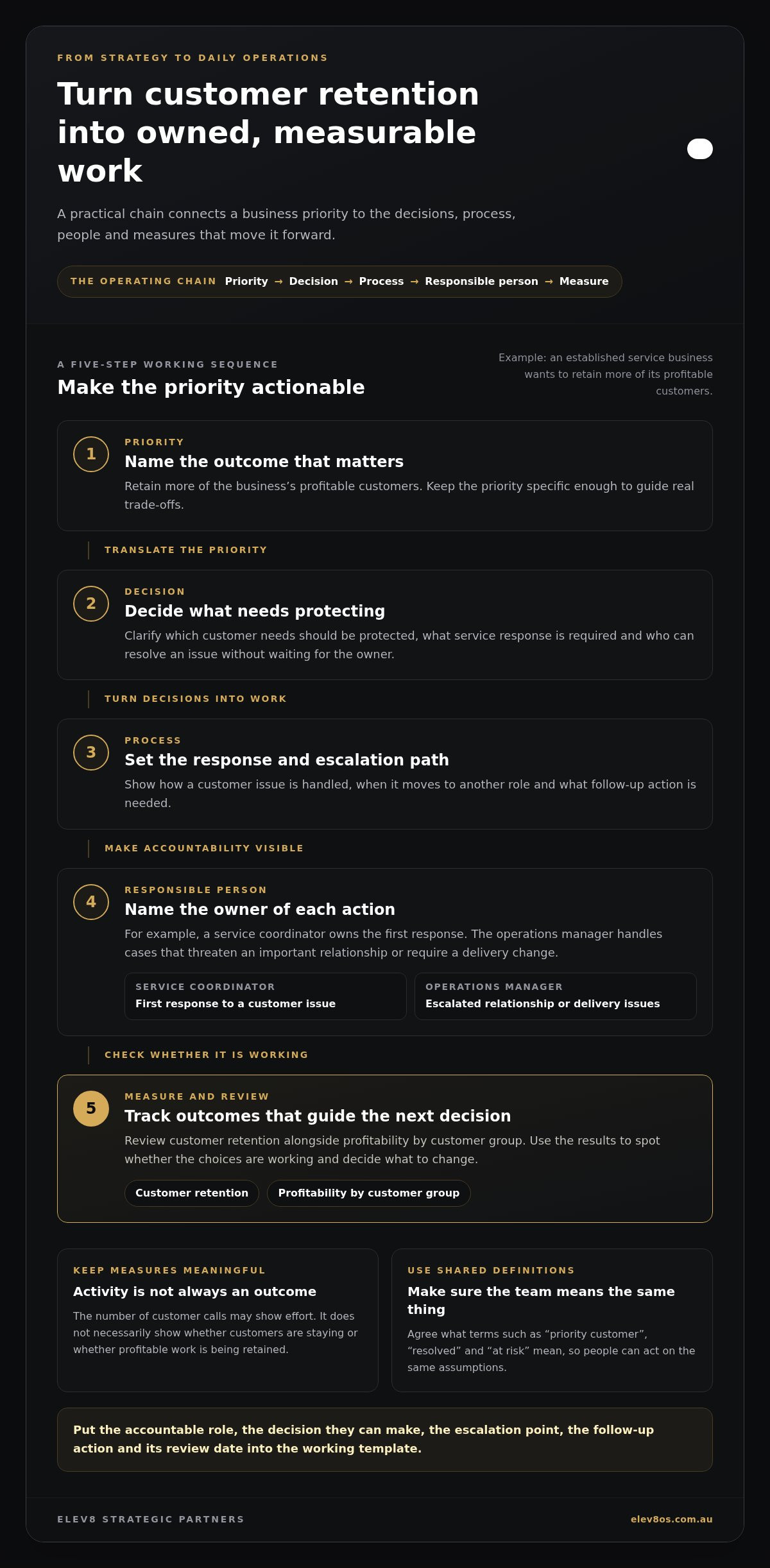
A business priority has no operational force until it shapes what people decide and do. The chain needs to be clear: priority, decision, process, responsible person, measure. Break one link and the strategy stays at the level of intention.
Suppose an established Australian service business wants to retain more of its profitable customers. That priority should guide decisions about which customer needs to be protected, what service response is required and who can resolve a problem without waiting for the owner. A review measure, such as customer retention alongside profitability by customer group, can show whether the choices are working. The point isn’t to track everything. It’s to make the trade-offs visible.
Connect business priorities to measurable work
A strategy model can help leaders settle priorities before they turn them into action plans. The Balanced Scorecard, for instance, can prompt a business to look beyond financial results and consider customer, process and capability perspectives. It can be useful where those views sharpen decisions, but no model suits every business. Choose the structure that fits the decision at hand.
Then separate meaningful measures from activity counts. The number of customer calls made may show effort; it won’t necessarily show whether customers are staying or whether the business is retaining profitable work. A useful measure helps someone decide what to do next. If the result changes and nobody’s response changes with it, the measure may be noise.
A shared operating language matters here. The owner, service manager and team need the same understanding of what “priority customer”, “resolved” or “at risk” means. Otherwise, people can complete the same worksheet and still act on different assumptions.
Build ownership into the tools people use
A practical template should make the handover from intention to action visible. Record the accountable role, the decision that role can make, the point where an issue must be escalated, and the follow-up action with its review date. That gives the team a working reference, not just a record of what was discussed.
For example, a service coordinator might own the first response to a customer issue, while the operations manager handles cases that threaten an important relationship or require a change to delivery. The owner can then see what needs their decision instead of being pulled into every routine call. The roles will differ by business; the discipline is to make them explicit.
A framework becomes useful when it gives people a shared basis for repeated decisions, and those decisions turn into consistent action.
That’s how business frameworks and templates connect strategy to the workday. They translate priorities into decisions people can make, responsibilities they can own and measures leaders can review. A completed worksheet is not the finish line. The real test is whether the team uses it when the next trade-off, customer issue or operational decision arrives.
Which business frameworks and templates fit your current bottleneck?
Start with the constraint, not a catalogue of popular models. Are you unclear about which customers to serve, unsure who owns key work, or unable to see whether performance is on track? Each problem calls for a different kind of tool. A framework that helps with market choices won’t automatically fix a handover or reveal where delivery is slipping.
Use this comparison to narrow the field. These are tool families, not a universal ranking. The right choice depends on the decision your business needs to make and whether your team can maintain the tool in everyday work.
| Business need | Useful framework type | Template output | Limitation |
|---|---|---|---|
| Clarify which customers or market position to prioritise | Market-positioning or customer-segment framework | Planning worksheet comparing customer groups, needs and strategic choices | Can organise assumptions, but leaders still need to choose where to focus |
| Reduce work that relies on the owner | Organisation structure and responsibility framework | Role map showing ownership, decision rights and escalation points | Won’t create accountability if roles aren’t agreed and used |
| Improve visibility of performance and follow-through | KPI or performance framework | Scorecard or tracker linking measures to owners and review actions | Measures can create noise if they don’t inform a decision |
Match the framework to the question
If the unresolved question is who to serve or how to stand apart, use a market-positioning approach to compare customer needs and the choices your business can support. If routine work keeps returning to the owner, look at structure and responsibility tools. If leaders can’t tell whether priorities are progressing, a KPI framework may help connect performance measures with review and action. None is automatically the best option.
Be precise about what you want to learn. “Improve sales” is too broad to guide tool selection. “See which customer group produces repeat work and whether our follow-up process is consistent” points towards a clearer analysis and a practical next step.
Choose a template the team can keep using
A one-off planning worksheet helps a team work through a specific choice, such as comparing customer groups. A recurring operational template supports repeated decisions, such as recording service issues, assigning an owner and tracking follow-up. The second needs a regular place in the workflow and someone with the time and authority to keep it current.
Keep administration in proportion to the decision. If maintaining a template takes more effort than using the information it produces, strip it back. A useful tool captures what the team needs to act, not every detail it could record.
Remember the limit: templates organise work, but they can’t make difficult choices for leaders. The best business frameworks and templates help expose the decision, ownership or performance gap that needs attention. They don’t remove the responsibility to address it.
How to put business frameworks and templates into practice
Implementation starts with a live business problem, not a blank document. Pick one point of friction that affects a real decision or handover, then build only enough structure to help the team handle it better. The goal is a tool people use, not a form that looks complete.
- Name the problem. State what is going wrong and where it shows up. For example, customer issues keep returning to the owner because staff aren’t sure what they can resolve themselves.
- Choose one tool. Select a framework that helps clarify the underlying issue, then use a template to capture the decisions or actions needed. Don’t combine several models unless the problem demands it.
- Adapt the template. Keep fields that support a decision, responsibility or follow-up action. Remove the rest. Use the smallest version that gives the team enough information to act.
- Assign ownership and review. Name who maintains the tool, who acts on what it reveals and when the team will review whether it’s useful.
Adapt a template without making it a paperwork exercise
A template should use the language your team uses at work. Replace abstract labels with terms people understand, and explain any measure that could be interpreted differently. If a field doesn’t change a decision, identify an owner or trigger a follow-up, remove it. Keep a note of the original problem the framework was chosen to address, so each change serves that purpose rather than adding complexity.
For instance, a handover template might need the customer issue, the person responsible, the next action and a follow-up date. It probably doesn’t need a long narrative if that detail won’t affect how the issue is resolved. Test the simpler version in the real workflow. Ask the people using it where they hesitate, what information they’re missing and what they ignore.
Make ownership and review part of the system
Every active template needs a purpose, an owner and a review point. The owner keeps it current; the review checks whether it still helps the business make the intended decision. Set the rhythm to match the work. A recurring service handover may need regular attention, while a planning worksheet may only need revisiting when its assumptions or priorities change.
Missed actions are useful evidence. They may point to unclear authority, competing priorities, an unrealistic process or a review that happens too late. Don’t respond automatically by adding another form. Find the break in the operating system and repair that first.
Keep a practical test in view: can the people responsible use this tool without the owner translating it each time? If not, clarify the language, decision rights or handover. Useful business frameworks and templates make work easier to own and review, rather than creating another layer of administration.
If the gap is no longer the template but consistent execution, explore a diagnostic Discovery Call to assess what needs to change in the operating system.
When business frameworks and templates need more than self-guided use
Self-guided tools suit a clear, contained task. You can identify the process, assign someone to maintain it and put the steps into use without the owner having to make every call. A template can help establish that structure, but it can’t compensate for unclear authority or follow-through that repeatedly breaks down.
Watch for the pattern: you’ve documented the process, yet decisions still come back to you; actions are agreed but not completed; or the team waits for the owner to interpret what the tool means. That isn’t a shortage of templates. It points to an execution problem that may need direct work inside the business.
What the Elev8 Toolkit Course contains
The self-guided Elev8 Toolkit Course is a practical starting point for owners who want to work through core operational frameworks at their own pace. It includes an Owner Dependency Audit, a Revenue & Profit Clarity Framework, a basic org-structure template and a KPI starter pack. Access is immediate and perpetual.
Use these resources to examine where the business relies on you, build clearer visibility and start shaping practical operating tools. They support the work; they don’t guarantee an outcome or replace the decisions and action needed to apply them. The course is a direct-purchase starting point in a broader journey, not a claim that every operational issue can be solved by self-guided use.
When the business needs embedded execution
If the owner remains the decision bottleneck or agreed actions keep stalling, the work may need more than another document. Elev8’s approach is embedded and execution-focused: work happens inside the business, with outcomes defining success, not tenure. Engagements conclude when the agreed outcomes are delivered and the business is positioned to grow without Elev8.
That work is grounded in direct communication. Clients are told what they need to hear, not simply what they want to hear. Tier 1 gives direct access to Josh Lawrence, with one active Tier 1 client per industry vertical at any time. The Elev8 Boardroom is facilitated by Josh for Tier 2 members, who need to arrive prepared and participate actively.
The next step is a diagnostic Discovery Call: a 30-45-minute video conversation with no pitch deck or slide presentation. It’s a chance to examine the operating constraint and determine whether embedded execution is the right next move. If your tools are in place but the business still depends on you to make them work, book a diagnostic Discovery Call.
Choose the next operational move
The next step isn’t to collect more business frameworks and templates. It’s to decide which operational constraint deserves attention first, and what would need to change for your team to handle it with less friction.
Keep the first move focused. Choose one decision or handover that currently slows the business down. Be clear about what’s getting in the way, who needs to act and what evidence would show the work is moving. That gives you a practical starting point, whether you’re working independently or need support to embed the change.
If the obstacle is bigger than a tool can solve, use a diagnostic conversation to examine what’s holding execution back and what kind of operating change makes sense. Book a diagnostic Discovery Call.
Build from the real constraint, not the perfect plan. One deliberate change can give your business a stronger foundation for the next.
Frequently Asked Questions
Are business frameworks and templates the same as a business plan?
No. A business plan sets out the direction, assumptions and intentions for the business. Business frameworks and templates help address specific decisions or processes along the way. For example, a plan may prioritise growth, while a framework helps assess which customer group to pursue and a template records the evidence behind that choice. Give each tool a defined job, or it can drift away from the plan it’s meant to support.
Can a small Australian business use frameworks designed for larger organisations?
Yes, if the framework helps with a real decision and you scale it to your team’s capacity. A trade business in Tamworth, Newcastle, Armidale, Coffs Harbour, Port Macquarie or Moree might use a role-mapping approach without adopting a large organisation’s layers of management. Keep only the responsibilities, measures and steps your people can maintain. The test is practical use, not the size of the organisation where the model began.
Should every department use the same business templates?
Not necessarily. Keep shared fields where leaders need to compare information, such as the person responsible, decision required and status. Then tailor fields to the work: a sales team may record customer follow-up, while an operations team tracks delivery issues. Before creating separate versions, identify why the difference is needed. Too many variations can make it difficult to reconcile information or understand who is accountable across teams.
How often should a business review its frameworks and templates?
Review a tool when the work or decisions it supports change, and set a check-in rhythm that suits its use. For instance, a new service offering may make an old customer-screening worksheet irrelevant, while a planning model may remain useful for longer. Look for signs such as staff bypassing the tool, outdated assumptions or decisions it no longer helps to make. A calendar reminder alone isn’t a reason to change it.
Can a template replace a standard operating procedure?
No. A standard operating procedure explains how to perform a task; a template captures information or records a result. For example, a procedure can describe how to prepare a customer handover, while a template records the agreed requirements and any outstanding actions. Use both where the process needs clear instructions and a consistent record. Keep the documents easy to locate, and make sure the people doing the task can follow them.
What should I do if a business framework does not fit my situation?
Check whether its assumptions match the decision you actually need to make. Write down the framework’s key questions, then test them against a recent business situation. Keep the parts that expose useful choices and adapt or discard the rest. If the problem stays unclear, speak with the people doing the work before selecting another model. The mismatch may come from an inaccurate diagnosis, not a lack of available frameworks.