
Foundations Toolkit for Business: A Practical Buyer’s Guide
Templates don’t fix a business that still runs on the owner’s memory. A foundations toolkit for business earns its place when its frameworks become clear responsibilities, regular decisions and operating habits the team can repeat.
If you’re carrying too many decisions, or your templates sit unused without clear ownership, the problem isn’t a shortage of documents. It’s knowing which gaps matter first and putting the right structure behind them.
This guide will help you assess what a useful toolkit should contain, who it suits and how to turn its frameworks into practical routines. You’ll see how tools such as an Owner Dependency Audit, a Revenue & Profit Clarity Framework, an organisational-structure template and a KPI starter pack can bring visibility to ownership, finances, roles and measurement. You’ll also get a practical way to choose your next step rather than trying to overhaul everything at once.
The Elev8 Toolkit Course is a self-guided entry point, not a substitute for applying the tools. The work starts when someone owns each framework, uses it in the business and builds a consistent rhythm around it. It can support owners in Tamworth, Newcastle, Armidale, Coffs Harbour, Port Macquarie and Moree who want to examine how their operations work.
Key Takeaways
- Use a foundations toolkit for business to spot where unclear ownership or owner dependence is holding operations back.
- Match each operational gap to a resource, then weigh its usefulness against the effort needed to put it into practice.
- Turn frameworks into action: record what you find, assign a next step and set a time to review it.
- Start with one meaningful issue. Trying to rebuild every process at once can make useful tools harder to apply.
- The self-guided Elev8 Toolkit Course costs $97 one-off and includes immediate digital access and perpetual access.
Why a foundations toolkit for business matters when operations rely on the owner
A business foundations toolkit is a structured set of resources for examining and organising the operations that keep a business moving. It helps make core questions visible: who makes which decisions, how work gets done, where money is coming from and what the business measures. The point isn’t to create paperwork for its own sake. It’s to understand how the operation actually works, beyond what the owner can hold in their head.
In an established owner-led business, dependency can look like the owner approving every quote, resolving routine staff questions or stepping in whenever a customer issue falls outside the usual pattern. Work may still get done, but progress slows whenever that person is unavailable or pulled in another direction. Knowledge and follow-through sit with one person instead of being anchored in shared responsibilities and routines.
Financial visibility can be just as fragile. Revenue may be reviewed regularly while costs, margins or cash commitments remain harder to see together. Roles can be informal, so two people assume the other owns a task, or everyone waits for the owner to decide. Measures may be collected inconsistently, making it difficult to tell whether an operational change is helping.
A plan can set direction, but direction alone won’t make day-to-day work clear. A useful toolkit helps examine the working parts too. For context on the importance of a comprehensive business plan, consider how it sets out goals, strategies and operations. Then ask whether the business has practical ways to translate those intentions into decisions, responsibilities and measures.
Which operational gaps should a business foundations toolkit help reveal?
Look for recurring workarounds. If staff repeatedly ask the owner for information, recreate the same document or chase approvals, the pattern may point to missing structure, not a lack of effort. If a process only works when one particular person is present, record what they know and decide who should own the next step. These are operational gaps worth examining.
What separates a framework from another unused template?
A framework helps organise thinking by providing a way to examine a problem. A template gives that thinking a usable structure, such as fields for recording responsibilities or measures. Neither does the work by itself. A blank template without context, an owner or a next action is just another file. Apply it to a real decision or routine, then assign responsibility for acting on what it reveals.
A business toolkit is useful when its frameworks clarify decisions, responsibilities and measures. That’s the test. Can someone tell what needs deciding, who is responsible and what will be tracked? If the answer is no, the tool hasn’t yet become part of the operation.
Choose one recurring friction point and examine it plainly. Write down where work stalls, what information is missing and who currently steps in. That gives you a grounded starting point for assessing the business. The aim isn’t to document every task or remove the owner from every decision. It’s to distinguish where their judgement is essential from where unclear expectations keep pulling them into routine work.
What the Elev8 Toolkit Course includes for business foundations
The Elev8 Toolkit Course is a self-guided digital course built around core operational frameworks. It gives an owner resources to examine key areas of the business and organise what they find. The owner works through the tools and decides how to apply them to the business’s circumstances.
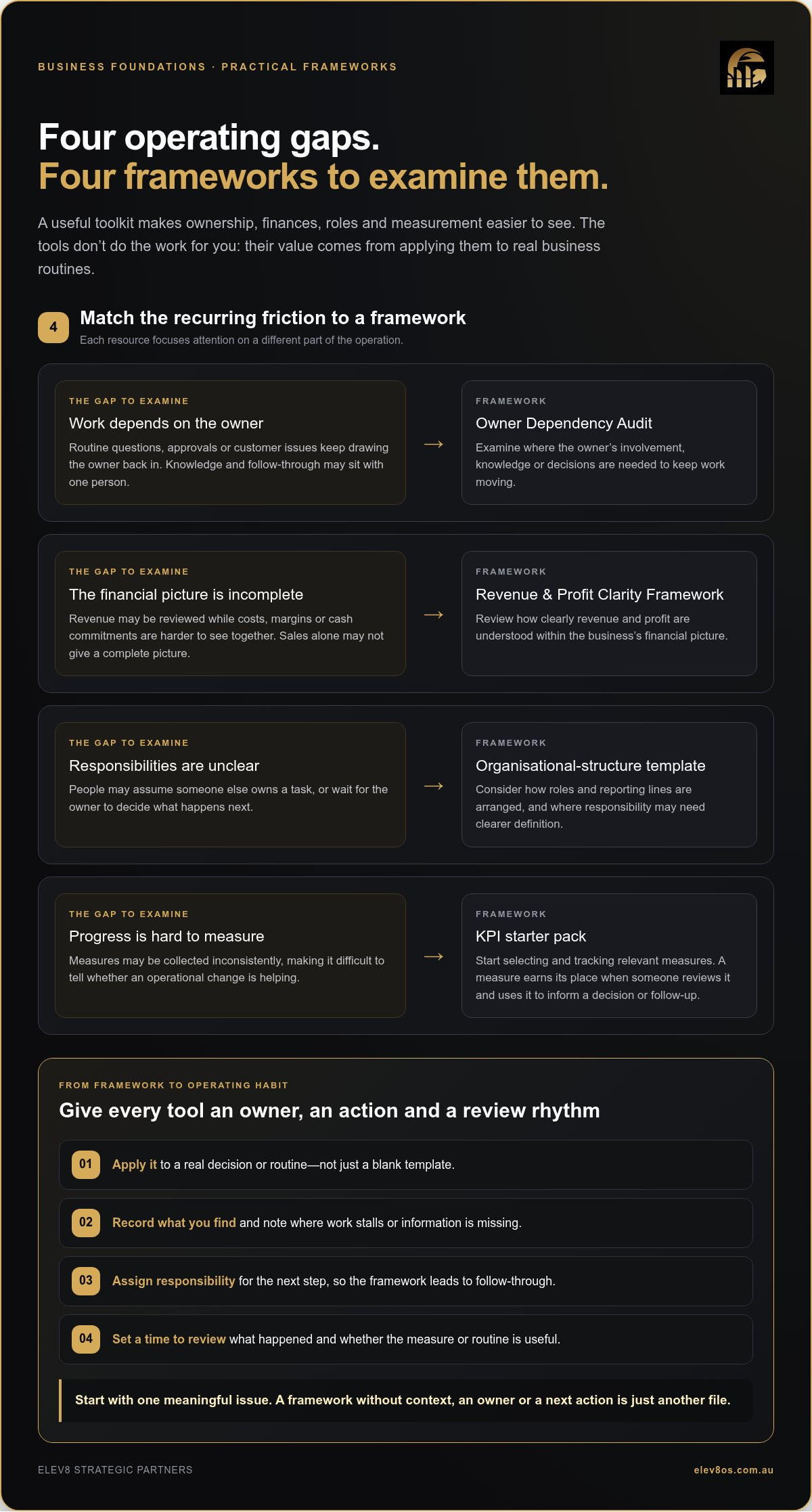
The Elev8 Toolkit Course brings together four practical resources for reviewing business foundations. Each has a distinct focus, from examining how much depends on the owner to considering how responsibilities and performance measures are set up.
How the Owner Dependency Audit and financial framework support self-diagnosis
The Owner Dependency Audit is a resource for examining where the owner remains central to business activity. Use it to identify areas where the owner’s involvement, knowledge or decisions are needed to keep work moving. It helps frame the issue for closer examination; it doesn’t promise to remove dependency or prescribe a single solution.
The Revenue & Profit Clarity Framework focuses attention on financial clarity. It gives the owner a resource for reviewing how clearly revenue and profit are understood, rather than assuming that knowing sales alone gives a complete picture. For broader context on planning, the U.S. Small Business Administration’s guidance on business planning covers how a plan sets out a business’s direction. The framework brings the focus back to reviewing the financial picture within the operation.
What the structure template and KPI starter pack are for
The basic organisational-structure template can help an owner consider how roles and reporting lines are arranged. It provides a structure for reviewing who is responsible for what and where responsibilities may need clearer definition. It doesn’t make decisions for the business or determine the right structure on its own.
The KPI starter pack is a starting point for selecting and tracking relevant measures. The useful measures depend on what the business needs to understand and act on. A measure only earns its place if someone reviews it and uses it to inform a decision or follow-up. The resource supports that consideration without promising a particular result.
- Owner Dependency Audit: examines reliance on the owner across business activity.
- Revenue & Profit Clarity Framework: supports a review of financial clarity.
- Organisational-structure template: helps consider roles and reporting lines.
- KPI starter pack: provides a starting point for choosing and tracking relevant measures.
Together, these resources make the foundations toolkit for business a practical set of prompts and structures for self-diagnosis. Their value depends on how they’re used: apply a resource to a real operating question, record what it brings into view and decide what action comes next. Access to a framework is a start, not a substitute for ownership and follow-through.
How to compare a foundations toolkit with your business’s actual needs
Start with the operational problem, not the size of the resource library. A foundations toolkit for business should help you examine a gap you can name, then connect what you learn to a decision or routine. Choose a toolkit by matching its resources to a defined operational gap, not its page count.
Use this comparison to test whether a resource is relevant and what it will take to put it to work. “Evidence of usefulness” means a practical sign that the tool has helped you clarify the issue, not a promised business result.
| Operational problem | Resource needed | Evidence of usefulness | Likely implementation effort |
|---|---|---|---|
| Routine decisions keep returning to the owner | A resource to examine owner dependency | You can identify where the owner’s input is still central | Review how decisions are handled and identify a next action |
| Revenue and profit are difficult to assess together | A financial-clarity framework | You can describe what you understand and what needs closer review | Set aside time to review the relevant business information |
| People are unsure who owns work | An organisational-structure template | Roles and reporting lines are easier to discuss | Compare the structure with how work is actually assigned |
| Measures are inconsistent or not used | A KPI starter pack | You can select relevant measures and establish a review routine | Agree who tracks and reviews each measure |
When does a self-guided toolkit fit an established business?
A self-guided course can suit an owner who wants structured resources for self-diagnosis and practical review, and can make time to interpret and apply them. The Elev8 Toolkit Course is self-guided. The owner connects the material to the business, decides what matters and follows through. It is designed to support the owner’s own review and action.
Be frank about capacity. If you can schedule time to examine one issue, make a decision and assign a follow-up, self-guided resources may be a workable fit. If the main need is for someone to work inside the business to drive implementation, a course alone may not meet that need. The distinction is about the work required and who will carry it.
What should a buyer check before choosing business frameworks?
Match the resources to a current need: owner dependency, financial clarity, organisational structure or measurement. Then check whether the findings can connect to an existing meeting, decision point or review routine. A framework with no place in the operating rhythm is unlikely to be used consistently.
Be clear about what the course includes: an Owner Dependency Audit, a Revenue & Profit Clarity Framework, a basic organisational-structure template and a KPI starter pack. Assess the resources on what they are, then decide whether you have the time and ownership to apply them.
Applying Business Foundations Frameworks After Access
Access to a framework is only the starting point. To make a foundations toolkit for business useful, move each finding into a decision, an owner and a review point. Start with one operational issue affecting the business now. Trying to rebuild every process at once spreads attention thin and makes follow-through harder.
- Identify the gap. Describe what is happening, where work stalls or what remains unclear.
- Select the relevant resource. Choose the framework that fits the issue, rather than filling in every tool by default.
- Record what you find. Capture the situation in plain language. Separate what you know from what needs further examination.
- Assign an action. Name the person responsible and state what they will do next. Keep the action proportionate to the issue.
- Review progress. Decide how you’ll observe whether the action happened and when to revisit the issue.
This sequence doesn’t require a special tracking template. A clear written record is enough to establish what was noticed, who owns the next step and how progress will be checked. Keep responsibility visible. “The team will look at it” isn’t ownership.
Start with the Owner Dependency Audit
Use the audit to examine decisions or work that repeatedly return to you. Record where that reliance affects continuity, delegation or the attention you can give to leadership priorities. Treat this as an illustrative review, not a prescribed set of audit questions or a scoring exercise. The useful output is a clearer view of where dependency sits and what you want to address first.
For example, suppose a team member can prepare a customer proposal, but it waits for the owner’s approval each time. Record that point of dependency, then assign a review of which decisions genuinely need the owner’s judgement and which could be handled under agreed boundaries. Set a time to revisit whether the new arrangement is being followed. Don’t assume one conversation fixes the process.
Turn financial clarity, structure and KPIs into reviewable actions
Use the Revenue & Profit Clarity Framework to organise questions about what the business understands about revenue and profit, and what needs closer review. Use the organisational-structure template to examine whether responsibilities and reporting lines reflect how work is actually done. Then consider which measures from the KPI starter pack are relevant to the issue at hand.
For each action, record an owner and a way to observe progress. For a measure, that might mean agreeing who will review it and where that review fits into an existing routine. The course resources don’t do this follow-through for you. Your operating rhythm must carry it.
Keep the first cycle tight: one gap, one relevant resource, one assigned action and one review. If you want to discuss a broader operational need beyond self-guided work, book a 30-45 minute video diagnostic conversation. It has no pitch deck or slide presentation, and it isn’t a sales call.
Is the Elev8 Toolkit Course the right next step for your business?
The Elev8 Toolkit Course may suit an owner who wants practical resources to review the business and is prepared to work through them independently. It’s a self-guided digital course, available for a one-off purchase of $97, with immediate digital access and perpetual access. You can purchase it directly; a Discovery Call isn’t required.
Fit depends on what you need next. If you want structured frameworks to examine operational foundations and can set aside time to apply them, the course offers a defined starting point. If you need work carried out inside the business, be clear that a self-guided resource supports your review and action, but doesn’t provide bespoke implementation or guarantee commercial outcomes.
Who is likely to benefit from a self-guided course?
Owners who want to examine areas such as owner dependency, financial clarity, structure and measurement may value having resources to guide that review. The important test is whether you’ll make time to use them. A course can organise your thinking, but it can’t make decisions, assign responsibilities or follow through on your behalf.
Before purchasing, identify one operational issue you want to examine and consider when you’ll work on it. That simple commitment helps you approach the material with a real business question, rather than treating access itself as progress.
What happens beyond the Toolkit Course?
The course is a direct-purchase entry point and the first step in the wider Elev8 Strategic Partners customer journey. Toolkit buyers receive a follow-up invitation to book a Discovery Call. The invitation is separate from purchasing the course, and the call isn’t a requirement for access.
The Discovery Call is a 30-45 minute video diagnostic conversation, with no pitch deck or slide presentation. It’s not a sales call. It’s a chance to discuss the operational reality and consider what kind of next step fits. Elev8 Strategic Partners’ approach is embedded over advisory: the Strategic Operations Engineer works inside the business. Success is measured by delivered outcomes, not length of engagement, and the engagement concludes when agreed outcomes are delivered and the business is positioned to grow without Elev8 Strategic Partners. Elev8 Strategic Partners communicates honestly, telling clients what they need to hear, not simply what they want to hear. For Tier 1, only one active client per industry vertical is allowed at any time.
If you’re ready to discuss an operational challenge beyond self-guided review, book a Discovery Call. Bring the issue you want to work through. The conversation is diagnostic, not a presentation.
Choose the next operating gap to tackle
A stronger business doesn’t come from collecting more frameworks. It comes from making one clear decision, assigning responsibility and following through until the new habit holds. Pick the operational gap that is costing the most attention right now. Decide what needs to change, who will own the next action and how you’ll review progress.
That is the practical test of a foundations toolkit for business: does it help move an issue out of your head and into the way the business operates? Start small, but set a real standard. If the first action isn’t owned or reviewed, the framework is still only a document.
If you’re facing a broader operational challenge and want to discuss what meaningful progress could look like, book a diagnostic Discovery Call. Use the conversation to get clear on the issue and the next step, without dressing the problem up or pretending a template will solve it on its own.
Build the operating habit one deliberate action at a time. That’s how a useful framework becomes part of the business.
Frequently Asked Questions
Is the Elev8 Toolkit Course suitable for a start-up?
The Elev8 Toolkit Course is designed for owners with an established operation who want to examine how the business runs and where structure needs attention. The practical question is whether there’s enough operating activity to make the frameworks relevant. For an established business in Tamworth, Newcastle, Armidale, Coffs Harbour, Port Macquarie or Moree, start by identifying an operational issue the course resources can help you review.
Can I buy the Elev8 Toolkit Course without a Discovery Call?
Yes. The Elev8 Toolkit Course is available to purchase directly, without booking a Discovery Call first. It costs $97 one-off and includes immediate digital access and perpetual access. You can start working through the self-guided course on your own. Toolkit buyers also receive a follow-up invitation to a Discovery Call as part of Elev8’s wider customer journey, but the invitation isn’t a purchase requirement.
Does the Toolkit Course guarantee business growth?
No. The Toolkit Course provides frameworks and resources, not a guarantee of growth or any other commercial result. What happens next depends on the decisions you make and the actions you take in your business. Before starting, write down what you want to understand or change. For example, if approval delays are the issue, note how that process currently works and review whether your next action addresses the cause.
Can I use the Toolkit if I already have business templates?
Yes. Existing templates don’t rule out using a foundations toolkit for business. Treat the course as a way to examine whether your current documents are being used consistently, rather than as a reason to replace them all. Pick one template and check whether people know when to use it, who maintains it and what decision or action follows. Keep what works; focus attention on the gaps.
How should I decide whether to book a Discovery Call after using the Toolkit?
Consider booking if you’ve worked through the material and can name an operational issue that needs attention beyond your own self-guided review. The Discovery Call is a 30-45 minute video diagnostic conversation with no pitch deck or slide presentation; it isn’t a sales call. Use it to discuss the business’s current position and constraints. Book a diagnostic Discovery Call when that conversation would help clarify your next step.
What is the difference between perpetual access and a subscription?
Perpetual access means you retain access to the Toolkit Course after the one-off purchase; it isn’t a subscription. A subscription generally involves recurring payments for continued access, while the Toolkit Course is a single $97 purchase. The distinction is useful when comparing learning resources: check whether access continues after payment or depends on recurring billing. For this course, access is perpetual.