
Business Owner Accountability Partner: How to Find Support That Drives Action
A pleasant check-in won’t move a stalled priority. A business owner accountability partner should do more than ask how the week went: they should challenge your thinking, make commitments visible and keep follow-through tied to the work that matters. Otherwise, urgent tasks keep winning and the same decisions land back on your desk.
It’s understandable if you’re carrying too much. When you’re responsible for the business’s decisions and delivery, good intentions can get buried in the daily grind. Accountability without honest challenge or practical follow-up is just another conversation.
This article will help you choose support that fits the problem you need to solve. You’ll compare peer accountability with embedded operational execution, then see what effective follow-through looks like: clear commitments, visible progress and direct conversations when action slips. The aim is not to add another meeting to your calendar. It’s to build momentum and a business that doesn’t depend on you to make every decision.
Key Takeaways
- A business owner accountability partner should turn priorities into clear commitments, visible progress and honest follow-up.
- Use a practical execution cycle: name the outcome, assign ownership, set a measure, review progress and tackle obstacles.
- Choose support based on the constraint: peer challenge or operational implementation.
- The Elev8 Strategic Partners Boardroom Program provides facilitated peer accountability in a monthly half-day session. Members must arrive prepared and contribute actively.
- Elev8 Strategic Partners allows only one active Tier 1 client per industry vertical at a time.
What a business owner accountability partner should actually do
The priority was agreed. The meeting ended with clear intent. Then the day filled with staff questions, customer issues and decisions that couldn’t wait. By Friday, the important work had slipped again. When this becomes a pattern, the problem isn’t always a lack of ambition. It may be a lack of structure around follow-through.
A business owner accountability partner is a person or structured group that challenges your commitments and tracks whether you act on them. The role isn’t to take responsibility off your shoulders. It’s to make ownership, progress and obstacles visible, so commitments don’t disappear into the week.
The basic idea is explained in What is an Accountability Partner? In business, the useful test is practical: does the conversation change what happens next? Effective accountability links each commitment to an owner, a way to measure progress and a point to review it.
Effective business accountability means making a clear commitment, tracking what happens and dealing honestly with what gets in the way. Encouragement can help, but it can’t replace that operating discipline.
How accountability differs from motivation
Motivation fluctuates. A clear commitment creates a repeatable expectation, even when the week gets messy. It turns “I should get to that” into a specific action someone can see and review. That doesn’t mean every conversation needs to feel like a performance review. The point is to keep the work moving, not to create paperwork or shame.
Take “improve delegation”. It sounds worthwhile, but no one can tell whether it’s happening. Make it concrete: assign a team leader ownership of the weekly supplier-order review, then agree to review how it’s working at the next fortnightly leadership meeting. Now there’s an action, an owner and a review point. If it stalls, the conversation can focus on the obstacle and the next decision, rather than another vague promise.
Signs an owner needs structured follow-through
Look at what keeps returning to you. Your team may be in place, yet routine decisions still come back to the founder for approval. Priorities remain overdue. Ownership is unclear. The same issue gets discussed at several meetings, but nobody changes the process or takes the next step.
These are signs of a system that relies too heavily on the owner, not simply a calendar that needs more reminders. An accountability partner can help expose where a commitment lacks a clear owner, where progress is hard to see or where the founder is holding on to decisions the team could make.
If daily operational demands keep pulling you back into the details, consider what needs to change in the way work and decisions are handed over. The guide to stepping back from daily business operations explores that shift. Structured follow-through helps turn it into action, rather than leaving it as another intention.
How a business owner accountability partner turns commitments into execution
A commitment only matters if it connects to a result the business needs. Otherwise, it becomes another task competing with customer work, staff issues and the day’s operational demands. A business owner accountability partner helps keep the focus on the priority, then makes the next steps clear enough to act on and review.
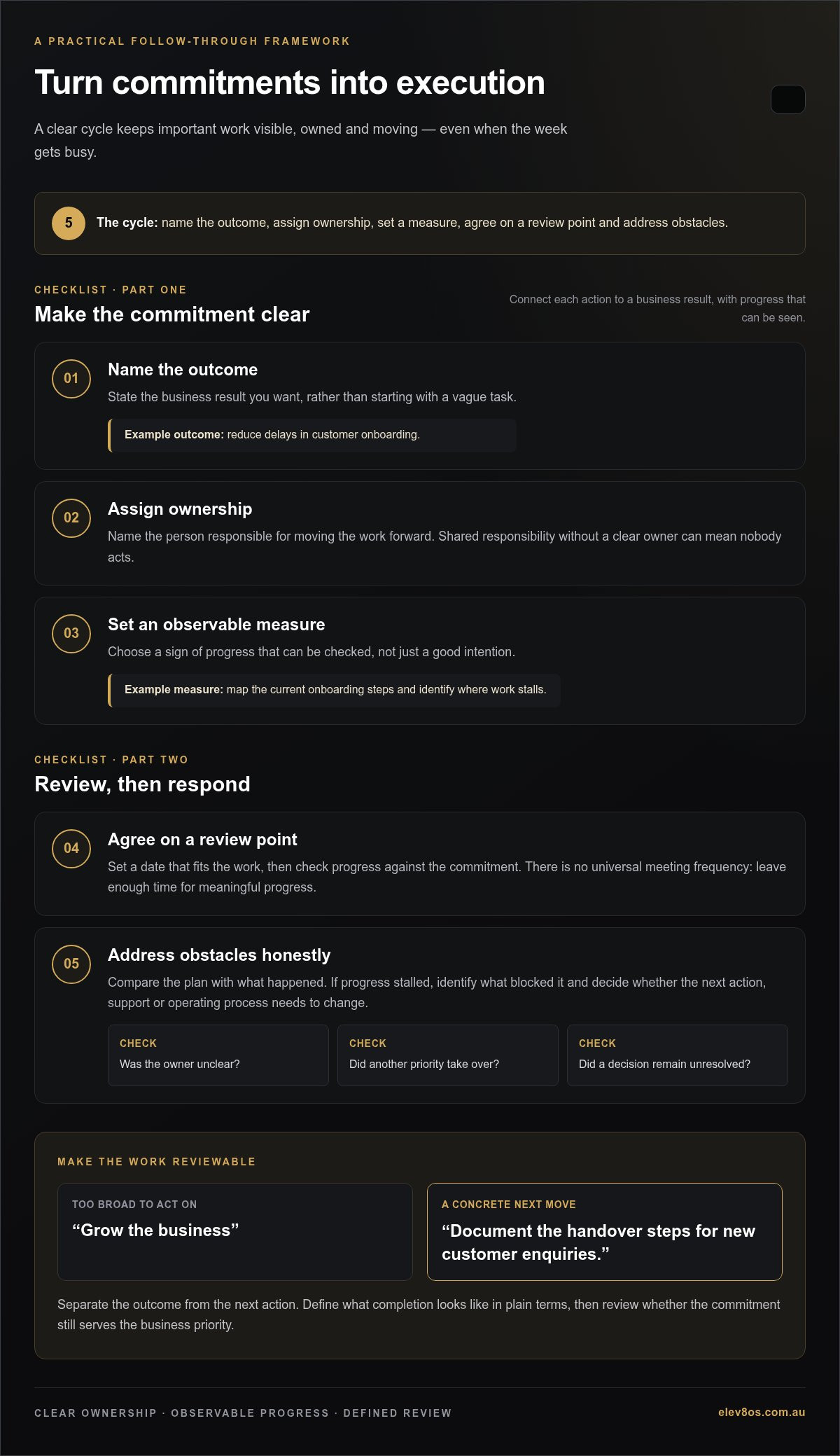
Use a simple cycle. Keep each stage visible:
- Name the outcome. State the business result, such as reducing delays in customer onboarding.
- Assign ownership. Name the person responsible for moving it forward. Shared responsibility without a clear owner often means nobody acts.
- Set a measure. Choose an observable sign of progress, such as mapping the current onboarding steps and identifying where work stalls.
- Agree on a review point. Set a date that fits the work and check progress against the commitment.
- Address obstacles. Identify what blocked progress and decide whether the next action, support or operating process needs to change.
Accountability requires a clear owner, observable progress and a defined review. The action should be within the owner’s control and contribute to the stated outcome. “Grow the business” is too broad to act on. “Document the handover steps for new customer enquiries” is a concrete next move that can support a larger improvement in customer onboarding.
Build commitments that can be reviewed
Separate the outcome from the next action. The outcome might be fewer delays; the next action could be mapping the current handover and assigning responsibility for each step. Define what completion looks like in plain terms, then agree when to review it. There’s no universal meeting frequency. The review point should suit the commitment and leave enough time for meaningful progress.
Make the review direct, useful and action-focused
At review, compare the plan with what actually happened. If the work stalled, get specific: was the owner unclear, did another priority take over, or did a decision remain unresolved? A useful accountability conversation doesn’t settle for “I ran out of time”. It asks what would prevent the same delay next time: a decision, a changed process or a clearer handover.
Honest challenge matters when a commitment is avoided, delayed or repeatedly renegotiated. The point isn’t to punish a missed date. It’s to name the pattern and test whether the commitment still serves the business priority. Indeed’s guidance on the role of an accountability partner also centres on follow-through and maintaining an effective working relationship. Close each review by confirming the next action, its owner and the agreed review point.
If execution is repeatedly blocked by the way work is organised, Elev8’s operational frameworks can help connect commitments with how the business runs.
Peer partner, accountability group or embedded operations support?
The right support depends on what’s stuck. Do you need someone beside you to keep a commitment visible, a group to challenge your decisions, or hands-on help to change how the business operates? These models aren’t interchangeable. A peer can expose a weak assumption; they won’t necessarily build the process needed to fix it.
Use this comparison to identify where the gap sits. The business owner still holds responsibility in every model, but the amount of structure and execution support changes.
| Support model | Challenge | Execution involvement | Structure | Owner’s responsibility |
|---|---|---|---|---|
| Self-managed partner | Mutual, based on each person’s willingness to be direct. | Usually limited to discussion and follow-up, not doing the work. | Set by the pair; consistency depends on both people. | Set commitments, bring progress updates and follow through. |
| Facilitated peer group | Perspectives and challenge from other business owners, supported by a facilitator. | Challenges decisions and commitments; members implement changes themselves. | Regular sessions with agreed expectations and active participation. | Arrive prepared, contribute honestly and act between sessions. |
| Embedded operational support | Direct challenge grounded in the work and operating realities of the business. | Works inside the business to help implement agreed changes. | Centred on defined outcomes, with work concluding when they’re delivered. | Make decisions, work alongside the process and build the capability to sustain progress. |
A peer accountability group can sharpen judgement and create useful pressure to act. Embedded operational support addresses a different need: putting changes into practice within the business. The distinction matters. Conversation can reveal a bottleneck, but it doesn’t automatically establish a new system, clarify decision rights or change how work moves through the team.
When a peer accountability group is the better fit
Choose peer challenge when you need perspective on complex decisions from owners who understand the weight of running a business. The value depends on confidentiality, preparation and active contribution; passive attendance won’t create useful challenge. The Elev8 Boardroom Program, facilitated by Josh Lawrence, meets monthly for a half-day session and has a maximum of four seats per room. Members are expected to arrive prepared and participate actively.
Group formats differ in size, facilitation and expectations. The business owner peer group comparison can help clarify which structure suits the kind of challenge you need.
When the operating problem needs embedded execution
If progress depends on changing internal systems, roles or workflows, discussion alone may not shift the work. Elev8’s Strategic Operations Engagement is embedded inside the business, not based in a boardroom. Josh Lawrence works directly with the business, with access as part of the engagement. The work is measured against agreed outcomes and typically runs 6-18 months, concluding when those outcomes are delivered and the business is positioned to grow without Elev8. Choose the model that matches the constraint, not the one that merely sounds supportive.
How to choose an accountability partner for your business
Start with the constraint, not the title of the person or programme. Do you need peers to challenge your thinking, a dependable structure for revisiting commitments, or practical implementation inside the business? These are different jobs. Choose support that addresses the point where progress is breaking down, while keeping you responsible for decisions and results.
A useful partner won’t simply agree with your plan. They’ll test the assumptions behind it, ask what action you own and make it easier to see whether the work is moving. Agree on the ground rules early: what stays confidential, how you’ll prepare, how you’ll participate and what progress should look like. Challenge should be candid, not personal; supportive, not comfortable at the expense of results.
Questions that expose whether the arrangement will work
Before committing to a structure, use these criteria to assess whether it will lead to more than a good conversation:
- Commitments are recorded, revisited and followed up.
- There is a clear way to respond when an operating constraint makes the original commitment unrealistic.
- The arrangement makes clear whether it provides peer discussion, structured follow-up or hands-on work inside the business.
- Challenge stays direct and tied to meaningful business outcomes.
Look for a clear distinction between discussion and implementation. A group may help you see a decision differently, but the work still sits with you and your team. If an operating system needs to be built or changed, the support needs to work inside the business. If governance is the central issue, first clarify whether you need accountability support or a formal board structure. An guide to whether your business needs an advisory board can help frame that question.
Accountability expectations in regional NSW
For established owners in Tamworth, Newcastle, Armidale, Coffs Harbour, Port Macquarie and Moree, fit comes from the quality of the challenge and the discipline people bring to the work. A strong arrangement needs preparation, honest participation and a clear way to carry decisions into the business, whether the issue is growth, team ownership or a recurring bottleneck.
For peer support, consider how a facilitated group may suit your needs. The right fit is not the most elaborate structure. It’s the one you’ll use consistently, where people can question your assumptions without taking over your responsibility.
If you’re weighing peer accountability against practical operational support, explore how Elev8 connects challenge with execution.
How Elev8 connects accountability with business execution
A business owner accountability partner should create more than a regular conversation. The work needs to fit the problem: peer challenge can sharpen a decision, while operational change may require someone working inside the business to help put agreed outcomes into practice. Elev8 distinguishes between these forms of support rather than treating them as interchangeable.
The Elev8 Boardroom Program is facilitated peer accountability led by Josh Lawrence. Members bring their business priorities and decisions to a monthly half-day session, where structured discussion creates room for direct challenge from other owners. The group has a maximum of four seats per room. It is a peer programme, not embedded operational delivery.
What the Elev8 Boardroom Program expects from members
The value of the group depends on how members show up. Participation is an ongoing commitment: arrive prepared, contribute actively and be ready to examine your own decisions as directly as you examine someone else’s. A useful session doesn’t end with discussion alone. Members are expected to take the work back into their businesses and act on what they commit to.
Elev8’s operating principles are clear: embedded over advisory, outcomes over tenure and honest over comfortable. Elev8 works inside the business, not from a boardroom, and tells clients what they need to hear, not simply what they want to hear. For Tier 1, success is measured by delivered outcomes, not length of engagement. The work concludes when agreed outcomes are delivered and the business is positioned to grow without Elev8. Tier 1 engagements are strictly limited to one active client per industry vertical at any time. Tier 2 pricing is discussed only during the Discovery Call.
Take the next step with a diagnostic conversation
The Discovery Call is a 30-45 minute video diagnostic conversation, not a sales presentation. There’s no pitch deck or slide presentation. The discussion covers the business’s current state, the owner’s goals, past attempts to address the problem, operating constraints and fit. For Tier 1 and Tier 2, it also covers the investment range. It’s a direct way to establish what’s actually holding progress back.
Come ready to talk plainly about what keeps slipping, what you’ve already tried and what needs to change. The aim is to diagnose fit and the work required, not to force a predetermined answer. If you’re ready for that conversation, Book a Discovery Call.
Make the next commitment count
Pick one business priority you’ve postponed and decide what needs to happen next. Not the whole transformation. One decision, handover or process change that would make a real difference to how the business runs. That’s a useful starting point for working out what support will help you follow through.
A business owner accountability partner should help you face the constraint honestly, then keep the next move connected to the business you’re building. The goal is progress that holds, not another burst of activity that fades when the week gets busy.
If you’re ready to identify what’s keeping your priorities from moving, book a Discovery Call. Bring the issue you keep circling back to. A clear diagnostic conversation can help identify the next practical step.
Frequently Asked Questions
What should I bring to my first accountability conversation?
Bring one business priority that matters now, along with the facts that show where it stands. Note what you’ve already tried, which decisions are still open and what has repeatedly interrupted progress. If other people are involved, clarify who currently owns each part. This gives the conversation something solid to work with and helps prevent it drifting into a general discussion of everything that’s difficult.
How do I keep an accountability partnership confidential?
Agree on confidentiality before sharing commercially sensitive details. Define what can be discussed outside the conversation, whether notes will be kept and how identifying information about staff, customers or suppliers will be handled. In a group, make the expectations explicit with every participant rather than assuming everyone shares the same boundaries. You can also describe a situation without naming people or disclosing details that aren’t needed to examine the decision.
Can an accountability partner help when my team avoids ownership?
Yes, a business owner accountability partner can help you examine why work keeps escalating back to you. For example, a delayed customer handover may reflect unclear authority, competing priorities or a missing process, not simply a lack of effort. Map who can decide, who completes each step and where the handover breaks down. The team still needs to own its work; structured challenge can help you address the conditions that make ownership difficult.
Does the Elev8 Boardroom Program require preparation between sessions?
Yes. Members are expected to participate actively and arrive prepared for the monthly half-day session. Preparation means being ready to discuss a real business issue, explain what has changed since the previous discussion and identify where you need challenge. Treating the session as time to attend without doing the thinking beforehand weakens the value for you and the other members. Josh Lawrence facilitates the group and provides direct access for its members.
Can a business owner join an accountability group while managing a busy schedule?
It depends on whether you can protect time for the group and follow through between sessions. The Elev8 Boardroom Program’s monthly half-day commitment is clear, so weigh it against your operating calendar before joining. Owners in Tamworth, Newcastle, Armidale, Coffs Harbour, Port Macquarie and Moree can assess the same practical questions: can you attend, prepare and contribute consistently? A packed schedule doesn’t make participation impossible, but it does make deliberate prioritisation essential.
What happens during an Elev8 Discovery Call?
The Discovery Call is a 30-45 minute video diagnostic conversation, with no pitch deck or slide presentation. It covers your business’s current state, your goals, past attempts to address the issue, operating constraints and fit. For Tier 1 and Tier 2, the investment range is discussed during this call, not beforehand. Come ready to describe the problem plainly and what you need to be different.
Can Elev8 work with more than one Tier 1 client in the same industry?
No. Elev8 allows only one active Tier 1 client per industry vertical at any time. That boundary is part of how the engagement is structured, not a claim that businesses in the same sector have identical needs. If you’re considering Tier 1 support, the Discovery Call is where the business context and fit are discussed. The principle is straightforward: one active client per vertical, with the work centred on agreed outcomes.