
Topics for a small business board of advice
A board of advice is only useful when it tackles the decisions the owner can’t solve alone. The practical answer to how to get board-level advice for a small business is to define the issues you need help with, then bring in one or two outside advisers with relevant expertise. Their advice is non-binding: you decide what to act on.
A meeting isn’t valuable simply because experienced people are in the room. It needs a clear purpose, honest discussion and actions that move the business forward. This guide explains what to put on the agenda, from strategy and departmental performance to financial results and KPIs. It also covers confidentiality, accountability, selecting and inducting advisers, and building the trust needed for useful challenge. The aim is sharper judgement and a clearer view of what to do next, not another meeting that produces good intentions without follow-through.
Key Takeaways
- Set the board’s purpose and scope around the decisions creating the greatest pressure, then seek complementary expertise to address them.
- Make confidentiality, honest challenge and clear accountability explicit ground rules before the first meeting.
- Start with one or two external advisers, and use a deliberate selection and induction process to set expectations.
- Assess fit by testing whether an adviser’s experience and perspective match your business’s real priorities.
- Use agendas, management reports and tracked actions to turn discussions about strategy and KPIs into practical next steps.
1. What Should A Small Business Board Of Advice Be Talking About?
A useful advisory board focuses on decisions with real commercial consequences, not routine updates. For a small or medium-sized business, that might mean testing a move into a new market, resolving a production bottleneck or deciding whether the business can scale without weakening service. Start by listing the strategic issues that need an outside perspective. Give each issue space on the agenda, along with the evidence and the person responsible for the decision.
An advisory board provides non-binding advice, and the owner decides whether to act on it. Members aren’t necessarily registered directors and can’t make decisions that bind the company. Unlike a formal board of directors, a board of advice has no legal or fiduciary responsibilities, doesn’t set policy and can’t enforce decisions. The distinction matters: advisers challenge assumptions and inform choices, while the owner remains responsible for running the business.
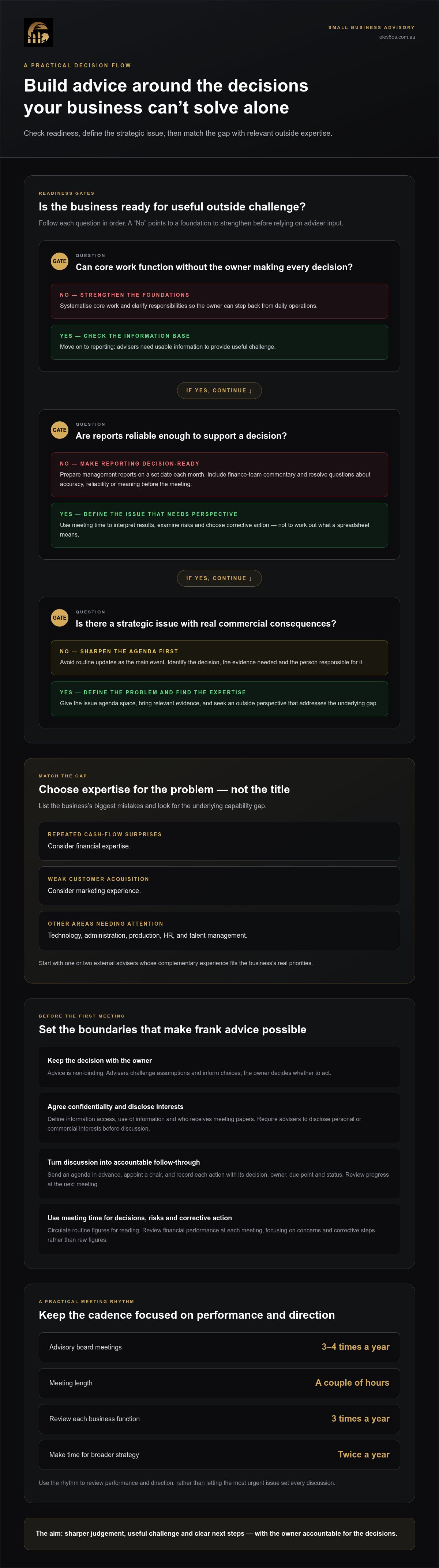
Choose people with complementary expertise that matches the problems you need to solve. List the business’s biggest mistakes, then look for the underlying gaps. Repeated cash-flow surprises may point to a need for financial expertise; weak customer acquisition may call for marketing experience. Technology, administration, production, HR and talent management may also need attention. Combining internal knowledge with independent perspectives can expose risks that people inside the business have come to accept as normal.
Keep discussion tied to evidence. Ask advisers to review departmental performance, concerns and resource needs, then examine the KPIs that show whether corrective action is working. A board can also test strategy against milestones: what has progressed, what has stalled, and whether the strategy or its development process needs to change. The NSW Government’s proposed small business advisory service is intended to provide specialist advice to help owners build practical skills for running and growing their businesses. That support addresses capability; an advisory board can focus on the specific strategic questions facing a business.
Readiness starts with the owner’s ability to step back from daily operations. Check whether core work is systematised well enough for the business to function without the owner making every decision. If reporting is unreliable or responsibilities are unclear, strengthen those foundations first. Advisers need usable information to provide useful challenge. A board of advice generally meets three to four times a year for a couple of hours. Review each business function three times a year and make time twice a year for broader strategy. These rhythms keep discussions focused on performance and direction, rather than whichever issue feels most urgent that week.
2. Rules of engagement, including confidentiality and accountability
Set expectations before the first meeting, while they’re still easy to align. Advisory board members should speak honestly, protect confidential information and put the business’s success ahead of personal interests. Define what information they can access, how they may use it and who can receive meeting papers. Require an adviser to disclose any personal or commercial interest in a decision before discussion begins. Clear boundaries support frank debate while keeping decision-making with the owner.
Give each meeting a practical structure. Send the agenda in advance, connect each item to a current challenge or opportunity, and appoint a chair to keep discussion moving. Separate information from decisions: circulate routine figures for reading, then use meeting time for questions, risks and corrective action. For example, a cash-flow concern should identify the decision needed, the person responsible and the evidence required to assess progress.
Prepare management reports on a set date each month. Give advisers enough time to review them before meetings, and address questions about the financial data’s accuracy, reliability or meaning in advance. Include finance-team commentary so non-accountants can understand the figures. That way, meeting time is spent interpreting results and choosing actions, not working out what a spreadsheet means.
Track every agreed action in a shared record. Note the decision, owner, due point and status, then review progress at the next meeting. If a task is incomplete, record the obstacle and clarify the next action. This makes accountability practical rather than vague. Keep minutes focused on decisions and follow-up, and store them with the relevant reports so the board can trace the reasoning behind a choice.
Review financial performance at each meeting, focusing on concerns and corrective steps rather than analysing raw figures. Schedule reviews of annual financials and tax returns, annual forecasts, the accountant’s tax-planning recommendations, and any dividends or distributions requiring authorisation. An accountant can help with company structures, financial reporting, budgeting, cash flow and understanding the business’s financial position. Give the accountant’s commentary a defined place in the reporting process, especially when a proposed decision depends on available cash or forecast assumptions.
These disciplines work only when leaders apply them consistently. A structured strategic alignment approach can help connect meeting decisions, leadership accountability and business priorities.
3. Selecting and inducting external members
Choose an adviser to fill a defined gap, not for an impressive title. Start with the strategic issues on your agenda, then identify the experience needed to challenge your assumptions. A business facing inconsistent cash flow may need someone who can scrutinise forecasts; one preparing to scale may need operational experience. Small businesses can start with one or two outside advisers, keeping the structure focused while they learn how discussion leads to progress.
Set a selection process before approaching candidates. Define the board’s objectives, scope and expected contribution, then assess each person against those needs. Look for relevant experience, independent judgement and the ability to explain difficult points plainly. A strong adviser doesn’t simply agree with the owner. They test assumptions, identify missing evidence and keep discussion anchored to the business’s priorities.
Independence matters. Include external perspectives that aren’t merely extensions of the owner’s existing network or internal leadership team. Ask candidates how they would handle disagreement, a missed target or a decision that conflicts with their own interests. Their answers reveal how they approach challenge and whether they can keep the business’s interests at the centre of discussion.
Before engaging someone, define what help the business needs, what the person will contribute and how that support could benefit the business. Be specific. If an expansion decision is delayed, identify whether you need a market assessment, financial scrutiny or operational insight. Clarify preparation, meeting contributions, confidentiality expectations and how agreed actions will be followed up. This makes the role clear for everyone.
Induction turns selection into a working relationship. Give each external member a concise brief on the business model, priorities, key risks and current strategic questions. Share relevant management reports and explain their terminology. Make clear that the board provides advice while the owner retains decision-making authority. Invite advisers to flag gaps in the papers before their first meeting, so discussion starts with substance rather than basic orientation.
Use the early meetings to test the structure. After each discussion, ask whether the adviser provided useful challenge, understood the business’s constraints and helped sharpen the next action. Record agreed actions and revisit progress at the following meeting. If their contribution stays broad or detached from the objectives, adjust the agenda or reset expectations. A deliberate induction gives external members enough context to contribute without letting the advisory role drift into day-to-day management.
4. Board confidentiality and trust
Trust starts with a clear agreement about handling business information. Before advisers receive a forecast, customer complaint or staffing update, define what they may see and who may access it. Members should maintain confidentiality and prioritise the success of the business over their own interests. Put expectations in writing and discuss practical examples. A board paper may contain commercially sensitive figures; a customer case may identify someone even without naming them.
Set rules for handling information as well as discussing it. Explain how members should store meeting papers, whether they may share them and what to do with copies after a meeting. Limit access to people who need the material for the advisory role. For example, a draft supplier negotiation may need a smaller circulation list than a general performance summary. Clear handling rules reduce accidental disclosure and give owners a sound basis for sharing the details advisers need.
Confidentiality should support frank discussion, not suppress uncomfortable facts. Owners should present missed targets, cash-flow pressure and operational mistakes plainly. Advisers can’t offer useful insight if information has been softened to protect appearances. In turn, members should challenge the issue, not attack the person who raised it. A productive meeting makes room for direct questions, explains the evidence behind a concern and records the decision without turning disagreement into personal conflict.
Build trust through consistent conduct. The chair can set the tone by inviting a dissenting view before a decision is settled, then giving the adviser room to explain their reasoning. If an adviser has a personal or commercial interest in an agenda item, ask them to disclose it before discussion. Agree how to handle the situation, including whether the member contributes or steps back. This keeps the process transparent and protects confidence in the advice.
Close the loop after each meeting. Record key decisions and actions, limit circulation of sensitive minutes, and follow up on commitments at the next discussion. If an adviser flags inaccurate information, correct the record and clarify which version is current. Owners earn trust by acting on agreed safeguards, not just stating them. Advisers earn trust by respecting boundaries, speaking honestly and putting the business’s interests first. Consistent behaviour is the test.
5. How do I assess whether a potential board adviser is a good fit for my business?
Assess fit against the business problem, not the adviser’s reputation. Write a short brief naming the decision you need help with, the evidence available and the outcome you’re aiming for. For example, if delayed orders are eroding customer confidence, ask how the adviser would investigate capacity, scheduling and delivery performance. Their approach should connect relevant experience to your operating conditions, not drift into a generic account of past success.
Test their thinking with a real scenario. Explain a current challenge, such as a planned expansion that depends on reliable cash flow, then ask what they’d need to understand before advising. A strong response identifies assumptions, missing information and trade-offs. Be cautious of an immediate prescription that ignores your constraints. You need someone who can sharpen the decision, not take control or simply endorse the owner’s preferred answer.
Ask how they handle disagreement. Describe a decision where the leadership team holds different views, then invite the candidate to explain how they would contribute. Look for direct questions, clear reasoning and respect for the people responsible for delivery. Ask how they respond when a recommendation isn’t adopted. An adviser who can challenge an assumption without making debate personal is more likely to help the board examine difficult issues productively.
Check that their expertise fits the work ahead. A finance specialist may add little to a customer-retention problem unless they can connect financial evidence to customer behaviour. A marketing adviser should examine the commercial issue behind a campaign, not just discuss creative preferences. Ask the candidate how they would interpret a relevant management report, identify the decision it informs and separate useful indicators from distracting detail.
Look for independence and sound judgement. Ask about interests that could intersect with your business, including existing commercial relationships or work they do elsewhere. Discuss how they would disclose a conflict before contributing to a related decision. Test their understanding of the advisory role: they offer insight, while the owner remains accountable for decisions and execution. A mismatch can undermine trust, even when the adviser has strong technical knowledge.
Finally, set clear signs of useful contribution. After an advisory discussion, assess whether the candidate helped clarify the issue, exposed a material risk or strengthened the next action. A suitable adviser doesn’t need to agree with you; they need to make the business’s reasoning and choices more robust. Build a stronger strategic advisory framework around the decisions your business needs to make.
Elev8 Strategic Partners: Strategic Business Partner Programme
Elev8 Strategic Partners’ Strategic Business Partner Programme provides structured strategic alignment and leadership support when business decisions need more discipline and direction. It’s a natural next step if you’ve clarified the issues your business faces but need a stronger framework for acting on them.
For leaders seeking collaborative insight and accountability, The Elev8 Boardroom is an executive advisory group focused on high-level decision-making. The Foundations Toolkit is another available offering for strengthening your business foundations.
Choose the support that fits the work ahead: aligning leadership around priorities, sharpening decision-making or building stronger foundations. To discuss your next step, visit elev8os.com.au.
Build the next stage with deliberate advice
The next step is to decide what kind of support will help you move from discussion to disciplined action. Choosing how to get board-level advice for a small business starts with matching the support to the work ahead, whether that means aligning leadership, strengthening decision-making or building firmer foundations.
Elev8 Strategic Partners offers the Strategic Business Partner Programme, The Elev8 Boardroom and the Foundations Toolkit. Each provides a different path for leaders seeking strategic alignment, collaborative insight or stronger business foundations. The right starting point is the one that addresses the pressure your business needs to resolve now.
Don’t let another planning cycle pass without turning priorities into clear action. Contact Elev8 Strategic Partners to discuss the next step for your business. Build with purpose, and make the decisions ahead count.
Frequently Asked Questions
What Should A Small Business Board Of Advice Be Talking About?
Focus discussion on choices that could materially change the business’s direction or resilience. For example, consider whether relying on one major supplier creates an unacceptable disruption risk, or whether succession planning identifies someone ready to take responsibility. Ask advisers to challenge the assumptions behind each choice, identify what evidence could change the decision and clarify what the owner needs to decide next. Keep operational updates brief unless they reveal a strategic risk.
Why are advisory boards useful for SMEs?
An advisory board gives small and medium-sized business owners perspectives they may not have internally. A retailer considering a wholesale channel, for instance, can test assumptions about customer demand, margins and fulfilment before committing resources. External members can challenge familiar habits and help leaders see trade-offs earlier. The value comes from applying relevant experience to a real decision, not collecting impressive biographies or meeting for its own sake.
Do Board of Advice members get remunerated?
Advisers may contribute without payment or receive a fixed hourly rate or retainer. Depending on the arrangement and their willingness to contribute, some may offer a couple of hours once a quarter without payment. Agree the basis before the first meeting, including preparation time, expected input and any expenses. Clear terms prevent payment assumptions from disrupting the relationship or the board’s work.
What board-level advisory options are available to small businesses in Australia?
Australian businesses can consider an independent advisory board, a peer advisory group or specialist input for a defined issue. An accountant can help owners understand financial position and cash flow; a lawyer can examine contracts and legal obligations. Elev8 Strategic Partners offers the Strategic Business Partner Programme, The Elev8 Boardroom and the Foundations Toolkit. Choose according to whether you need strategic alignment, collaborative decision-making or practical business frameworks.
How can an Australian small business find an experienced board adviser or mentor?
Write a brief naming the challenge, the expertise needed and the decisions the adviser would help examine. Ask candidates how they’d approach a relevant scenario, such as entering a new sales channel, and what information they’d need. Across Coffs Harbour, Tamworth, Newcastle, Armidale, Port Macquarie and Moree, local business networks can help you find relevant experience. To get board-level advice for a small business, assess judgement and fit, not titles alone.
What does a board adviser do, and how is that different from a director or consultant?
A board adviser gives non-binding advice, and the business owner decides whether to adopt it. An adviser isn’t necessarily a registered director and can’t make decisions that bind the company. A formal director has governance responsibilities and may make decisions for the company under its governance arrangements. A consultant is usually engaged for defined professional work. Set the adviser’s scope clearly so strategic discussion doesn’t become a confused mix of governance and delivery.
How much does a non-executive director or board adviser cost for a small business in Australia?
Payment depends on the role’s scope, expertise, preparation and expected contribution. A board adviser may contribute unpaid time, charge a fixed hourly rate or work on a retainer; arrangements for non-executive directors are a separate consideration. Set out responsibilities and the payment basis before appointing someone. Consider the time needed to prepare reports and support productive meetings, not only the amount paid for attendance.
What Australian government programs offer small-business mentoring or board advice?
For businesses in New South Wales, the NSW Government’s proposed small business advisory service is intended to provide specialist advice that helps owners build practical skills to run and grow their businesses. Small businesses can also build knowledge through low-cost workshops, practical information guides and a free business advisory service. These options can help owners clarify what expertise they need before engaging an adviser or forming a board.