
Leadership Team Accountability Framework: A Practical 2026 Checklist
What if your leadership team’s missed commitments aren’t a motivation problem, but a design problem? A leadership team accountability framework works when ownership, decision rights and follow-through are built into the same operating system.
If responsibilities overlap, decisions leave meetings without a clear owner, or every difficult call lands back with the founder, the problem is visible. More meetings won’t fix it. Leaders need clear commitments, measurable outcomes and a consistent way to raise risks before they become costly delays.
This practical 2026 checklist shows you how to define who owns what, set decision boundaries and track commitments against outcomes. You’ll also learn how to address a missed commitment constructively by finding its cause rather than defaulting to blame. We’ll cover a leadership rhythm that keeps decisions moving and gives the team earlier visibility of execution risks. The aim is a system leaders can run consistently, so the founder no longer has to carry every decision.
Key Takeaways
- Build a leadership team accountability framework around one accountable role for each priority, clear decision rights and evidence of completion.
- Set the outcome, review point and dependencies before work starts, so commitments can be assessed rather than interpreted.
- Choose tools for the job: role-clarity tools, decision-right models and performance-setting methods solve different problems.
- Use a repeatable checklist to review progress, surface risks, escalate blockers and learn from missed commitments across distributed teams.
- Elev8 Strategic Partners’ Strategic Operations Engagement embeds execution inside established businesses, typically for 6-18 months, and concludes when agreed outcomes are delivered and the business is positioned to grow without Elev8 Strategic Partners. Success is measured by outcomes, not engagement length. Elev8 Strategic Partners tells clients what they need to hear and allows only one active client per industry vertical at a time.
What a leadership team accountability framework fixes, and what it is not
A leadership team accountability framework is an agreed system for assigning ownership, setting decision rights, measuring outcomes and following through. It gives each leadership priority a clear path from decision to completed work, instead of leaving progress to memory or goodwill.
Leadership accountability means owning an agreed result and making progress, risks and blockers visible.
That’s not the same as blame. A missed commitment is a signal to examine what happened: Was the outcome clear? Did the owner have the authority, capacity and support to deliver? Were dependencies resolved? Address those conditions before concluding that an individual failed. This distinction reflects the broader meaning of Understanding Accountability in Leadership, where accountability concerns answerability for actions and outcomes, not automatic fault.
Without a shared system, leadership responsibilities can overlap or disappear between roles. Two executives may start the same work, while a decision that belongs to neither sits untouched. The founder then gets pulled in to settle routine questions. The cost is more than delay: the team loses a reliable view of what’s progressing and what’s at risk.
Accountability versus responsibility: why the distinction matters
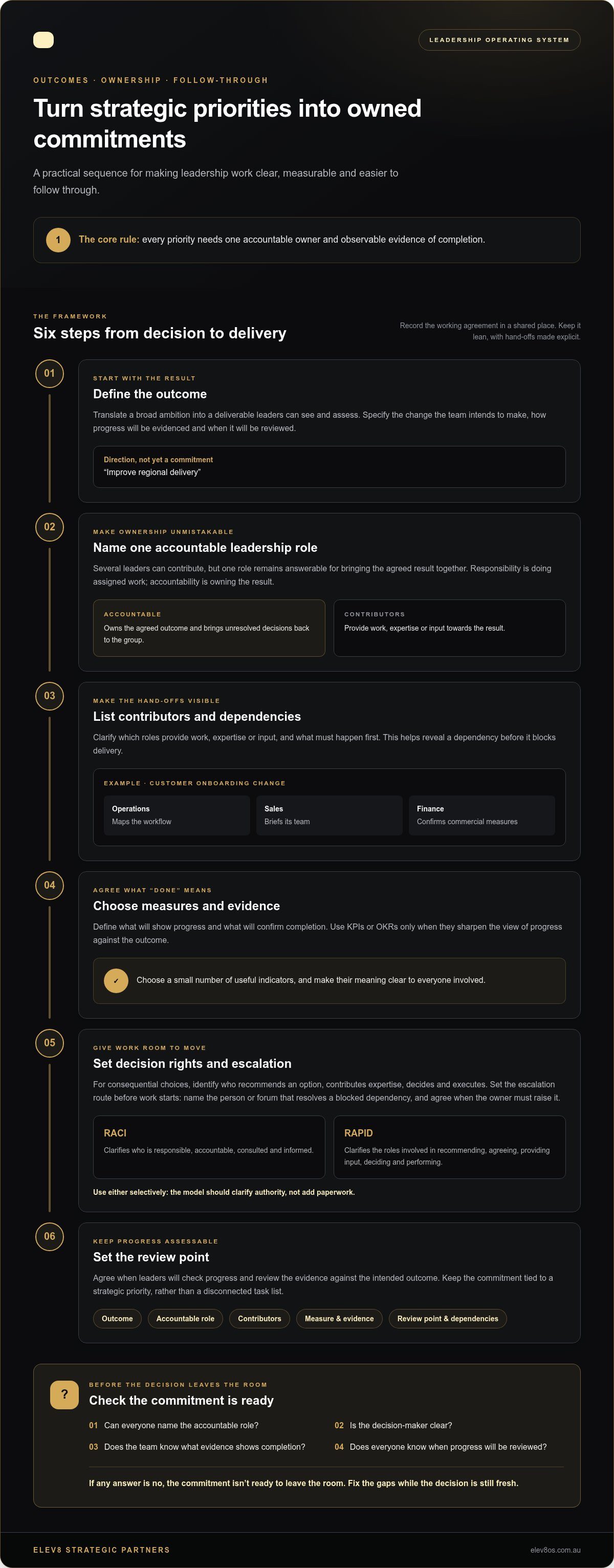
Responsibility is doing assigned work. Accountability is owning the agreed result. Several leaders can contribute, but one role must remain answerable for bringing the outcome together. For example, a leadership team may agree to change its customer onboarding process. Operations may map the workflow, Sales may brief its team and Finance may confirm the commercial measures. One named executive owns the overall outcome and brings unresolved decisions back to the group. If a dependency slips, the first question is what needs clearing, not who deserves blame.
Signs the leadership team lacks a working framework
Look for patterns, not one-off misses. The same decision returns to the agenda because nobody owns the next step. Actions have no due point or evidence of completion. Leaders report meetings held and tasks started, yet the agreed result remains unfinished. If the founder repeatedly has to clarify authority, break ties or chase updates, that’s a structural signal. The team needs clearer ownership, not another round of reminders.
Use a short diagnostic after each leadership decision. Can everyone name the accountable role? Is the decision-maker clear? Does the team know what evidence will show the outcome is complete, and when progress will be reviewed? If any answer is no, the commitment isn’t ready to leave the room. Fix the gaps while the decision is still fresh.
Build the leadership accountability framework around outcomes and ownership
A leadership team accountability framework must connect the business priority to the work that will deliver it. Start with the outcome, then assign one accountable leadership role. From there, define what completion looks like, when progress will be reviewed and which dependencies could block delivery.
Every priority needs one accountable owner and observable evidence of completion. Without both, a commitment is hard to track and easy to reinterpret.
Turn strategic priorities into owned commitments
Translate broad ambitions into deliverables the leadership team can see and assess. “Improve regional delivery” is a direction, not a commitment. Specify the change the team intends to make, the evidence that will demonstrate progress and the point at which leaders will review it. Keep the commitment tied to a strategic priority, not a disconnected task list.
Record the working agreement in a shared place. Keep it lean, but make the hand-offs explicit:
- Outcome: What business result is this priority meant to produce?
- Accountable role: Who owns the result, even when others do the work?
- Contributors: Which roles provide work, expertise or input?
- Measure and evidence: What will show progress, and what will confirm completion?
- Review point and dependencies: When will leaders check progress, and what must happen first?
Use KPIs or OKRs only when they sharpen the view of progress against the outcome. A measure that tracks activity but says nothing about whether the intended change is happening adds administration, not control. Choose a small number of useful indicators and make their meaning clear to everyone involved.
Make decision rights and escalation explicit
Ownership alone won’t move work if nobody knows who can make the next decision. For consequential choices, identify who recommends an option, who contributes expertise, who decides and who executes. A RACI model clarifies who is responsible, accountable, consulted and informed. RAPID clarifies the roles involved in recommending, agreeing, providing input, deciding and performing. Use either selectively. The model should make authority clearer, not create another layer of paperwork.
Set the escalation route before work starts. Name the person or forum that resolves a blocked dependency, and agree when the owner must raise it. Escalate when a decision is outside the owner’s authority, a dependency threatens the agreed outcome or new information changes the assumptions. Bring the issue forward with its impact and a recommended next step. That gives decision-makers something to resolve, not a vague status update.
When strategy, operational measures and execution stay connected, leaders can see where a commitment is stuck and act before it quietly drops off the agenda. For established founder-led businesses that need commitments to become operating changes, embedded operational execution can help build accountability into the work itself.
Choose accountability tools that fit the leadership team, not the other way around
A leadership team accountability framework can include role maps, decision models and performance measures, but more tools don’t automatically create more clarity. Start by naming the friction: unclear ownership, slow decisions or weak visibility of progress. Then choose the simplest method that addresses it.
Choose the tool last; define the accountability problem first. A role-clarity tool won’t speed up a decision if nobody has authority to make it. A scorecard won’t fix competing expectations if leaders haven’t agreed on the outcome.
| Tool | Question answered | Useful application | Limitation |
|---|---|---|---|
| RACI | Who is responsible, accountable, consulted and informed? | Mapping roles across shared work | Doesn’t, by itself, settle a contested decision |
| RAPID | Who recommends, agrees, gives input, decides and performs? | Clarifying participation in consequential decisions | Can add steps if used for routine choices |
| KPIs | Which operating measures need regular monitoring? | Tracking the health of important business activity | Measures can reward activity without proving progress |
| OKRs | What objective matters, and what results indicate progress? | Organising measurable work around a priority | Too many objectives can scatter attention |
RACI and RAPID: clarify roles or decision flow
RACI maps responsibility, accountability, consultation and information across work. Use it when leaders are unsure who owns a contribution or needs to be involved. RAPID clarifies participation in a consequential decision, from recommendation through decision and execution. Use it when a choice keeps circling because input and authority are tangled. Neither model replaces judgement. Keep the map focused on work where ambiguity creates real delay or risk.
KPIs and OKRs: measure progress without creating noise
KPIs monitor important operating measures; OKRs organise an objective and the results that indicate progress towards it. Select only the measures that help leaders assess the priorities in scope. For example, counting planning sessions may show activity, but not whether the agreed operational change has taken hold. Ask what each measure will help the team decide, then remove any that don’t answer that question.
Resist the urge to stack methods. Using RACI, RAPID and a scorecard for the same commitment can create duplicate tracking and more places for updates to drift. Match the tool to the gap, explain how the team will use it, then check whether it has made ownership or decisions clearer. If not, simplify. The best tool is the one that helps leaders act on the agreed outcome, not the one with the most elaborate template.
Use this leadership accountability checklist to make follow-through routine
A leadership team accountability framework only holds if leaders use it between planning sessions, not just when a commitment is already late. Run the same sequence at each review. For distributed teams across regional and metropolitan Australia, keep the commitment record in one shared place and make updates available to leaders who can’t attend the same meeting.
Before the leadership meeting: prepare accountable commitments
Review each previous commitment against its agreed outcome. Bring evidence, not just a status label. If work is blocked, state the cause, likely impact and decision needed. Before adding a new commitment, confirm there’s a clear owner, a measure, evidence of completion and a review point. If any piece is missing, tighten the commitment before it enters the team’s workload.
Use this checklist in order:
- Select the priority. Agree which business outcome matters most now, and what work will move it forward.
- Name the owner. Assign one accountable leadership role. Record contributors separately so shared work doesn’t become shared, and therefore unclear, ownership.
- Define completion. Set the measure and observable evidence that will show whether the outcome has been delivered.
- Check the conditions. Record dependencies, decision rights and capacity constraints. Identify what must happen first and who can resolve a blocker.
- Set the review point. Agree when progress will be checked and where updates will be recorded. Give regional and metropolitan leaders the same view of commitments, decisions and evidence, whether they join live or contribute asynchronously.
- Review progress and misses. Compare evidence with the agreed outcome. If a commitment slipped, identify whether the cause was capacity, authority, a dependency or a changed priority.
- Escalate and learn. Decide what action, resource or decision will unblock progress. If the same barrier recurs, change the operating conditions instead of sending another reminder.
During and after the review: resolve misses without blame
Ask direct questions: What changed? What’s blocked? Which decision or resource would restore progress? A missed commitment is a fact to investigate, not proof of poor intent. But repeated misses without a clear cause or corrective action are a signal that the system needs attention.
Before the meeting ends, record the revised action, its accountable role and the next review point. Avoid “the team will sort it” as an action. A group can contribute, but one role must own the next move. Share the updated record promptly so leaders in other locations aren’t relying on hallway conversations or incomplete notes.
If commitments keep failing because authority, dependencies or priorities remain unresolved, address the operating constraint directly. A reminder can prompt action once; it can’t repair a broken hand-off or unclear decision route.
For a practical diagnosis of your current operating constraints, book a 30-45 minute video diagnostic conversation. It’s not a sales call, and there’s no pitch deck or slide presentation. You can also explore Elev8’s embedded execution approach.
How Elev8 embeds leadership accountability into execution
A leadership team accountability framework can be well designed and still fail if it stays in a document. Elev8’s Strategic Operations Engagement embeds a Strategic Operations Engineer inside an established founder-led business to build operating structure and put agreed changes into practice. The work happens from inside the business, not from the sidelines.
Embedded accountability: build the system from inside the business
Embedded execution connects strategic priorities to the way leaders plan, decide and deliver. The SOE Framework is built around Strategy, Operations, Execution: establish direction, shape the operating system around it, then put the work into motion. That means working with the business as changes take hold, rather than handing over a framework and leaving the leadership team to translate it alone.
Josh Lawrence is the direct access point for the Strategic Operations Engagement. The work is defined by agreed outcomes, not tenure. Engagements typically run 6-18 months and conclude when the agreed outcomes are delivered and the business is positioned to grow without Elev8. Success is measured by outcomes, not engagement length. The aim is a business that can sustain its operating rhythm without Elev8 remaining embedded.
This approach requires honest conversations. Elev8 tells clients what they need to hear, not simply what they want to hear. Elev8 also allows only one active client per industry vertical at a time. The standard is focused execution, not another set of recommendations sitting beside the work.
What happens in the Discovery Call
The first step is a 30-45 minute video diagnostic conversation, not a sales call. There’s no pitch deck or slide presentation. The conversation examines the current state of the business, the founder’s goals, what’s already been tried and the operating constraints affecting progress. It’s a chance to diagnose fit and understand where execution is getting caught, rather than jump to a packaged answer.
If the Strategic Operations Engagement is a fit, its pricing is discussed during the Discovery Call. No pricing is discussed before that conversation. The point is to establish the business context and the outcomes required, so any next step is grounded in the actual operating challenge.
Leadership commitments that repeatedly fail to become operating changes usually need more than another document or reminder. They need ownership, structure and execution built into the business. If that’s the constraint you’re facing, Book a diagnostic Discovery Call.
Make the next leadership commitment the test
Put the framework to work on one priority that matters now. At the next leadership meeting, ask the team to name the decision that keeps stalling, the commitment that keeps slipping or the risk that only the founder can see. Use that real pressure point to test whether ownership and authority are clear enough to move work forward.
A leadership team accountability framework isn’t finished when the roles are written down. It earns its place when leaders use it to make decisions, expose blockers early and adjust how the business operates. Start with one practical change, review whether it shifted execution, then build from what the team learns. Keep the standard high and the process usable.
If leadership commitments still aren’t translating into operating change, Elev8 works inside established businesses to build execution capability. Explore Elev8’s embedded execution approach, then consider what your team needs to put in place next. With clear ownership and consistent follow-through, your business can keep moving without every decision resting with the founder. To discuss your operating constraints, book a diagnostic Discovery Call.
Frequently Asked Questions
What is a leadership team accountability framework?
A leadership team accountability framework gives executives a common reference point when priorities compete. It helps reveal whether leaders have agreed what success looks like before people commit time and resources. For example, if Sales and Operations both need the same specialist, leaders can use the framework to settle priorities and trade-offs explicitly, rather than letting the conflict surface later as missed delivery.
How do you hold a leadership team accountable without creating a blame culture?
Make it safe to raise bad news early, and make it normal to do so. Leaders can model this by acknowledging their own part when a commitment stalls, such as setting an unrealistic deadline or failing to secure a decision. Then focus the discussion on recovery: what can still be delivered, what needs to change and who will communicate the revised expectation. Candour and fairness must apply to senior leaders too.
What should a leadership accountability framework include?
Include enough structure to resolve real friction, not every possible scenario. A useful test is whether a leader can explain how a priority connects to a business result, what decisions are reserved for the leadership group and how changed assumptions are handled. Trial the framework on one live priority first. If leaders need a separate spreadsheet, meeting or approval chain to use it, remove the unnecessary layer.
How often should a leadership team review accountability?
Choose a cadence that matches the pace of the work, then keep it predictable. A stable priority may need less frequent discussion than a time-sensitive operational change. Add an exception check when a key assumption shifts, a dependency fails or a decision can’t wait for the next scheduled review. For teams across Tamworth, Newcastle, Armidale, Coffs Harbour, Port Macquarie and Moree, a shared written record helps keep the same decisions visible across locations.
What should leaders do when a team member misses a commitment?
Speak with the person directly before turning the miss into a wider performance judgement. Confirm what was agreed and what they understood the outcome to mean. Then ask what support or decision would make recovery possible, and agree a realistic next checkpoint. If delivery can’t be recovered, reset expectations with affected teams promptly. A separate review can then examine whether the same work design or hand-off is causing repeated slippage.
Can accountability be shared across a leadership team?
Collaboration can be shared; the coordination of a defined outcome still needs a clear lead. For a cross-functional objective, agree how the group will resolve competing recommendations before they arise, such as which executive has final authority or which forum makes the call. Also name who communicates the decision to affected teams. This prevents a group discussion from being mistaken for a decision and keeps contributors aligned after the meeting.