
How to Move Daily Operations Beyond the Business Owner
A business that relies on its owner for every decision cannot operate independently. To build a business that runs without you, document repeatable work, give capable leaders clear decision-making authority, and choose an operating model that can grow without adding you to every process. The goal isn’t to disappear; it’s to make day-to-day operations reliable without your constant involvement.
You already know delegation alone won’t solve the problem. If every task still comes back to you for approval, you haven’t removed the bottleneck; you’ve shifted it. The real change comes from clear systems, defined roles and leaders who know what they’re responsible for.
This guide breaks the work into practical steps: identify where the business depends on you, document the processes others need to follow, strengthen your team’s decision-making, and assess whether your business model supports growth. You’ll also learn to step back gradually and stay informed through useful measures, instead of getting involved in every detail.
Key Takeaways
- Map the decisions and customer relationships that still depend on you to expose the business’s real bottlenecks.
- Give each role clear ownership, decision boundaries and escalation points, not just a list of tasks.
- Build practical procedures around repeatable work, then have the people doing that work keep the documentation current.
- Assess whether your revenue model can grow without adding the same amount of owner involvement to every sale.
- Test operational independence in stages, using regular reports to spot problems without stepping back into every decision.
How owner dependence can affect business value
Start by identifying where decisions, customer trust and essential knowledge still depend on you. Then transfer responsibility for those functions into clearly defined roles, so the business can operate without your daily intervention.
-
Assess owner dependence and business value
List the decisions that stall when you’re unavailable, from pricing exceptions to supplier-payment approvals. Then identify which customers rely on your personal reputation or expertise. Freelance and consulting businesses can be harder to run independently when clients are buying access to the owner rather than a service others can deliver.
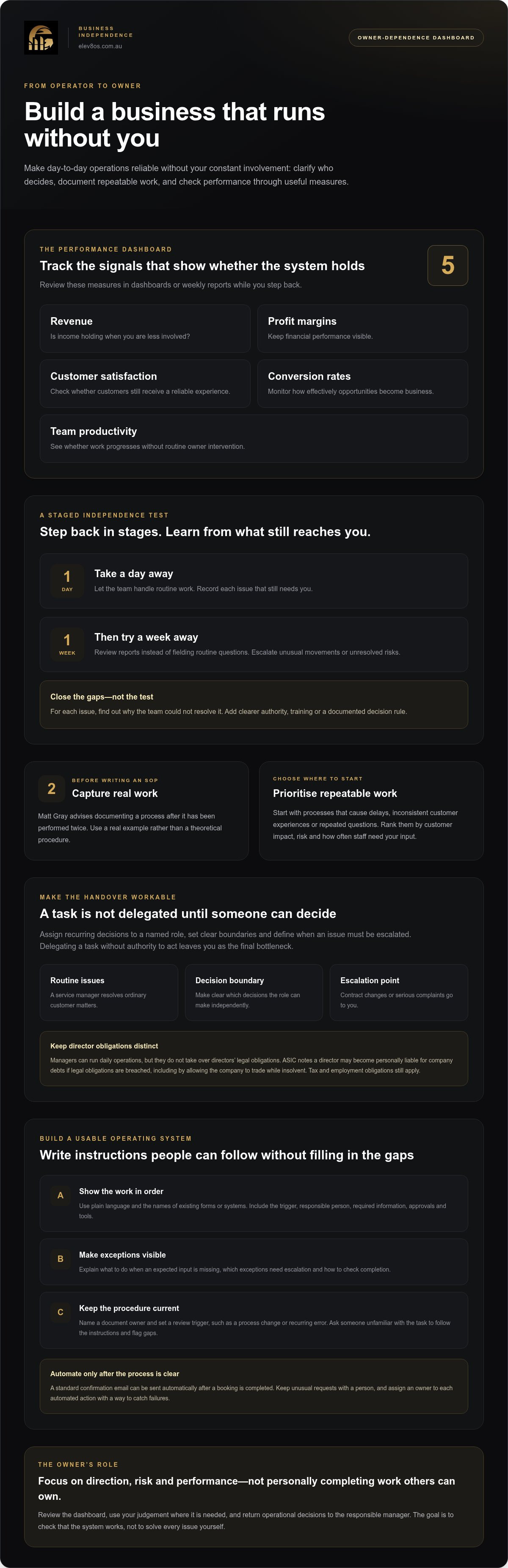
Check whether a capable team member can maintain each relationship and deliver the same work. Track revenue, profit margins, customer satisfaction, conversion rates and team productivity using dashboards or weekly reports. These measures show whether performance holds when you step back, rather than leaving you to rely on a general impression of how the business is going.
-
Delegate ownership and decision-making
Assign each recurring decision to a named role, with clear boundaries and an escalation point. For example, a service manager might resolve routine customer issues while escalating contract changes or serious complaints to you. Delegating a task without the authority to act leaves you as the final bottleneck.
Managers can run daily operations, but they don’t take over directors’ legal obligations. A director may become personally liable for company debts if legal obligations are breached, including by allowing the company to trade while insolvent, according to the Australian Securities and Investments Commission. Tax and employment obligations still apply, so assign responsibility for relevant records, payments and staff matters.
-
Reduce reliance on the owner
Stop being the only person with critical knowledge, key relationships or approval authority. Name a deputy for each essential function, then give them the access, information and decision-making rights to act. If a customer only deals with you, bring the account lead into regular conversations before stepping back.
Set a staged test: take a day away, then try a week away while reviewing reports instead of fielding routine questions. Record each issue that still reaches you, work out why the team couldn’t resolve it, and close the gap with clearer authority, training or a documented decision rule.
-
Shift from operator to business owner
Reserve your attention for direction, risk and performance, rather than personally completing work others can own. Each week, review the dashboard, decide which problems need your judgement, and return operational decisions to the responsible manager. Your role shifts from solving every issue to checking that the system works.
Stepping away carries risks: missed warnings or unclear authority can disrupt customers, cash flow or staff decisions. Reduce those risks with staged absences, named deputies and weekly reporting on revenue, profit margins, customer satisfaction, conversion rates and team productivity. Keep financial controls visible, and escalate unusual movements or unresolved risks promptly.
Documenting processes with SOPs and checklists
Turn repeatable work into instructions another team member can follow without asking you to fill in the gaps. Start with processes that cause delays, inconsistent customer experiences or repeated questions for you.
-
Choose processes to document first
List recurring tasks that stall when you’re unavailable, then rank them by customer impact, risk and how often staff need your input. Start with a routine handover, order fulfilment or customer complaint response, not an obscure task used once a year. Matt Gray advises documenting a process after it has been performed twice. That gives you a real example to capture instead of a theoretical procedure.
- Note the trigger that starts the work and the person responsible.
- Record the information, approvals and tools needed to finish it.
- Identify exceptions that genuinely need escalation.
-
Document repeatable processes as SOPs
Write the steps in the order the work happens, using plain language and the names of the forms or systems staff already use. For example, a customer-onboarding SOP can show who receives the signed agreement, creates the account and schedules the first check-in. Add a checklist for steps that must never be missed, and a short video walkthrough when a screen-based task is difficult to describe.
Name a document owner who will keep each instruction up to date. Ask a team member unfamiliar with the process to follow it. Their questions will expose missing steps, unexplained shorthand or decisions that still depend on you.
- Include the purpose, owner, sequence and completion check.
- Show what to do when an expected input is missing.
- Set a review trigger, such as a process change or recurring error.
-
Follow established processes
Make the current SOP easy to find where the work happens, then train the people responsible for using it. When a staff member proposes an exception, record the reason and decide whether the process needs updating. Don’t let one-off workarounds become invisible rules: they cause inconsistent results and make it harder to hand work between people.
Automate repetitive steps only after clarifying the process. For example, a standard confirmation email can go out automatically after a booking is completed, while unusual requests stay with a person. Assign an owner to each automated action, with a way to catch failures and a clear route for exceptions.
- Review completed work against the checklist.
- Ask staff to update instructions when the actual work changes.
- Track repeated errors and revise the process at its source.
If documentation exposes wider gaps in ownership or priorities, strategic alignment support can help connect operating practices with business direction.
Building a leadership team
Develop leaders who can make sound decisions, explain the business direction and help others grow. A title alone won’t remove you as the bottleneck.
- Define the leadership role before recruiting. List the decisions managers must own, such as resolving customer escalations, setting team priorities or approving routine spending. Separate those from decisions requiring director oversight. The practical answer to how to build a business that runs without you starts with a clear mandate for every leadership role.
Assess candidates against real situations. Ask how they would respond to a missed delivery, a team conflict or a sudden change in demand. Look for people who explain their reasoning, take responsibility and know when to escalate. A capable leader must also be able to train others, not just handle difficult work personally.
- Give leaders authority in the room where decisions are made. Invite the relevant manager to contribute before a decision is settled, rather than holding a separate meeting afterwards. If the operations lead owns delivery, include them when discussing capacity, customer commitments and workflow changes. A decision made without the accountable leader creates confusion and weakens ownership.
Set clear boundaries alongside that authority. For example, a team leader might resolve a roster gap within agreed staffing limits, while a major change to service commitments comes to you. Document the boundary and explain its purpose. Staff need to know which decisions they can make without permission.
- Train your leadership team on the long-term direction and the commercial facts behind it. Explain the priorities, the customers the business serves and how operational choices affect profit and loss. Share relevant operational and salary information openly enough for leaders to understand the trade-offs they manage.
Over-communicate the reasoning behind important decisions. If you’re prioritising retention over short-term sales, explain that choice and its implications. Leaders can then apply the same logic when you’re absent, instead of guessing what you would prefer. Ask them to summarise the direction in their own words and apply it to a current decision.
- Set a consistent standard for preparation and participation. Expect every leader to arrive ready with relevant figures, risks and proposed actions. The trust accelerator for preparedness calls for 100% preparedness and participation. Use that standard in each leadership meeting, not just when a major problem appears.
For each action, name the owner, timeframe and dependencies. The Australian Government Department of Health and Aged Care recommends identifying these elements for delegated actions. Close each meeting by confirming who will act, what must happen first and when progress will be reviewed.
- Use regular check-ins and a small set of KPIs to assess performance without taking decisions back. Review revenue, profit margins, customer satisfaction, conversion rates and team productivity. Ask the responsible leader to explain a change, identify its cause and propose the next action. You retain visibility; the manager retains ownership.
If you’re deciding how to build a business that runs without you, assess whether management capacity matches the work you plan to delegate. Hiring a manager in Australia has no single fixed cost; it depends on role scope, seniority, location and employment arrangements. Outsourced operations pricing depends on workload, deliverables and service boundaries, with the price provided after a quote request. Define those requirements before choosing the structure, so the expense buys decision-making capacity rather than another layer of approvals.
Choosing a scalable, system-friendly business model
Choose a model where growth doesn’t depend on you personally delivering every sale. Your model determines the workload your systems and team need to handle.
- Trace a customer’s journey from first enquiry to completed delivery. Record your role at each stage, including selling, approving exceptions and checking quality. Your choice shapes how to build a business that runs without you, because some offers depend more heavily on personal expertise. Identify whether owner time, delivery capacity, customer acquisition or inconsistent work is the main constraint.
Then test what your team can deliver consistently. A consultancy built around the founder’s specialist judgement may need to narrow its offer or train other experts. Don’t assume software can solve a bottleneck caused by customers buying your personal attention.
- Assess recurring revenue against what the customer actually needs. A subscription may suit customers who need ongoing service, regular replenishment or continued access. A one-off purchase may fit a problem with a clear endpoint. Choose an arrangement that matches the value delivered, not simply the billing pattern that seems easiest to scale.
For example, a bookkeeping firm could provide ongoing support to clients who need regular financial records maintained. That model still needs defined service boundaries and a way to handle unusual requests. Recurring billing without controlled delivery can create recurring pressure on the owner.
- Consider subscription and software-as-a-service models when delivery can be standardised. They can support automation and delegation, but customers still need support, quality checks and a way to handle exceptions. Separate routine requests from cases requiring specialist judgement. Test whether a trained team member can resolve common issues without relying on your personal knowledge.
Automation doesn’t mean independence. Someone must monitor failed actions, maintain accurate inputs and handle exceptions. Assign those responsibilities before expanding; otherwise, you may become the default support desk as customer numbers grow.
- Specialise in an industry or type of work where your team can repeat and improve delivery. A focused marketing agency, for example, can refine onboarding and reporting for one customer group instead of rebuilding its approach for each client. Specialisation turns experience into shared methods rather than knowledge held only by the founder.
Many businesses stall at around A$1M+ in revenue. At that stage, examine whether each new sale also adds owner involvement. If it does, tighten the offer, delivery method or decision structure before chasing more volume.
- Choose a strategy that fits the business you want to build. An artistic, performance-focused, lifestyle or build-to-sell approach creates different demands. Align customer selection, hiring, pricing and delivery with that direction instead of pulling the business towards conflicting goals.
Ask whether someone else can explain the offer, deliver its core value and resolve routine issues. Use that test to decide how to build a business that runs without you: identify the model’s remaining constraint, then change the offer or operating design before adding complexity. Scale the system, not your personal workload.
What business processes should be documented first to reduce owner dependence?
Start with work that stops, changes or waits for approval when you’re unavailable. Prioritise processes by customer impact, operational risk and how often staff need your judgement.
- List the recurring decisions and handovers that still land on your desk. Include customer onboarding, complaints, quoting, supplier orders, invoicing and staff scheduling. Mark every process that regularly waits for your approval or relies on knowledge only you hold. This shows where documentation can remove a real bottleneck, instead of creating paperwork for work the team already handles reliably.
Ask the people doing each task to describe the actual sequence. A sales handover, for example, may involve details passed verbally from the salesperson to the delivery team. Capture what must be transferred, who receives it and what signals that the work is ready to begin.
- Document customer-facing processes where inconsistency can damage trust. Start with how staff respond to enquiries, confirm orders, handle complaints and communicate delays. For a complaint process, record who acknowledges the issue, what information they gather and which situations need escalation. This gives staff a practical guide without forcing every customer conversation into a rigid script.
Include decision points. Team members should know what they can resolve directly, what needs a manager and what information to pass on. Check that the instructions cover common exceptions, such as a missing order detail or a delayed supplier delivery.
- Document money-handling processes before they become invisible risks. Explain how staff prepare invoices, approve expenses, follow up overdue accounts and reconcile records. For example, an invoicing guide should specify the trigger, required job details, responsible role and final review. Separate preparation from approval when the work requires an independent check.
Tie each procedure to the records staff use. Specify where supporting documents are stored and how to report an error. Clear steps make it easier to spot an incomplete invoice or an expense awaiting approval before it affects cash-flow visibility.
- Document processes that protect delivery when a key person is away. Cover staff handovers, supplier ordering, access to essential information and customer updates during delays. Assign a backup role for each critical task, then ensure that person can find the relevant instructions and records. A procedure no one can locate won’t protect continuity.
For each delegated action, identify an owner, indicative timeframe and key dependencies, as recommended by the Australian Government Department of Health and Aged Care. This clarifies who acts, what must happen first and when progress should be visible.
- Make documentation part of the work, not a one-off owner project. Ask staff to update instructions regularly with what they do, why they do it and when each step applies. A change to a booking process, for instance, should prompt the responsible staff member to revise the relevant guide and notify affected colleagues.
Review documents after a repeated error, a process change or a handover that fails. Keep the current version easy to find, and remove outdated copies that could send staff down the wrong path. Strengthen your business operating framework by aligning process ownership with the decisions your team needs to make.
Elev8 Strategic Partners: Strategic Business Partner Programme
Elev8 Strategic Partners’ Strategic Business Partner Programme provides structured strategic alignment and leadership support when documented processes and delegated authority still aren’t translating into consistent execution. It helps business leaders establish growth and governance frameworks that support sustainable operational success.
Turn to the programme when you need sharper alignment between business direction, leadership decisions and daily operations. If peer insight and accountability would strengthen high-level decisions, The Elev8 Boardroom offers an executive advisory group. The Foundations Toolkit is another option for building a stronger base for operational progress.
Bring the decisions, bottlenecks and priorities you need to address into the conversation. Visit elev8os.com.au to explore the Strategic Business Partner Programme.
Make owner independence part of the next decision
Ultimately, how to build a business that runs without you comes down to what the business can sustain without your intervention. Treat independence as an operating standard, not a finish line. Whenever a decision returns to you, ask whether the cause is unclear authority, missing capability or a system that no longer fits the work.
Choose one recurring bottleneck and make removing it the next leadership priority. Name a clear owner, agree on what good performance looks like and decide how the team will raise issues without handing every decision back to you. That discipline turns owner independence into a practical test of business strength.
Elev8 Strategic Partners can help leaders work through strategic alignment and governance when daily operations remain too dependent on the owner. Contact Elev8 Strategic Partners to discuss the next step for your business.
Build deliberately, one decision at a time. The result is a business better able to operate without you.
Frequently Asked Questions
Which business models are easiest to operate without the owner day to day?
Business models with repeatable delivery and revenue that isn’t tied to the owner’s hours are generally easier to run independently. Subscription services, recurring-revenue businesses and software-as-a-service can support standard workflows when customers receive ongoing value. A specialist service can work too, if trained staff can deliver it consistently. Test the model by tracing a customer transaction from first enquiry to completion and identifying where it still needs the owner’s personal judgement.
How do you hire and train managers to run a small business independently?
Hire for sound judgement, ownership and the ability to develop others, then train managers using real decisions from your business. Give a candidate a scenario, such as a missed delivery or customer complaint, and ask them to explain their response. Once appointed, let them lead a project with a clear outcome, provide the information they need, and review their reasoning afterwards. This builds independent judgement, not just familiarity with tasks.
What systems and software help automate small business operations?
Choose systems that eliminate duplicate entry and make important work visible, rather than buying software to solve an undefined process. A small business might connect customer records, invoicing and job tracking so staff can follow a request from enquiry through payment. Ensure each system has a clear owner, appropriate access controls and a way to identify failed actions. Keep a person responsible for exceptions, customer concerns and decisions requiring judgement.
How can you delegate decision-making while maintaining quality and accountability?
Define decision boundaries and make the expected result clear to the person taking ownership. For example, a customer service lead could resolve routine complaints within the agreed policy, while unusual contractual issues go to a senior manager. Keep a decision log for exceptions, recording the reason, owner and outcome. Review patterns with the team and update guidance when recurring decisions show that a boundary or standard needs clarification.
What steps can an Australian small business owner take to transition out of daily operations?
Start by transferring one function, such as customer scheduling or supplier coordination, and appoint someone accountable for its results. Tell staff and customers who now handles routine decisions, so they know where to direct requests. Review outcomes through business reports, then expand the transfer when the function runs steadily. Owners in Tamworth, Newcastle, Armidale, Coffs Harbour, Port Macquarie and Moree can use the same staged approach.