
How to Delegate Decisions and Step Back from Daily Operations
You don’t lose control by stepping back; you lose it when every decision still depends on you. The practical answer to how to step back from day to day business operations is to give capable people authority over operational decisions while keeping strategic choices with you. Set clear boundaries for what they can decide and what they need to escalate.
If your team brings every problem back to you, delegation hasn’t shifted the workload. It has just added another approval step. Responsibility needs to come with the authority, information and resources to act.
This guide explains how to define decision rights, track results without micromanaging and build leadership depth in your service business. You’ll also learn how to test whether the business can keep running while you’re temporarily away.
The aim isn’t to disappear or surrender oversight. It’s to replace constant intervention with clear expectations, reliable reporting and a team able to make sound decisions without waiting for your approval.
Key Takeaways
- Give your second-in-command authority to match their responsibilities, with clear escalation rules for decisions that still require your input.
- Use a small set of meaningful measures to spot trouble early, then discuss a red result with the manager before stepping in.
- Document the work that keeps the business running and identify the three to five responsibilities only you can perform.
- Build leadership depth by preparing more than one person to take on greater responsibility, rather than relying on a single key operator.
- Test your absence plan by letting managers run the operating system and setting up practical team updates that keep you informed.
1. Defining a second-in-command’s decision authority and responsibilities
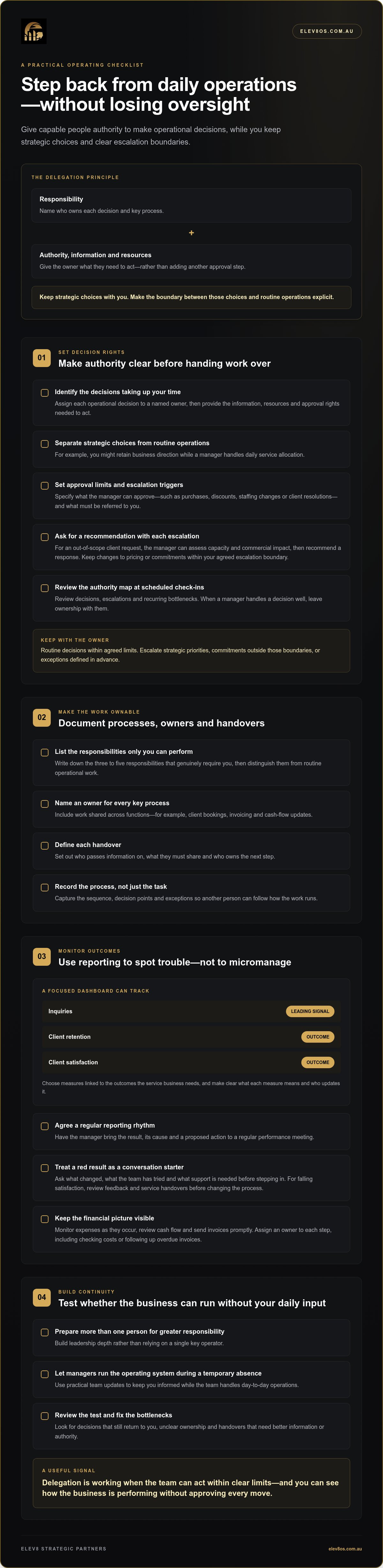
Delegation works only when responsibility and authority move together. If a manager owns client scheduling but can’t reallocate staff, routine delays will still land on your desk. Start by identifying the operational decisions that consume your time. Assign each to a named owner, then give that person the information, resources and approval rights to act.
Choose a second-in-command based on the function they understand, not their title alone. List the three to five responsibilities only you can perform, then separate strategic choices from routine operations. For example, you might retain decisions about business direction while your manager handles daily service allocation. Make the boundary explicit so everyone knows who owns each decision.
Assign an owner to every key process, including work shared across functions. In a service business, one person might own client bookings, while another manages invoicing and cash-flow updates. Line functions deliver services to customers; staff functions support that work through areas such as accounting or human resources. Name an owner for each handover and define what information they must pass on.
Set clear limits for delegated approvals. Specify which purchases, discounts, staffing changes or client resolutions the manager can approve independently. Document which decisions require escalation, such as changing strategic priorities or making commitments beyond agreed boundaries. Use real examples: a manager may resolve a routine scheduling clash but refer a proposed change to the service model.
In Australia, review the manager’s employment terms, remuneration and payroll treatment alongside the authority they can exercise for the business. Record any changes and seek appropriate tax, legal and employment advice before putting them into effect.
Make the escalation rule practical. For each exception, specify what triggers a referral, who receives it and what information must accompany it. Ask managers to bring a recommendation with the problem instead of returning the decision to you without analysis. This builds their judgment while keeping you informed about decisions with wider consequences.
For example, if a client requests work outside the agreed scope, the manager could assess capacity, identify the commercial impact and recommend a response. Your rule might let them resolve the request within existing service boundaries, while changes to pricing or commitments come to you. This makes both the manager’s responsibility and their limits clear.
Review the authority map at a scheduled check-in. Compare decisions made, escalations raised and recurring bottlenecks. When the manager handles a decision well, leave ownership with them. Taking delegated work back at the first difficulty teaches the team to wait for your approval.
2. Monitoring outcomes and repeating successful processes
Track results, not every movement. A dashboard can show inquiries, client retention and satisfaction without drawing you into each task. Choose measures linked directly to the outcomes your service business needs. For example, if client response times slip, review that measure alongside feedback and completed work. Make sure employees know what each measure means and who updates it.
Set a simple reporting rhythm. Ask the manager to review the dashboard with you at a regular performance meeting, bringing the result, its cause and a proposed action. Leading indicators can reveal likely changes before month-end results arrive. For a service team, a fall in new inquiries may signal a future workload issue before it appears in revenue reports.
Use a red measure to start a conversation, not to take control. Investigate the result with the manager before intervening. Ask what changed, what the team has tried and what support they need. If client satisfaction has fallen, for example, examine recent feedback and service handovers before changing the process. Reporting should focus attention, not run the business for you.
Keep the financial picture visible. Monitor expenses as they occur, review cash flow and send invoices promptly. These habits help you spot working capital pressure before it constrains daily operations. Assign an owner to each step, such as checking outgoing costs or following up on overdue invoices. A cash-flow review should lead to a decision, not another unread report.
Post-deployment monitoring matters whenever a business changes a process or system. In software development, day-2 operations happen after deployment. They include monitoring applications, collecting data to improve the pipeline, maintaining backups and restores, and restoring service after infrastructure failure. The practical lesson applies broadly: implementation isn’t the finish line. Define who watches for faults and who acts when performance drops.
Test a revised procedure on a small scale before making it standard. Look for gaps, collect feedback from the employees doing the work, then adjust the steps. If a new booking process causes repeated handover delays, map where requests stall and fix that point. Compare the result with the process objective before rolling out the change across the business.
When a process meets its objective, document the method and repeat it where the same conditions apply. Record the sequence, decision points and exceptions, then identify other workflows that could use the same approach. Don’t copy a procedure blindly. A process that works for client bookings may need adapting for invoicing or service delivery.
Keep the review disciplined. An action register can record each improvement, its owner and its next step, rather than leaving commitments in meeting notes or memory. If reported work differs from real work by 33%, observe the process directly and compare what people report with what happens. That gap can expose hidden rework or bottlenecks.
If reporting and follow-through still depend on you, consider structured strategic alignment and leadership support to build clearer oversight without returning to daily control.
3. Definition of day-to-day business operations
Day-to-day operations are the recurring activities that generate profit and increase business value. In a service business, these may include allocating work, delivering services, responding to clients, issuing invoices and resolving routine problems. Map the process from the first client inquiry through to payment. This shows where work flows smoothly, where it stalls and which decisions still depend on you.
Separate operational work from leadership work. Define the three to five responsibilities only you can perform, such as setting direction or approving major strategic changes. Then identify what belongs in daily, weekly, monthly and quarterly routines. For example, client delivery may need daily oversight from a team leader, while you review strategic priorities quarterly.
Risks arise when tasks have no owner, decisions drift or essential knowledge stays with you. Clients may receive inconsistent service if staff can’t follow the same process, and unresolved bottlenecks can delay delivery or payment. The answer isn’t to keep every task. Document ownership, handovers and escalation points before you step back.
Document key processes in enough detail for someone else to follow them. Business process mapping breaks work into logical phases, using written instructions or a flow chart. For a new client, it might show how a request moves from inquiry to assessment, scheduling, delivery and invoicing. Record who acts at each stage, what information they need and what happens when an exception occurs.
Process modelling goes further by recording the current workflow and establishing a baseline. Compare the steps with the intended outcome, then identify bottlenecks that may be slowing work unnecessarily. For example, if a service booking waits for two separate approvals, test whether one clear approval point can preserve the right controls while removing a delay. Update the process after testing the change.
Your role as CEO is to connect the company’s objectives to the work across its functions. Line functions generate revenue through customer services; staff functions support delivery through areas such as accounting, human resources and legal work. Both contribute to profitable operations. Set priorities that protect client delivery and business capacity, rather than letting routine requests consume every available hour.
Use the Eisenhower Matrix to distinguish urgent work from important work, then schedule focused time with time blocking. These methods help you protect strategic tasks from constant operational interruptions. A 60-hour workweek shouldn’t be treated as a requirement for growth. Build a way to stay connected that doesn’t require 40 hours of work each week, using defined reviews and clear operating information.
Effective delegation starts with an accurate picture of the work, not a vague instruction to “take over”. Review the process map with the people doing the work, confirm that every handover has an owner and revise instructions when the workflow changes. This gives the team a practical operating reference and lets you lead instead of repeatedly rebuilding the same decisions.
4. Creating a leadership bench with multiple potential successors
A single capable manager can become another bottleneck if every important decision lands with them. Many small and medium-sized businesses have one or two people showing leadership potential, but those people are often stretched thin. Identify emerging leaders across different functions and build capability beyond the person already carrying daily operations.
List the decisions and responsibilities that would stall if you were unavailable. Match each to a potential leader who understands the work, communicates clearly and follows through. A senior technician may be ready to coordinate job allocation; an experienced administrator may be suited to managing client handovers. Don’t assume the most senior employee is automatically the right successor.
Give each person a defined stretch assignment with a clear outcome. For example, ask a team leader to run the weekly service meeting, resolve routine scheduling conflicts and report recurring capacity problems. Set the authority boundary before the assignment starts. Afterward, review their decisions, the consequences and what they would change next time.
One plumbing business example involved developing three people to take on greater responsibilities within six months. Leading hands and senior technicians received training for expanded roles. The practical lesson is to build leadership through real work: assign decisions, observe performance and increase responsibility as capability becomes evident.
Don’t build the business around a single operations manager. One plumbing business initially relied heavily on one operations manager before developing a broader leadership pipeline. Map critical responsibilities across the team, then identify who can cover each function. If one person holds all the operational knowledge, train another to handle specific decisions and handovers.
Put the development plan in writing. Record each person’s current responsibilities, the next capability to build, the practical assignment and the review point. For example, a senior technician might first lead job allocation, then handle client escalations within agreed service boundaries. Keep feedback specific: name the decision, its impact and the next action required.
Use evidence to decide when to expand someone’s authority. Look at whether they meet commitments, communicate risks early and make sound decisions within their remit. If they struggle with a new responsibility, coach their decision-making rather than reclaiming the whole task. That keeps the assignment useful and reveals whether the gap is knowledge, confidence or an unclear process.
A leadership bench is working when daily operations don’t depend on one person’s memory or availability. Test it by asking a capable team member to lead a normal operating cycle, including meetings, handovers and issue resolution. Note where work pauses, then close the gaps with training, written procedures or clearer authority. Build depth deliberately, before someone’s absence exposes the weakness.
5. Planning for temporary absence from a service business
A temporary absence tests whether your operating system works without your constant input. A service business needs clear coverage for client inquiries, delivery, staff decisions, invoices and urgent issues. Choose the absence you want to test, then list what must keep running while you’re away. Include the decisions, information and access each person needs to handle their part.
Prepare employees by explaining the change, naming the person leading daily operations and clarifying their authority. Give the team a written handover covering current commitments, client priorities, open issues and escalation triggers. For example, a service coordinator may handle schedule changes, while the manager resolves delivery problems within agreed limits. Employees need to know who owns each decision before you leave.
Prepare customers by explaining who will manage their work and how to reach that person. The team can send monthly client updates so you stay informed without managing service delivery. An administrative team member can also provide a weekly summary of new leads and conversions. Set the format and owner for each update before your absence begins.
Build the handover around the work, not your memory. Document recurring tasks, client-specific requirements, supplier details, deadlines and the steps for handling common exceptions. A Business Back-Up Plan typically takes 3-4 weeks. Its aim is to document enough operational knowledge for someone stepping in to get the work 85% right. Use that standard to decide what must be written down first.
Test the plan before relying on it. Let managers run the operating system while you stop checking routine work. Observe whether they can manage service delivery, resolve ordinary problems and keep commitments moving. If a decision stalls, record what information or authority was missing. Then update the handover and test the plan again under normal operating conditions.
Set contact boundaries in advance. Decide which issues justify an urgent call and which belong in the next scheduled update. For example, a serious client disruption may need escalation, while a routine roster change should stay with the manager. Without that distinction, employees may interrupt you constantly or delay raising an issue that needs attention.
Keep the business capable of running without you 24/7, rather than relying on your availability to patch every gap. Before leaving, check that key processes have an owner, client work has clear coverage and managers can access the information needed to act. After returning, review outcomes and fix weak points instead of taking every responsibility back.
If you need to build the leadership structure and accountability behind a workable absence plan, develop a stronger operating framework.
Elev8 Strategic Partners: Strategic Business Partner Programme
Elev8 Strategic Partners’ Strategic Business Partner Programme provides structured strategic alignment and leadership support. It’s a natural next step when you’ve defined operational responsibilities but need stronger governance and leadership alignment to make the shift stick.
Use the programme to work through the decisions still bottlenecked around you, clarify how leadership responsibilities connect to business priorities, and build a more deliberate approach to oversight. The focus is sustainable operational success, not adding another layer of routine approvals. It’s suited to service business leaders ready to move from personal intervention towards clearer accountability and strategic direction.
If you’re ready to strengthen the structure behind your next step, visit Elev8 Strategic Partners for strategic business support.
Build a business that can move without you
Deciding how to step back from day to day business operations is ultimately about what your leadership should make possible next. When the business no longer relies on your constant intervention, you can focus more on direction, resilience and opportunities the team can’t pursue while you’re tied to daily decisions.
That shift takes more than handing over tasks. It calls for deliberate alignment between your priorities, leadership responsibilities and the way decisions get made. Elev8 Strategic Partners’ Strategic Business Partner Programme supports strategic alignment and leadership. The Elev8 Boardroom offers a setting for collaborative insight, accountability and high-level decision-making, while the Foundations Toolkit is another option for strengthening your business foundations.
If you’re ready to build a business that depends less on your daily presence, contact Elev8 Strategic Partners. Start shaping a stronger structure for the business, and make room for the leadership only you can provide.
Frequently Asked Questions
How Do I Get Out of the Day-to-Day Without Losing Control of the Business?
Keep control through visibility and decision boundaries, not by approving every task. For example, let a service manager resolve routine client complaints while you retain decisions that change contract terms or business direction. Review a short decision log to see what was decided, why and with what result. If the same issue keeps returning, fix the underlying process instead of taking the decision back.
When is the right time to start preparing a second-in-command?
Start before the business depends on you to keep routine work moving. A useful signal is staff regularly pausing for your approval on matters within their roles, or client work stalling when you’re unavailable. Choose a potential second-in-command who understands the operation and can earn colleagues’ trust. Begin with a defined responsibility, then expand their remit as their judgment becomes clear.
Why can’t I step back from the day to day operations in business?
Often, knowledge, decisions or relationships have become concentrated around the owner. You may also be correcting work before others can learn, or solving problems without recording how to handle them next time. Identify recurring interruptions in your calendar and trace each to its cause. If a client escalation depends on your personal history, transfer that context and document the next action.
How can a business owner step back from day-to-day operations?
To learn how to step back from day-to-day business operations, change one recurring workflow at a time. Choose a task with a consistent pattern, such as preparing a client proposal, and have a team member lead it from start to finish. Agree how they’ll handle exceptions, then review the result. Keep the workflow with them unless evidence shows the process or support needs adjusting.
What tasks should a business owner delegate first?
Start with recurring tasks that follow clear rules and don’t require your unique judgment. Examples include preparing meeting agendas, coordinating routine bookings or gathering information for a client update. Retain authority over sensitive commitments or choices that could significantly change business direction. Before handing over work, explain what a completed task looks like and where the person can find the information they need.
How often should a business owner review operations and financial performance?
Set a regular review rhythm that reflects how quickly your workload, cash position and client commitments can change. Monitor expenses as they occur, review cash flow routinely and make sure invoices go out promptly. Use operational check-ins to address emerging delivery issues, then schedule a separate review for broader performance. Focus on acting on meaningful changes, rather than inspecting every minor transaction.