
Business Governance Guide for Growing Australian Firms
What if better governance made decisions faster instead of adding another layer of process? If every important call still lands on the founder’s desk, ownership is fuzzy and risks surface late, the problem isn’t a lack of paperwork. It’s a lack of clear ways to decide, act and follow through. Learning how to build business governance means putting those foundations in place before growth makes the gaps harder to ignore.
Governance can sound like something designed for listed companies and formal boardrooms. Growing Australian firms need something more practical: clear decision rights, named accountability and a regular rhythm for reviewing performance, risks and priorities. Not bureaucracy. A working system your team can use.
This guide shows you how to build that system without burying people in process. You’ll learn how to clarify who decides what, establish useful review routines and make sure decisions lead to action. The aim is straightforward: better visibility, fewer bottlenecks at the founder’s desk and a business that can keep moving as it grows.
Key Takeaways
- Spot when informal control is no longer enough, and identify where decisions stall or responsibilities blur.
- Set clear decision rights by naming who proposes, decides, implements and reviews important matters.
- Build reporting rhythms that surface performance, emerging risks, decisions required and overdue actions.
- Learn how to build business governance through practical steps, from diagnosing gaps to testing and refining arrangements.
- Adjust governance as your strategy, leadership team and operating complexity change, keeping structure useful rather than burdensome.
How to build business governance when informal control stops scaling
A decision sits in someone’s inbox because nobody knows who can approve it. A task slips because everyone thought someone else owned it. Then the founder steps in, settles the issue and becomes the escalation point again. The business keeps moving, but too much depends on one person being available to unblock it.
Business governance is the practical system that sets how decisions are made, responsibilities assigned, oversight exercised and accountability maintained. It gives people clear authority and makes it possible to see whether important decisions and actions are being followed through. Broad principles of corporate governance offer context, but a growing firm needs arrangements that work in its actual operating conditions.
Governance is not the same as daily management. Governance establishes who has authority, what needs oversight and how issues are raised. Management plans and delivers the work within that direction. Confuse the two and either the founder gets dragged into routine decisions or important risks and trade-offs go unexamined.
Signs informal business governance is no longer enough
Watch the decisions that keep circling back. One manager approves a supplier change, another waits for the founder. A team member agrees to a deadline, but no one owns checking whether the work is complete. These are not just communication snags. They expose missing decision rights and unclear hand-offs.
Picture an established Australian trades business with a founder, an operations lead and a growing team. The operations lead may handle scheduling, but still seek the founder’s approval for every customer exception. Meanwhile, staff aren’t sure who follows up when a job runs behind. The issue isn’t necessarily that people lack effort. The system hasn’t made authority and follow-through clear.
Repeated escalation is a useful signal. So are approvals that vary depending on who’s asked, decisions that get revisited without new information, and actions that disappear after meetings. If the founder has to remember every open issue, the business has a visibility problem as well as a dependency problem.
Governance is not paperwork for its own sake
Useful governance puts the right information in front of the right people at the right time. It makes decisions, responsibilities and emerging risks visible, then gives actions an owner and a review point. A short decision record or a clear approval boundary can do more than a thick policy no one uses.
Proportion matters. A growing firm may need agreed authority limits and a regular review of key risks, not several approval layers for routine work. Add structure where a decision has real consequence or repeatedly causes confusion. Keep straightforward delivery moving. The aim is not to make every choice formal; it’s to stop important choices relying on memory, guesswork or the founder’s constant intervention.
That balance is the foundation of a governance framework for a growing business. To understand how to build business governance in practice, start by finding where decisions stall, ownership breaks down and oversight arrives too late. Then build only the structure needed to close those gaps.
Build the governance foundations: decision rights, roles and risk ownership
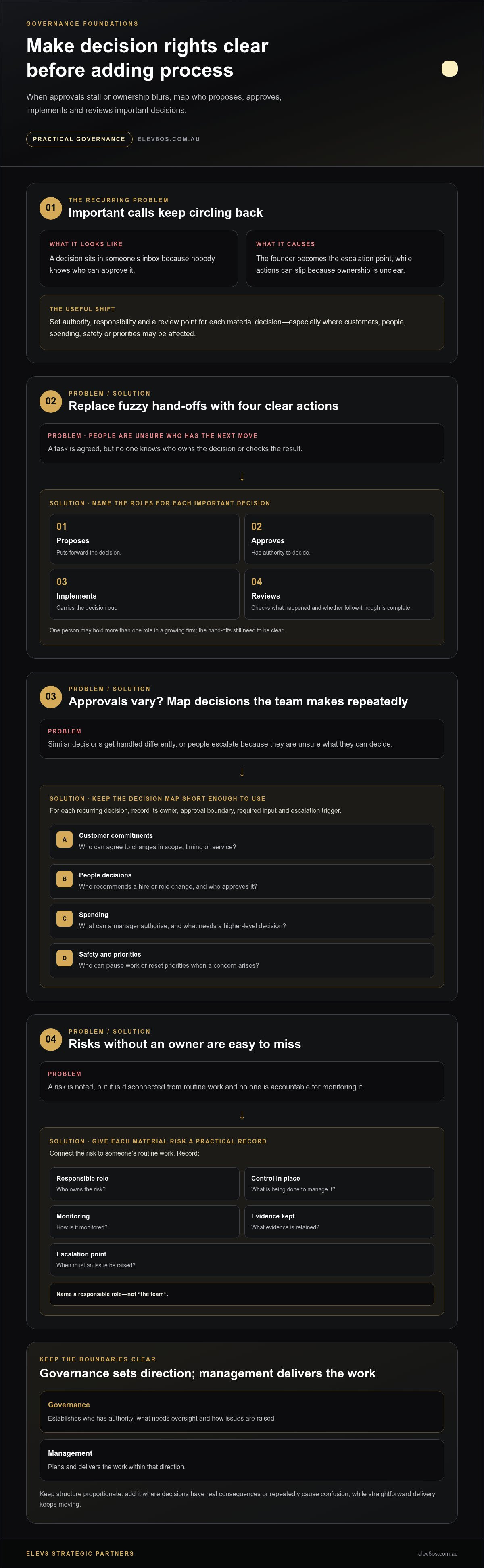
Once you can see where decisions stall, assign authority before adding meetings or committees. A workable system separates four actions: who proposes a decision, who approves it, who carries it out and who checks the result. One person may hold more than one role in a growing firm, but the hand-offs still need to be clear.
Each material decision needs a clear owner, authority and review point. That sentence is a useful test for any decision that can affect customers, people, spending, safety or business priorities.
Map decision rights before adding committees
Start with decisions the team makes repeatedly, not every possible scenario. For each one, record the decision owner, approval boundary, required input and escalation trigger. Keep the map short enough to use during real work.
- Customer commitments: who can agree to changes in scope, timing or service?
- People decisions: who recommends a hire or role change, and who approves it?
- Spending: what can a manager authorise, and what needs a higher-level decision?
- Safety and priorities: who can pause work or reset priorities when a concern arises?
For example, a regional manufacturer might let an operations lead handle routine scheduling while reserving a major shift in production priorities for the executive team. The owner sets the boundary; the operations lead acts within it. Escalation is triggered by a defined exception, not by uncertainty over who is allowed to decide.
Keep ownership oversight distinct from executive responsibility and delivery. Owners may set direction and review performance; executives translate that direction into plans; team members deliver the work. In a smaller business, those roles can overlap, but people should still know which capacity they’re acting in. Otherwise, oversight can slip into micromanagement, or no one may challenge a decision that needs scrutiny.
Assign accountability for risks and controls
A risk register is useful only when it connects a risk to someone’s routine work. For each material risk, record a responsible role, the control in place, how it’s monitored, what evidence is kept and when an issue must be escalated. Avoid naming “the team” as the owner. Shared awareness helps; named accountability drives follow-through.
A safety risk, for instance, might connect to a documented site check, an identified person responsible for completing it and a clear route for raising an unresolved issue. The register should point to the real process and record, not sit apart as a polished document nobody uses. Review it when conditions change or a control fails.
For an Australian company, governance arrangements also sit alongside applicable director responsibilities under the Corporations Act 2001. Directors’ duties include care and diligence, acting in good faith and avoiding insolvent trading. The Act and ASIC guidance are relevant context, but a general operating map isn’t a substitute for advice on a company’s specific obligations.
Building these tools into daily operations takes more than writing them down. For established founder-led firms, embedded operational support can help put decision rights, controls and accountability to work inside the business. Elev8 Strategic Partners works on an embedded basis, measures success by delivered outcomes rather than engagement length, and concludes when agreed outcomes are delivered and the business is positioned to grow without Elev8 Strategic Partners. Its principles are Embedded over advisory, Outcomes over tenure, Honest over comfortable, and One industry at a time, with only one active Tier 1 client per industry vertical.
Create governance rhythms that turn reporting into decisions
A report that lists activity but prompts no decision is an update, not effective oversight. Governance reporting should make four things visible: performance against priorities, emerging risks, decisions required and actions still unresolved. Keep the focus on what leaders need to decide, challenge or monitor. Supporting detail can sit behind the summary.
Reporting creates value when it changes a decision or triggers accountable action. That’s the test for every metric and agenda item. If no one can say what response the information calls for, it may not belong in the leadership review.
Set a useful leadership review cadence
Match the review frequency to the urgency of the decisions and the exposure involved. A fast-moving cash concern may need attention sooner than a longer-term capability priority. Give each review a defined purpose, the information required and a named decision-maker. Close by recording the decision, action owner and due date, then check progress at the next relevant review.
Keep routine operational updates separate from governance discussions. A delivery lead might report that jobs are on schedule; leaders need a governance discussion if a recurring delay threatens a key priority, requires a change in resources or exceeds the lead’s authority. The first informs the team. The second calls for oversight, a decision or a clear escalation.
Turn reporting into decisions and follow-through
Use a consistent format to connect each significant report to a decision and what happens next. For example, a service business could track customer complaints as an operational measure, then bring a repeated pattern to leaders if it points to a control gap or a decision about service standards. The table makes that hand-off explicit.
| Reporting item | Decision needed | Accountable owner | Follow-up |
|---|---|---|---|
| Customer complaints rising in one service area | Change the process or investigate further? | Service lead | Record the decision and review the next complaint trend |
| Supplier delivery risk affecting planned work | Approve an alternative or adjust priorities? | Operations lead | Assign the action and set a review point |
| Overdue actions from a prior leadership review | Reassign, escalate or revise the due date? | Original action owner | Update the action record with the reason and next step |
Make governance records useful after the meeting
Store current decision, risk and action records where the people responsible can find them. Keep the record lean: capture the issue, decision or unresolved question, owner and next review point. Label confirmed facts separately from assumptions, forecasts and open issues. That distinction stops a projection being treated as a result and makes it easier to challenge gaps before they harden into accepted truth.
Learning how to build business governance means building these rhythms into real operating systems, not producing reports that gather dust. For established founder-led businesses that need execution support, Elev8’s embedded operational support works inside the business. Its principles are Embedded over advisory, Outcomes over tenure, Honest over comfortable, and One industry at a time, with only one active Tier 1 client per industry vertical. Success is measured by delivered outcomes, not engagement length; engagements conclude when agreed outcomes are delivered and the business is positioned to grow without Elev8.
How to build business governance in practical implementation steps
Don’t start with a stack of policies. Start with the points where work gets stuck, decisions bounce between people or risks lack an owner. The right process for how to build business governance is staged: find the gaps, fix the highest-impact ones, then test whether the new arrangements hold under real operating conditions.
Keep the system proportionate to the business. A firm with a small leadership team and straightforward operations may need clear authority boundaries and a simple review record. More locations, more complex work or higher exposure may call for tighter controls. Build from the team’s existing capability, not from an idealised corporate template.
Start with a governance gap assessment
Take a practical inventory before changing roles or creating new forums. Look for recurring decisions, unresolved escalations, unmanaged risks and responsibilities that people interpret differently. Then separate the urgent fixes from larger structural work. A decision bottleneck affecting daily delivery may need attention now; a broader redesign of leadership oversight can be planned deliberately.
- Diagnose the gaps. Review where approvals stall, actions go unfinished and risks lack a clear owner. Ask the people doing the work where authority is unclear.
- Prioritise decisions. Focus first on decisions with the greatest operational or commercial exposure, or those that repeatedly return to the founder.
- Assign authority. Name who proposes, decides, implements and reviews each priority decision. Set approval limits and explain what triggers escalation.
- Document the arrangements. Record decision rights, reporting expectations, escalation routes and review responsibilities in a format people can find and use.
- Test and refine. Run the arrangements against real decisions. Fix unclear ownership, missed hand-offs and unnecessary approvals as they surface.
Consider a regional NSW business with teams working from separate locations. A customer issue raised at one site might need a local response, while a change affecting service commitments across locations needs a wider decision. Define which role can resolve the issue locally and what circumstances require escalation. That gives each team a usable boundary without forcing every decision through the same person.
Document, test and improve the arrangements
Documentation is a working tool, not the finished job. Use a live decision map, risk record or action log that reflects how the business actually runs. Then test it against a current decision: can the team identify the owner, authority, required input and review point without relying on informal workarounds?
After each test, check whether the arrangement improved visibility and follow-through. If people still ask the founder to settle routine matters, authority may be too vague. If every action needs multiple sign-offs, the process may be too heavy. Adjust the boundary, then check again.
If turning governance into repeatable processes needs hands-on execution, build practical business systems and frameworks with Elev8. Elev8 works embedded inside established businesses, and success is measured by delivered outcomes, not engagement length. Engagements conclude when agreed outcomes are delivered and the business is positioned to grow without Elev8. Its principles are Embedded over advisory, Outcomes over tenure, Honest over comfortable, meaning clients hear what they need to hear, and One industry at a time, with only one active Tier 1 client per industry vertical.
Keep business governance active as the business and leadership team grow
Governance isn’t a document you finish and file away. It needs to keep pace with changes in strategy, leadership roles, risk exposure and operating complexity. A structure that worked when the founder could oversee every major decision may become a bottleneck as the team, customer commitments or locations expand.
There’s a balance to hold. Too little structure leaves decisions dependent on the founder and makes accountability hard to track. Too much adds sign-offs and meetings that slow ordinary work. Review the arrangements when a role changes, a new risk emerges or decisions begin falling between existing responsibilities. Keep what helps people act with clarity. Remove what adds friction without improving oversight.
Know when internal ownership needs more support
Look for repeated action slippage, unresolved authority gaps and routine decisions that still land with the founder. These are signs the business may have outgrown its current capacity to implement and maintain governance. The answer isn’t another document that sits outside daily operations. It’s hands-on work inside the business to make responsibilities, operating processes and follow-through function together.
That kind of support must fit the business. Elev8 works with established founder-led firms that have an operational foundation, embedding a Strategic Operations Engineer inside the business. The focus is execution, not advice delivered from a boardroom. Its principle of Embedded over advisory means building and implementing the operating infrastructure alongside the team.
Choose a next step that matches the governance gap
Before seeking broader support, write down one unresolved decision or accountability gap. State what keeps happening, who is affected and what needs to change. That simple record gives the discussion a firm starting point and helps distinguish a specific implementation problem from a general feeling that the business needs “more governance”.
Elev8 engagements typically run 6-18 months, but success is measured by delivered outcomes, not engagement length. An engagement concludes when agreed outcomes are delivered and the business is positioned to grow without Elev8. Honest over comfortable means clients hear what they need to hear, not what they want to hear. One industry at a time means Elev8 has only one active Tier 1 client per industry vertical at any time.
If the gap is clear and you’re ready to examine how governance can work inside your business, book a diagnostic Discovery Call. It’s a 30-45 minute video call, with no pitch deck or slide presentation, and it isn’t a sales call. Book a diagnostic Discovery Call to discuss the operational issue you’ve identified.
Build governance that can grow beyond the founder
The next step isn’t to make governance bigger. It’s to make it durable enough that the business can keep making sound decisions as people, priorities and risks change. Start with one decision or accountability gap that still depends too heavily on you. Make it visible, assign ownership and put the follow-through into the way the business operates.
If putting that change into practice needs experienced hands inside the business, Elev8 embeds a Strategic Operations Engineer to build operational infrastructure and accountability. Its approach is Embedded over advisory, Outcomes over tenure, and Honest over comfortable, telling clients what they need to hear, not what they want to hear. Elev8 measures success by delivered outcomes, not engagement length, and engagements conclude when agreed outcomes are delivered and the business is positioned to grow without Elev8. It also works with only one active Tier 1 client per industry vertical at a time.
Understanding how to build business governance is the start. The real measure is whether decisions move, responsibilities hold and the business becomes less dependent on the founder. If you’re ready to work through a specific governance gap, book a diagnostic Discovery Call. Build the structure your next stage of growth will need.
Frequently Asked Questions
What is business governance in simple terms?
Business governance is how a business sets direction, makes important decisions and checks that responsibilities are being met. Think of a customer refund: governance clarifies who can approve it, what limits apply and who reviews recurring complaints. That keeps decisions consistent without forcing every issue up to the owner. For leaders exploring how to build business governance, start with choices that carry real consequences for customers, staff or the business.
Does every Australian small business need a formal board?
No. A formal board isn’t a universal requirement for every small business, and a sole trader doesn’t need one simply to operate. Legal structures differ, though: a company has directors, and those directors have responsibilities even if the business doesn’t hold formal board meetings. The right governance arrangements depend on the entity, its activities and applicable obligations. Don’t confuse the absence of a formal board with the absence of accountability.
Can a small business build governance without adding a board?
Yes. A small business can set practical governance arrangements through its existing leadership structure. For example, a business owner might reserve major commitments for themselves while authorising an operations manager to resolve routine customer issues within agreed limits. Keep a record of decisions that affect priorities or carry material risk, then review whether the arrangement works. Add a committee or board only if it solves a real oversight or decision-making need.
Is business governance different from day-to-day management?
Yes. Management organises people and resources to deliver work; governance sets the boundaries and oversight around important choices. In a building business, a site manager might schedule trades and track progress, while leadership determines which projects fit the business’s capacity and risk appetite. In a small firm, the same person may do both. Being clear about which role they’re acting in helps prevent routine delivery from crowding out oversight.
How often should a business review its governance arrangements?
There’s no single review schedule that suits every business. Set a planned review point that fits the business’s pace and exposure, then revisit arrangements sooner if a trigger appears. Triggers might include a leadership change, a new operating location, a major shift in strategy or an incident that reveals a control weakness. Keep a note of what changed and why. That makes the next review grounded in actual business developments, not habit.
What happens when decision-making authority is unclear in a business?
Work can stall while people wait for approval, or move ahead on conflicting assumptions. A team member may promise a customer a delivery date without checking capacity, while another person believes that commitment needs approval. The immediate fix is to identify the decision that’s getting stuck, name who has authority and set a clear boundary for exceptions. If the same confusion recurs, treat it as a system issue, not just an individual performance problem.
Which Australian governance requirements apply to my company?
Requirements depend on your legal structure, activities and industry, so there isn’t one checklist for every Australian business. Directors of companies have duties under the Corporations Act 2001, including care and diligence, acting in good faith and avoiding insolvent trading. Other obligations may apply depending on your circumstances. A business operating in Tamworth, Newcastle, Armidale, Coffs Harbour, Port Macquarie or Moree should identify its entity type and seek advice on requirements relevant to its operations.