
Strategic Partner Instead of Consultant: What Business Owners Need
Another strategy deck won’t help if nobody has the capacity to put it into action. If recommendations keep stalling and every major decision still lands on your desk, you may be asking whether a strategic partner instead of consultant would give your business more useful support. The answer depends on the work that needs doing, not the title on the proposal.
A consultant can bring targeted expertise and advice for a defined problem. A strategic partner may be a closer fit when you need ongoing alignment, execution and leadership support, rather than recommendations to carry back to the team. Neither option is automatically better. The wrong fit can leave you with advice you can’t implement, or a relationship your business doesn’t need.
This article will help you distinguish the roles, assess your business problem and leadership capacity, and set clear expectations for strategy, implementation and accountability. You’ll also see how Elev8 Strategic Partners’ Strategic Business Partner Programme focuses on strategic alignment and execution, so you can judge whether that support fits your business.
Key Takeaways
- Match the support to the problem: a defined technical issue may call for targeted expertise, while broader leadership or operating challenges may need sustained alignment.
- Compare providers by scope, working cadence, execution responsibilities and accountability, not job title alone.
- Decide whether a strategic partner instead of consultant fits by identifying where decisions stall and who has the capacity to carry recommendations through.
- Prepare for a strategic partnership by defining the challenge, gathering relevant information, aligning leaders and agreeing how progress will be reviewed.
- Assess whether Elev8’s Strategic Business Partner Programme aligns with your priorities through its focus on strategic alignment and execution.
Strategic partner vs consultant: what is the difference?
You’ve received the advice. The recommendations make sense. Yet the decisions, follow-through and operational changes still sit with you and your leadership team. That gap is where the difference between a consultant and a strategic partner becomes practical, not just a matter of title.
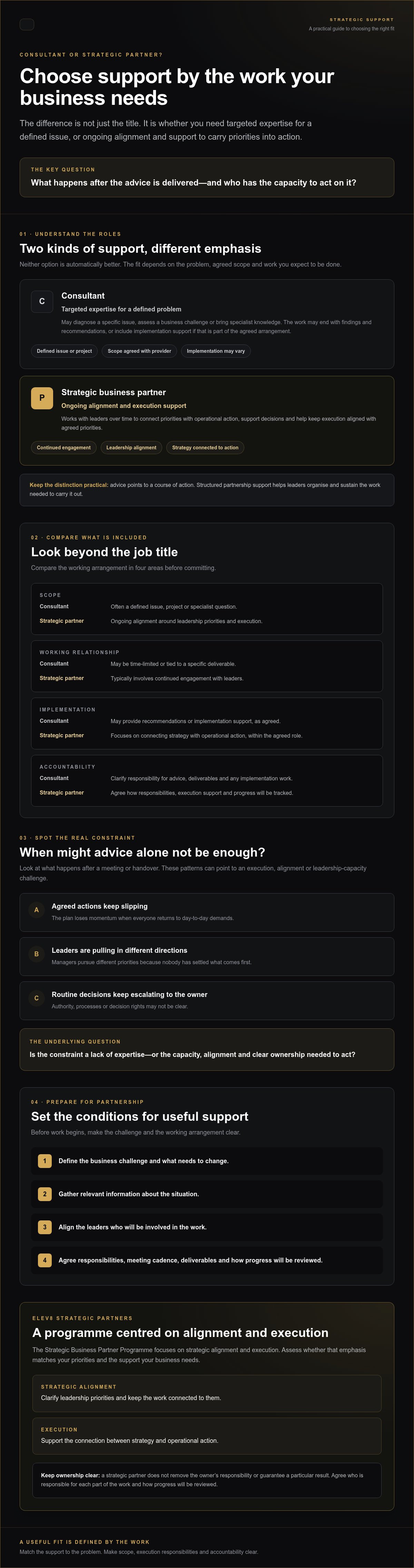
A consultant is generally an external specialist engaged to diagnose a defined issue, provide expertise or recommend a course of action. A strategic business partner works with leaders over time to align priorities and support strategic execution. The Strategic partnership concept can take different forms, so focus on what the working relationship actually includes.
What does a business consultant typically do?
A consultant might investigate why a process is underperforming, assess a specific business challenge or bring specialist knowledge the team doesn’t have. The engagement may end with findings and recommendations, or include hands-on implementation support. That depends on the provider, agreed scope and working arrangement. A consultant isn’t inherently detached or ineffective. The fit depends on the problem and the work you expect them to do.
What does a strategic business partner do?
A strategic business partner helps connect leadership priorities with operational action. That can include structured guidance as leaders clarify direction, work through decisions and keep execution aligned with agreed priorities. It doesn’t remove the owner’s responsibility or guarantee a particular result. Before work begins, agree responsibilities, meeting cadence, deliverables and how progress will be reviewed.
Advice points to a course of action. Structured partnership support helps leaders organise and sustain the work needed to carry it out.
| Area | Consultant | Strategic business partner |
|---|---|---|
| Scope | Often a defined issue, project or specialist question. | Ongoing alignment around leadership priorities and execution. |
| Working relationship | May be time-limited or tied to a specific deliverable. | Typically involves continued engagement with leaders. |
| Implementation | May provide recommendations or support implementation, as agreed. | Focuses on connecting strategy with operational action, within the agreed role. |
| Accountability | Clarify responsibility for advice, deliverables and any implementation work. | Agree how responsibilities, execution support and progress will be tracked. |
If you’re weighing a strategic partner instead of consultant, don’t rely on the label. Ask who will do what after the plan is set, how decisions will be handled and what accountability looks like in practice. The answers show whether the arrangement matches the work your business needs.
When does a strategic partner offer more than another set of recommendations?
The signal isn’t that your business needs more advice. It’s that agreed actions keep slipping, leaders are pulling in different directions, or decisions can’t move without the owner stepping in. In that situation, the constraint may be execution capacity, alignment or how responsibility is distributed, rather than a lack of ideas.
Signs advice alone is not resolving the problem
Look at what happens after the meeting or handover. Does the plan lose momentum when everyone returns to day-to-day demands? Are managers pursuing different priorities because nobody has settled what comes first? Does routine work keep escalating to the founder because authority, processes or decision rights aren’t clear?
These patterns point to a wider leadership or operating challenge. Another recommendation may add detail without changing the conditions that stop people acting. A strategic partner may be worth considering if you need ongoing support to align leaders, work through decisions and connect agreed priorities with action. That work still depends on clear responsibilities and commitment from the leadership team.
Consistent execution needs clear ownership. If nobody is accountable for the next step, even a sound plan can stall.
When a consultant may still be the right choice
A bounded engagement can be the better fit when the question is specific and the work has a clear edge. You might need an external review of one process, specialist input on a defined issue or recommendations to inform a particular decision. If your team can take responsibility for what follows, a longer-term partnership may be unnecessary.
Before engaging anyone, pin down three things:
- Deliverable: What will be produced or clarified?
- Timeframe: When will the work start and finish?
- Implementation: Who will act on the recommendations, and what support, if any, is included?
The right choice depends on the shape of the problem. A technical question with a defined answer calls for a different arrangement from recurring leadership bottlenecks. Choosing a strategic partner instead of consultant makes sense only if ongoing alignment and execution support match the actual gap. A label won’t fix unclear authority or competing priorities.
Trust matters too. Harvard Business Review’s guidance on building trust in a strategic partnership highlights authenticity, logic and empathy as drivers of trust. Look for those qualities in how a prospective partner listens, explains their reasoning and responds to the operating reality you describe.
If ongoing alignment and execution support are the gaps you’ve identified, review the Strategic Business Partner Programme as one option to assess against your needs.
How to compare a strategic partner with a consultant before committing
A new title isn’t proof of a different service. Compare the actual work, who owns it and how progress will be handled. The right choice depends on what your business needs and what your leaders can realistically carry.
Use these five points to test the fit:
- Business need: Is the challenge a defined issue requiring specialist input, or does it involve broader leadership alignment and sustained execution?
- Scope: What work is included, and what sits outside the engagement? Ask for clear examples of the work the provider will take responsibility for.
- Cadence: How often will you work together, and what happens between formal strategy discussions?
- Execution: Will the provider advise, support implementation or help leaders maintain focus on agreed actions? Be specific about who does each task.
- Accountability: Who owns decisions, tracks progress and raises a flag if priorities or commitments slip?
Don’t assume every consultant only advises or every strategic partner gets involved in implementation. Working practices vary. Compare the responsibilities and support you’ve agreed, not just the label on a proposal.
Questions to test the scope and working relationship
Ask what the provider will do between strategy discussions. Who owns decisions and implementation tasks? How will progress be reviewed, and how will the arrangement adapt if business priorities change? The answers should make clear what the provider contributes and what remains with your team. If the answers are vague, clarify expectations before committing.
Assess fit for a regional NSW business
A business in Tamworth may face different operating pressures from one in Newcastle, Armidale, Coffs Harbour, Port Macquarie or Moree. Location alone doesn’t determine the right support. Consider your leadership capacity, the complexity of day-to-day operations and whether you can access the specialist expertise your current challenge requires.
If a focused issue is holding up one decision, a defined specialist engagement may fit. If priorities keep competing and leaders need ongoing support to connect strategy with execution, assess whether a strategic partner instead of consultant better matches the work. Check the proposed cadence against your team’s availability, too. A structure that looks sound on paper won’t help if leaders can’t participate consistently.
Elev8’s Strategic Business Partner Programme focuses on strategic alignment and execution. Compare that focus with the criteria above, then explore Elev8’s strategic partnership approach to understand whether it may suit your needs.
How to prepare your business for a strategic partnership
Good preparation makes the work sharper. Before you consider a strategic partner instead of consultant, get clear on the business challenge, the evidence behind it and the decisions your leadership team needs to make. You don’t need a perfect plan. You do need an honest picture of what’s happening and who can act on it.
Shared priorities make strategic work more actionable. If leaders arrive with different definitions of the problem, external support can’t replace the alignment that’s missing inside the business.
Set a clear brief before the first conversation
Describe the issue in observable terms. “We need to grow” is an aspiration; “delivery delays are affecting our ability to meet agreed customer deadlines” is something a team can investigate. Separate the visible symptom from possible constraints behind it, such as unclear ownership, limited leadership capacity or a decision that keeps getting deferred.
Bring the facts you have, not just a polished story:
- Current priorities and relevant operating information, such as workflow, responsibilities or existing performance measures.
- What you’ve already tried, what changed and what remains unresolved.
- Decisions that are waiting, who has authority to make them and what is holding them up.
This gives the conversation a practical starting point and helps you avoid treating a surface-level symptom as the whole problem.
Agree measures, roles and review points
Before work begins, align the leaders who will need to make decisions or carry out actions. Set out who owns each decision, task and communication point. If authority is unclear, address that directly; otherwise, work may keep returning to the owner for approval.
Choose practical indicators tied to the priority, not a long list of measures nobody uses. If the issue is delayed decisions, for example, agree how you’ll track whether decisions are being made and acted on. Set review points to check what has moved, what is blocked and whether the original priority still holds. These are useful operating habits, not a substitute for a detailed governance guide. Keep the scope, roles and review rhythm clear enough for leaders to use.
Preparation is shared work. Leaders need to make time, surface unresolved choices and follow through on responsibilities. Agree the strategic partner’s role and the business’s role upfront, including how the engagement can adjust if priorities shift.
If your priorities, decision rights and unresolved challenges are ready to discuss, explore Elev8’s Strategic Business Partner Programme, which focuses on strategic alignment and execution.
How Elev8’s Strategic Business Partner Programme works as a next step
If you’ve identified a need for ongoing alignment and strategic execution, Elev8’s Strategic Business Partner Programme may be worth assessing. It is structured to help established business leaders connect strategic priorities with execution. The useful question isn’t whether it sounds better than a consultant. It’s whether the programme’s structure matches the work your business needs and the time your leaders can commit.
Compare it against the criteria from the previous sections. What challenge needs attention? What support is included? How will leaders participate? How will responsibilities and progress be discussed? Fit, scope and suitability need a direct conversation. Don’t assume a programme label tells you exactly how the work will operate for your business.
What to clarify before exploring Elev8’s programme
Bring your current priorities, the main constraint affecting execution and any decisions that remain unresolved. Explain what you’ve tried and where progress is getting stuck. Then ask practical questions:
- How is the programme structured, and what participation is expected from you and your leadership team?
- How does the work connect strategic priorities with execution?
- How might the programme relate to your leadership goals and operating challenges?
Clear answers help both sides assess whether the working relationship is appropriate. Be candid about your team’s capacity, decision-making responsibilities and what you expect from strategic support. A useful discussion should make responsibilities clearer, not leave you guessing.
Choose the support that matches the work ahead
A defined specialist question or bounded review may call for a focused engagement, especially if your team can take responsibility for implementation. Ongoing alignment and execution support may be more relevant when leaders need help maintaining shared priorities and moving strategic work forward. Choosing a strategic partner instead of consultant is a question of fit, not status.
Other Elev8 offerings may suit different needs. The Elev8 Boardroom provides a structured peer advisory setting for senior executives seeking peer insight and accountability. The Foundations Toolkit offers practical frameworks, templates and systems. These serve distinct purposes. Ask what’s relevant to your challenge rather than assuming they’re part of the programme or required for it.
Established leaders across regional NSW can assess the fit without presuming every business faces the same constraints. Be clear about the work, the leadership capacity available and the support you’re looking for. Then discuss whether a strategic partnership fits your business.
Choose the support that moves work forward
The choice isn’t about which title sounds more senior. It’s about whether your business needs focused expertise for a defined issue or sustained support to align leadership and execute priorities. Before choosing a strategic partner instead of consultant, be clear about the challenge, your team’s capacity and who will own the work.
Elev8’s Strategic Business Partner Programme focuses on strategic alignment and execution. The Elev8 Boardroom offers senior executives a structured peer advisory setting, while the Foundations Toolkit provides practical frameworks, templates and systems. Each serves a different need, so assess fit against the work ahead rather than assuming one option suits every business.
If ongoing strategic support may match your priorities, discuss whether a strategic partnership fits your business. Bring the challenge you’re working through and the decisions still waiting. A clear conversation can help you choose a practical next step and build momentum with purpose.
Frequently Asked Questions
What is the difference between a strategic partner and a consultant?
A consultant typically brings external expertise to a defined issue or project, offering diagnosis, specialist advice or recommendations. A strategic partner works with leaders over time to align priorities and support strategic execution. The distinction isn’t that one gives advice and the other doesn’t. It’s the scope, working relationship, implementation role and accountability agreed. Before you commit, clarify who owns decisions and follow-through.
Is a strategic partner just another name for a consultant?
No. The title alone doesn’t tell you what support is included. Some consultants may help with implementation, while a provider calling themselves a strategic partner may have a narrower role than you expect. Look past the label and ask what they’ll do, how often you’ll work together, what your team must contribute and how progress will be reviewed. The agreed responsibilities matter more than the job title.
When should a business hire a strategic partner instead of a consultant?
Consider a strategic partner instead of consultant when the challenge involves continuing leadership alignment, decision bottlenecks or difficulty carrying priorities into action. If your team needs a defined review or specialist answer and can handle implementation, a focused consulting engagement may be enough. Assess the gap honestly: is it a lack of expertise, or does the business need ongoing structure and leadership support to keep strategic work moving?
Can a strategic partner help implement business strategy?
A strategic partner may support the work of putting strategy into action, but the role depends on the agreed scope. Clarify whether the provider will help leaders prioritise actions, maintain alignment or review progress, and what remains your team’s responsibility. For example, if a new priority requires decisions across several functions, establish who makes those decisions and who owns each action. Don’t assume implementation support is included without discussing it.
How do I choose a strategic partner for my business in regional NSW?
Start with the challenge, your leadership capacity and the operating context, not your postcode alone. A business in Tamworth may have different needs from one in Newcastle, Armidale, Coffs Harbour, Port Macquarie or Moree. Ask how the provider will work with your leadership team, what participation is expected and how they’ll understand your operating reality. Then compare scope, cadence, execution responsibilities and accountability against your actual needs.
What should I ask a strategic partner before signing an agreement?
Ask what the work includes, what sits outside scope and what you’ll receive or work through together. Clarify how often you’ll meet, what happens between discussions, who owns decisions and actions, and how progress will be reviewed. Ask how the approach can respond if your priorities shift. Confirm expectations in the agreement before proceeding, including each party’s responsibilities, deliverables and how the working relationship will be reviewed.
Can a small or mid-sized established business benefit from a strategic partner?
Yes, if the business has clear priorities and the leadership capacity to take part in the work. Size alone doesn’t determine fit. An established small or mid-sized business may value support when leaders need to align decisions and move strategic priorities into execution. Elev8 Strategic Partners supports established business leaders through its Strategic Business Partner Programme. Assess whether its focus and working expectations match your needs before deciding.