
Strategic advisory for established business owners: guide
What if the problem isn’t a shortage of advice, but that every important decision still comes back to you? That’s a familiar strain in established businesses. Growth can expose gaps in operating systems, leadership accountability and strategic alignment. Effective strategic advisory for established business owners should help move decisions out of the owner’s hands and into clear priorities, practical systems and accountable action.
You may already know the value of an outside perspective. But recommendations that stay in a presentation don’t change how the business runs. Useful support connects strategy to day-to-day operations, clarifies leaders’ responsibilities and keeps agreed actions moving after the meeting.
This guide explains what strategic advisory should change inside an established business, how to assess the support available and how to prepare for a useful discussion. You’ll learn how to identify the real bottleneck, decide whether a strategic partner, peer forum or practical toolkit fits your needs, and check that support includes follow-through, not just advice. The goal is sharper priorities and a business that relies less on you to keep every part moving.
Key Takeaways
- Strategic advisory for established business owners should connect important decisions to clear priorities and practical execution.
- Trace each priority to an accountable leader, the day-to-day practices needed to deliver it and a regular review point.
- Compare advisory options by the support your business needs: decision-making, execution, leadership accountability or practical tools.
- Before seeking support, define the issue, gather relevant business information and identify who needs to take part in decisions.
- Compare Elev8’s Strategic Business Partner Programme, The Elev8 Boardroom and Foundations Toolkit by the type of support each provides.
What strategic advisory means for established business owners
Strategic advisory for established business owners is structured support for consequential decisions, setting priorities and carrying them through. It connects the business’s direction to choices leaders make about time, resources, responsibilities and operating practices. An adviser brings a disciplined outside perspective, while the owner and leadership team remain responsible for decisions and implementation.
The foundation is strategic management: deciding where the business is heading and how it will organise its work to get there. Advisory makes that practical. It helps leaders test whether priorities are clear, whether the right people own the work and whether there’s a routine for reviewing progress and adjusting course.
A plan can set direction, but it can’t ensure the business follows through. Ongoing strategic support creates space to revisit priorities as conditions change, surface stalled decisions and address gaps between what leaders agree and what teams do. The measure isn’t the volume of recommendations. It’s whether decision-making and execution become more deliberate.
What does strategic advisory help an established business owner do?
It helps translate broad goals into operating decisions and clear ownership. If leaders are pursuing several priorities at once, advisory can help them decide what takes precedence and what can wait. If a decision keeps circling without resolution, it can bring the options and trade-offs into focus. If follow-through is inconsistent, it can prompt clearer responsibility and regular reviews of agreed actions. It doesn’t guarantee growth or profit. It strengthens how the business makes and acts on decisions.
When does a business outgrow informal advice?
Look at the work that repeatedly returns to the owner. Are routine escalations taking up time? Do important projects lack a clear owner? Do leaders leave discussions with different ideas about what happens next? These are signs that informal conversations may no longer be enough to keep decisions and responsibilities aligned.
As a business grows more complex, its existing habits can start to strain. More leaders, functions and competing demands can expose gaps in governance, communication and operating discipline. There’s no universal revenue or headcount threshold for seeking support. The practical test is whether your current way of setting priorities, assigning responsibility and reviewing progress is still working.
Good advisory adds structure without taking control. It should sharpen the owner’s judgement, strengthen the leadership team’s accountability and leave the business better equipped to make its next decisions.
How strategic advisory connects business direction to execution
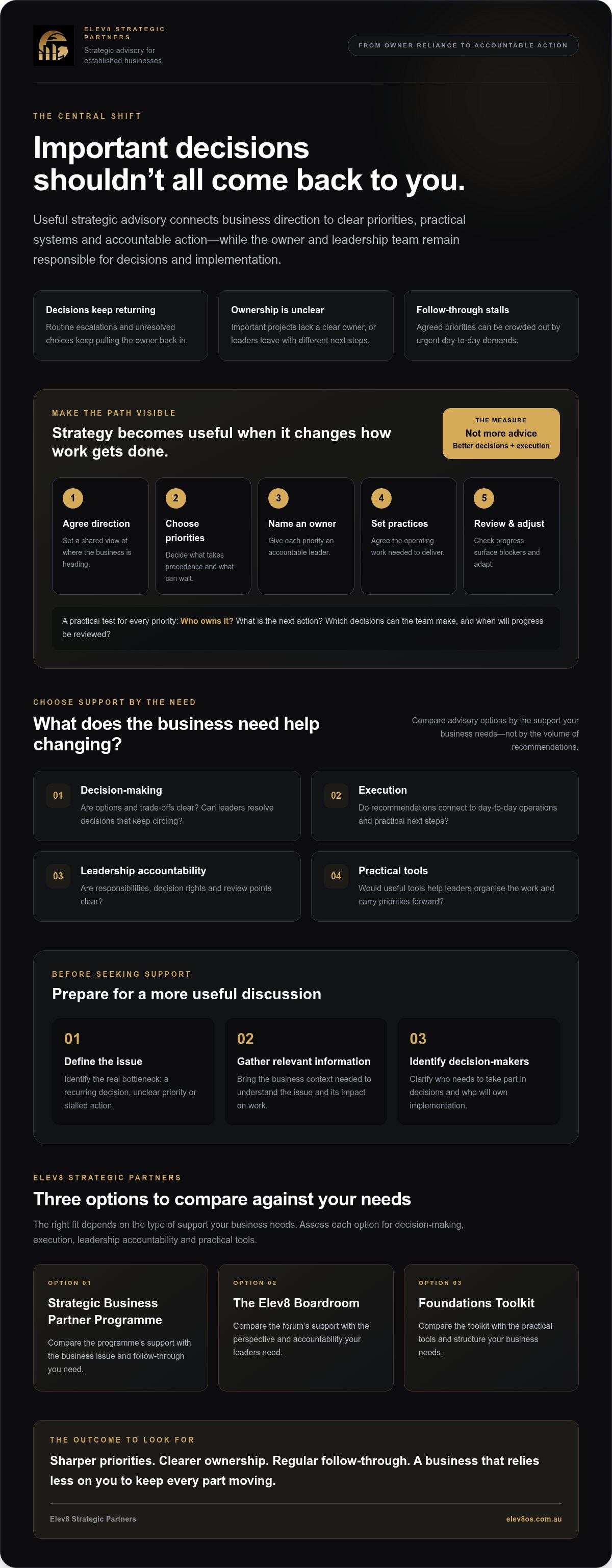
A business direction matters only if it changes how work gets done. Make the path from strategy to execution visible: agree on the direction, choose a manageable set of priorities, assign an owner to each, set the operating practices needed to deliver them, then review progress and adjust.
Strategy sets the direction; operational execution turns it into owned work, decisions and follow-through. Harvard Business School Online’s discussion of successful strategy execution also focuses on the gap between a plan and its implementation. Without clear ownership and review, urgent daily demands can crowd out agreed priorities.
Leadership alignment is practical, not ceremonial. Leaders need a shared view of what comes first, what can wait and who can make which decisions. Governance, in this context, means clarifying decision rights, accountability and escalation paths. It doesn’t automatically mean adding formal structures. If your business has specific legal or regulatory obligations, verify them with an appropriately qualified professional rather than assuming a general advisory discussion covers them.
Turn strategic priorities into decisions and ownership
For each priority, name an accountable owner, agree on the next action and set a review point. Illustrative example: if improving delivery reliability is a priority, a leader might review recurring delays, propose an operational change and report back at the next leadership review. Clear decision rights also show the team what they can resolve themselves and what genuinely needs the owner’s input.
Build an operating rhythm that keeps leaders accountable
Use regular leadership reviews to check decisions, blockers and agreed actions. Track a small number of measures tied directly to priorities. Reporting that doesn’t inform a decision adds overhead. Record decisions, owners and next actions in a shared system so important work doesn’t depend on memory, repeated follow-ups or individual workarounds.
Use a simple test: can leaders explain what matters now, who owns the next step and when progress will be reviewed? If not, the operating rhythm may need attention. For a practical reference point, explore Elev8’s strategic support and consider how its focus on alignment, execution and accountability relates to your leadership team’s needs.
How to assess strategic advisory against your business needs
Start with the bottleneck, not the format. Do you need help making a difficult decision, keeping a priority moving, aligning leaders or putting clearer operating systems in place? Strategic advisory for established business owners should address a need you can identify, rather than offering a structure before understanding the problem.
Use these areas to compare the support on offer. Ask for specifics, not broad assurances.
| Area | What to clarify | What to look for |
|---|---|---|
| Decision support | How will discussions help us weigh options and set priorities? | A clear process for turning business issues into decisions and next steps. |
| Execution involvement | What happens after a decision is made? | Clarity on how actions are tracked, where support applies and what remains the team’s responsibility. |
| Leadership accountability | How are owners, responsibilities and follow-through agreed? | A defined approach to reviewing commitments and surfacing blockers. |
| Practical tools | What frameworks, templates or systems are available? | Tools that address a real gap in your operating foundations, rather than adding paperwork. |
Questions to ask before engaging an adviser
Ask how a priority becomes an action, who owns follow-through and how progress is reviewed. Clarify what the adviser expects from you and your leadership team between discussions. Request relevant examples and check what they demonstrate: a process, a change in responsibilities or documented follow-through. Treat outcome claims carefully and ask what evidence supports them.
It’s reasonable to ask how you can avoid ending up with another set of recommendations. Look for a clear explanation of how discussions connect to action, what each party is responsible for and how the work will be reviewed. If the answers stay vague, ask for more detail before deciding.
Match the support model to the problem
For business-wide alignment and execution, consider whether you need structured guidance involving the owner and leadership team. Peer discussion may suit leaders who want to test assumptions, hear strategic feedback and build accountability. Practical frameworks may be more relevant when responsibilities or operating systems need clearer structure. These needs can overlap, but the formats aren’t interchangeable. Choose based on the gap, not on which option sounds most appealing.
For example, Elev8’s Strategic Business Partner Programme combines structured guidance with strategic execution; The Elev8 Boardroom offers curated peer discussion, strategic feedback and accountability; and the Foundations Toolkit provides practical frameworks, templates and systems. Compare each against your requirements, and confirm the current format, responsibilities and review process before deciding.
How to prepare for strategic advisory as a regional NSW business owner
Make the first discussion useful before it starts. Bring a clear account of the issue, the evidence behind it and the people who need to make or carry out the decision. Strategic advisory for established business owners works best when the conversation is grounded in how the business actually operates, not a broad request to “grow” or “improve”.
Prepare the business problem before the first discussion
Write down decisions that keep returning without resolution. Note where work stalls, where responsibilities blur and which issues repeatedly land back with you. Bring relevant plans, operating measures and examples that show what’s happening, such as priorities that keep slipping or decisions that are revisited without a clear next step.
Keep your preparation focused. Gather:
- Current business priorities and the plans intended to support them.
- Existing systems or routines used to track work and decisions.
- Examples of recurring bottlenecks, escalations or inconsistent follow-through.
- The names or roles of people who need to take part in decisions and implementation.
You don’t need a polished presentation. You need enough detail to separate symptoms from the underlying problem. Be clear about what you want the discussion to resolve, what you’ve already tried and what decision is now required.
Check regional access and working arrangements
Elev8 Strategic Partners lists Tamworth, Newcastle, Armidale, Coffs Harbour, Port Macquarie and Moree as service locations. A location listing doesn’t confirm a particular delivery arrangement or current availability, so check the details directly before making plans.
Ask how discussions and follow-up work for your location. Confirm the delivery format, meeting cadence, who should participate, which communication channels are used and what’s expected between sessions. If in-person meetings are relevant, clarify any travel expectations rather than assuming they’re included. Agree what information you’ll provide, who will make decisions and how actions will be followed up.
These questions help you assess fit as well as prepare. The arrangement should make it practical for the people responsible to take part and keep decisions connected to the work, without leaving the owner to carry every action alone.
Once you’ve mapped the issue and the working arrangements you need, review Elev8’s strategic support and consider how it aligns with your business requirements.
What strategic advisory with Elev8 Strategic Partners can involve
Strategic advisory for established business owners should match the work the business needs to move forward. Elev8 Strategic Partners offers three forms of support, each with a different emphasis: structured guidance and execution, peer discussion and accountability, or practical operating frameworks.
Choose the Elev8 support that fits the work ahead
The Strategic Business Partner Programme combines structured guidance with strategic execution. It may be relevant if the central challenge is aligning business direction with priorities and carrying those priorities into action. Clarify how the programme works in practice, what execution support involves and what will be expected from you and your leadership team.
The Elev8 Boardroom offers curated peer discussion, strategic feedback and accountability. It may suit an owner or leadership team looking to test assumptions, hear other perspectives and maintain focus on commitments. Ask about the current format and how participation supports the issues you want to work through.
The Foundations Toolkit provides practical frameworks, templates and systems. Consider it if the gap is in the structure underpinning day-to-day operations, such as organising responsibilities more clearly or putting repeatable practices in place. Confirm which tools are included and how they relate to your needs.
These options address different needs, though your requirements may overlap. A leadership team might need structured support to align and execute priorities while also needing clearer operating frameworks. Be specific about the constraint you’re trying to address before deciding which format fits.
Take the next step with clear expectations
Describe the current constraint plainly: what keeps getting stuck, who it affects and what you want to change. Then ask Elev8 to confirm programme suitability, format and availability. Check who needs to participate, what’s expected between discussions and how responsibilities and follow-through are handled.
Fit depends on the owner’s needs, the leadership team’s willingness to engage and the arrangements confirmed directly with Elev8. Don’t choose based on a label alone. Choose support that connects to work your business is prepared to do.
Discuss strategic support with Elev8.
Put the next strategic decision into motion
Effective strategic advisory for established business owners should leave the business clearer on what matters, who owns the work and how progress will be reviewed. The right support strengthens your judgement and your leadership team’s follow-through. It doesn’t take responsibility for decisions away from you.
Elev8 Strategic Partners’ Strategic Business Partner Programme combines structured guidance with strategic execution. The Elev8 Boardroom offers peer discussion, strategic feedback and accountability. Elev8 lists service locations across regional New South Wales, including Tamworth, Newcastle, Armidale, Coffs Harbour, Port Macquarie and Moree. Confirm current programme arrangements and suitability against your needs.
Name the constraint that keeps pulling you back into the day-to-day. Then take a considered next step: discuss the strategic work your business needs with Elev8. Clear priorities and shared responsibility can help build a business that moves forward with less reliance on you to carry every decision.
Frequently Asked Questions
What is strategic advisory for established business owners?
Strategic advisory for established business owners is structured support to help an owner and leadership team make important decisions, set priorities and connect those priorities to business operations. It should address the company’s actual constraints, not deliver generic advice. Before engaging an adviser, ask how recommendations become owned actions, who is responsible for follow-through and how progress will be reviewed.
When should an established business owner seek strategic advisory?
Consider strategic advisory when important decisions keep returning unresolved, operations are harder to coordinate or too much work still depends on you. These signs don’t automatically mean you need an external adviser. First define the problem, identify who must act and decide what practical change would make support worthwhile. For example, clarify whether you need to resolve a decision bottleneck or make responsibilities clearer across the leadership team.
How is strategic advisory different from business coaching?
The terms can overlap, so compare the work rather than relying on labels. Ask whether the support focuses on your development, business-wide priorities, leadership alignment, execution or a combination. Clarify who is responsible for implementing agreed actions and how progress is reviewed. The right approach should match the business’s needs, with clear expectations and responsibilities. Don’t assume a title alone tells you what an adviser will do.
What should I ask a strategic business adviser before engaging them?
Ask how they assess your business, turn priorities into actions and review follow-through. Clarify the time commitment expected from you and your leadership team, the meeting cadence and what support continues between discussions. Request relevant examples and ask what can be verified. Then test whether the proposed approach addresses your specific constraint, such as stalled decisions or unclear ownership, rather than applying a standard answer to every business.
Can strategic advisory help a business that has plateaued?
It may help identify whether a plateau is connected to unclear priorities, leadership alignment, operating systems or decisions bottlenecked with the owner. Advisory alone can’t guarantee growth or a particular financial result. The practical test is whether the work helps your leadership team understand the constraint, assign actions and review progress against relevant business priorities. Start by defining what has stalled and what evidence would show that the underlying issue is being addressed.
Is strategic advisory available to businesses in regional New South Wales?
Elev8 Strategic Partners lists Tamworth, Newcastle, Armidale, Coffs Harbour, Port Macquarie and Moree among its service locations. Confirm current availability, delivery format and meeting arrangements for your area directly with Elev8. Ask how follow-up works and who needs to participate, especially if your leadership team operates across multiple locations. A location listing doesn’t confirm a specific delivery arrangement, so check the details before making plans.
What happens in a strategic advisory engagement?
The format depends on the provider and programme, so confirm the details before committing. A sound process should clarify the business challenge, agree priorities, identify responsibilities and establish how actions will be reviewed. Ask what preparation is expected, who should attend and how the work connects to your existing systems. At Elev8, support options include the Strategic Business Partner Programme, The Elev8 Boardroom and the Foundations Toolkit; check which, if any, fits your needs.