
Peer Advisory vs Business Coaching: Which Helps Your Business Move Forward?
What if the best support for your business isn’t another person with an answer? If you’re weighing peer advisory vs business coaching, the real question is what kind of challenge you need to work through. More opinions won’t help if there’s no structure for testing a decision, building a capability or following through.
It’s easy to blur individual development and peer challenge. They serve different purposes. Business coaching typically centres on your development and accountability in one-to-one sessions. Peer advisory brings business owners together to test decisions against experience, challenge assumptions and stay accountable to action.
This article compares their purpose, format and fit, so you can match the support to the constraint in front of you. It also explains what meaningful participation and progress require. Elev8’s Boardroom Program is a facilitated peer-advisory group with monthly half-day sessions and a maximum of four seats per room. It’s structured challenge, not one-to-one development. Elev8’s broader operating principle is embedded over advisory: working inside the business, communicating honestly, and building towards agreed outcomes.
Key Takeaways
- Choose support by the work required: individual development, structured peer challenge or operational execution.
- In peer advisory vs business coaching, the key difference is where input comes from and how sessions are structured.
- Name the constraint, decide what kind of input you need, then define how you’ll act on it.
- Peer input is only useful when you arrive prepared, speak candidly and participate actively.
- The Elev8 Boardroom Program offers monthly facilitated half-day sessions, hot-seat work and peer accountability, with a maximum of four seats per room.
Peer Advisory vs Business Coaching: What Problem Are You Actually Solving?
Individual development and structured peer challenge are different kinds of support. Business coaching is typically a one-to-one process focused on the owner’s goals, behaviour or leadership capability. Peer advisory is a facilitated group process where business owners bring live issues and test them against the experience and questions of other members.
Neither format is automatically better. The useful question behind peer advisory vs business coaching is more specific: are you trying to build your own capability, make a stronger decision, or get a change implemented? A conversation can sharpen your thinking. It won’t, by itself, change a system, assign responsibility or carry work through the business.
For a foundational overview of its purpose and practice, Business coaching is generally described as a process that supports business owners and leaders in their work. The format and methods can vary between providers, so don’t assume every engagement follows the same structure or produces identical outcomes.
What does business coaching typically focus on?
In a one-to-one process, attention stays on you and the goals you bring. Regular conversations can help you reflect on a difficult leadership situation, identify a behaviour that’s getting in the way, or set priorities when competing demands are pulling you in different directions. The value depends on the focus of the work and your willingness to act between sessions. It’s personal development and accountability, not a guarantee that operational changes will be built for you.
What happens in a peer advisory group?
A facilitated peer group gives owners a structured place to put current business challenges under scrutiny. In hot-seat work, one member presents a specific issue while the group asks focused questions, tests assumptions and offers perspectives drawn from its members’ experience. The aim is not to collect as many opinions as possible. It’s to surface blind spots and clarify options, while the decision remains yours.
That structure separates peer challenge from casual networking. A general conversation might produce contacts or a useful tip; a focused session works on a defined problem, with a facilitator keeping discussion on track. Preparation matters. Bring the facts, explain what you’ve already tried and state what decision you need to make. Vague questions invite vague input.
Peer perspectives can broaden your view, especially when you’re too close to a decision to see its assumptions. But agreement from a group isn’t proof that a choice is sound, and discussion doesn’t create implementation capacity. If the bottleneck is your leadership judgement or consistency, individual development may be the closer fit. If you need experienced people to test a live decision, structured peer challenge may help. If the decision is clear but the business lacks the systems, ownership or follow-through to execute it, you need operational work inside the business. Diagnose that constraint first. Then choose the format that works on it.
How Peer Advisory and Business Coaching Work in Practice
The difference shows up in the rhythm of the work. A one-to-one engagement gives one person sustained attention to your goals and circumstances. A peer group puts a live business issue in front of several owners, with a facilitator guiding the discussion. Both need focus between sessions; neither format creates progress just by appearing in the calendar.
There’s no single standard for either format. Session length, frequency, group size, facilitation style and participant expectations vary between programmes. Look at the working pattern, not just the label. What do you bring into each session? What happens afterwards? Who owns the next step?
What to expect from one-to-one coaching conversations
Goal-setting, reflection and follow-up are common elements, though the exact approach depends on the provider and the work agreed. A private conversation can make room for personal context that may be hard to discuss in a group, such as a leadership habit, a difficult relationship at work or hesitation around a decision.
That attention can sharpen your priorities. But if the problem spans the business, insight alone may not be enough. A new operating process still needs an owner, clear steps and follow-through across the team. Be clear about whether the work is meant to develop your capability or also address business-wide implementation.
What makes a peer group useful rather than just social?
A useful session has a clear structure, active facilitation and a defined challenge to examine. The member in the hot seat should explain the issue, relevant facts and the decision or obstacle they’re working through. Other members then ask focused questions and offer perspectives, rather than jumping straight to generic advice.
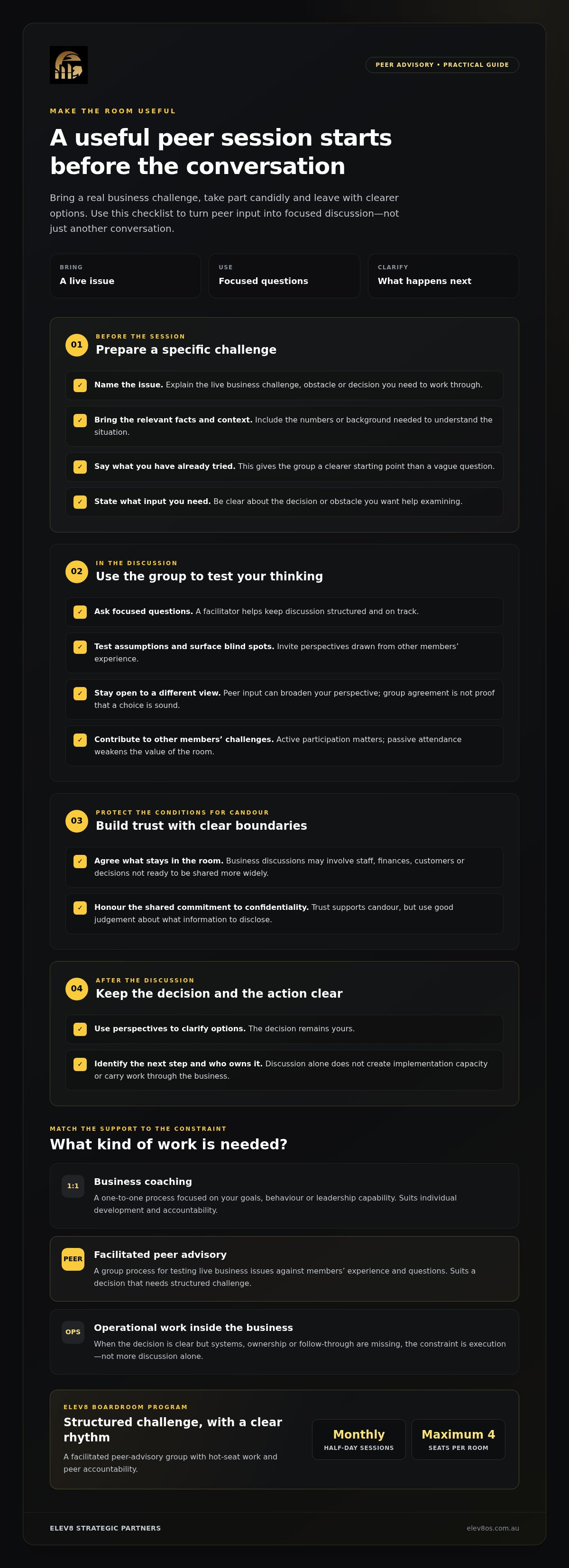
Preparation changes the quality of the conversation. Bring the numbers or context needed to explain the issue, identify what you’ve already tried and be ready to hear a view you may not share. Members also need to contribute to others’ challenges; passive attendance weakens the value of the room.
Confidentiality is practical, not decorative. Business owners may discuss staff, finances, customers or decisions that aren’t ready to be shared outside the group. Members need clear expectations about what stays in the room and a shared commitment to honour them. Trust supports candour, but it doesn’t replace good judgement about what information to disclose.
Peer feedback can inform a decision, but it doesn’t implement the decision. You still need to choose a course, assign responsibility and make sure the work happens. That distinction matters if your real constraint is execution rather than perspective.
For a concrete example of a facilitated peer format, the Elev8 Boardroom Program runs monthly half-day sessions with hot-seat challenge work and peer accountability. Each room has a maximum of four seats, and members are expected to arrive prepared and participate actively. Explore the Elev8 Boardroom Program if structured peer challenge fits the work you need to do.
Peer Advisory vs Business Coaching: Compare Fit, Focus and Accountability
The right format depends on what needs to shift. A complex decision may benefit from challenge from people who understand the pressure of ownership. A personal leadership goal may need private attention and space to examine your own habits. Neither format guarantees a better decision or stronger execution. The work still depends on the quality of the conversation and what you do afterwards.
| Comparison | Peer advisory | One-to-one business coaching |
|---|---|---|
| Primary focus | A live business issue, decision or competing priorities. | The business owner’s goals, behaviour or leadership capability. |
| Source of input | Perspectives and questions from other business owners, guided by a facilitator. | A private conversation centred on the individual’s circumstances and goals. |
| Session format | Facilitated group discussion, which may include focused challenge work on one member’s issue. | Individual sessions, with structure and methods that vary by programme. |
| Accountability | Peers can question assumptions and ask what action follows; the member remains responsible for acting. | Regular conversations may support reflection and personal follow-through; implementation still needs clear ownership. |
Use the comparison as a starting point, not a verdict. The label alone won’t tell you whether the format can address your constraint.
When is peer advisory likely to fit better?
Peer advisory may suit a decision with several moving parts: whether to pursue a new market, how to handle competing priorities, or whether a growth plan rests on assumptions that haven’t been tested. Other owners can bring perspectives shaped by the pressures of running a business. That input is most useful when you share enough context, stay open to challenge and are willing to test your own reasoning.
When might one-to-one business coaching fit better?
One-to-one support may be a closer fit if your goal is to change a leadership habit, communicate more clearly with your team or reflect on a sensitive personal challenge. A private setting can keep attention on your experience without requiring you to discuss it in a group. If the goal also involves changing how the business operates, name who will own each step and how progress will be followed through.
Choose the format by the work needed, not the label alone. In peer advisory vs business coaching, the practical distinction is whether you need outside challenge on a business issue or sustained attention to your individual development. If the real gap is implementation, neither a strong discussion nor a personal insight replaces owners, systems and action inside the business.
How to Choose the Right Support for Your Business Challenge
Choose support after you’ve identified the constraint. A decision that needs sharper scrutiny is different from a leadership capability gap. And both differ from a business that knows what to do but can’t get the work built and moving. Use these four steps to match the format to the job.
- Name the problem. Describe what’s stuck in plain terms. Is the gap your own capability, a decision that needs broader perspective, or operational execution? “We need to grow” is too broad. “Our sales process loses momentum after proposals go out” gives you something to diagnose.
- Identify the input you need. Do you need a private space to examine how you lead, or a group to question your assumptions about a business choice? If the process itself is broken, ask what operational changes, ownership and systems are required. Discussion can clarify the issue; it doesn’t automatically build the fix.
- Assess your readiness. Look honestly at the time you can commit, the context you’re prepared to share and your willingness to hear candid feedback. In a peer group, will you prepare a clear issue and contribute to others’ discussions? Can you respect confidentiality? If you want reassurance but aren’t ready to test your thinking, the format may not deliver much value.
- Define follow-through. Decide who owns the next action and what observable progress looks like. That might mean a documented decision, a process assigned to a team member or a specific change in how you lead. Without an owner and a next step, support risks becoming another conversation rather than useful work.
Diagnose the work before choosing a format
Separate thinking from building. If you’re weighing two options, peer challenge may help expose risks and blind spots. If you need to develop a personal leadership habit, individual work may provide the focus to examine it. If an agreed decision has stalled because nobody owns implementation, the priority is operational execution. Name the gap first, then decide what kind of support can address it.
Keep the measure practical. What should be different in the business if the support is working? You might expect a decision to be recorded, a responsibility clearly assigned or a recurring bottleneck to have a defined process. Don’t confuse time spent in sessions with progress on the ground.
Check readiness for a peer advisory commitment
Peer discussion asks something of you. Arrive prepared, share enough detail for members to understand the issue, and be willing to question your own assumptions. Protect other members’ sensitive information too. Most importantly, make room to act between sessions. If there’s no time or intention to follow through, more perspectives may simply add to the noise.
If the diagnosis points to execution rather than more discussion, consider embedded operational support. Elev8’s operating principle is embedded over advisory: working inside the business towards agreed outcomes, not relying on a boardroom conversation to carry change through.
How Elev8’s Boardroom Program Fits, and Where Embedded Execution Begins
The Elev8 Boardroom Program is a facilitated peer-advisory group for business owners who want structured challenge around live business issues. Josh Lawrence facilitates the monthly half-day sessions and provides members with direct access. The work includes hot-seat challenge sessions and peer accountability. It creates a disciplined space to examine decisions; it doesn’t execute operational change inside your business.
Max 4 seats per room. The small room supports focused discussion, but the value still depends on what each member brings. Arrive prepared with the relevant context, take part actively, and be candid about what’s happening. Listening alone won’t deliver the full benefit. Members are expected to contribute to the discussion and follow through on their own commitments.
What the Elev8 Boardroom Program is designed to provide
The programme combines structured peer challenge with an annual business review and access to Elev8 frameworks. It’s ongoing, with a 30-day written notice required to exit. That commitment calls for consistent participation, not occasional attendance when a difficult decision lands. For a broader view of what to consider in a peer group, use the guide Executive Peer Advisory Boardroom Australia: A Practical Buyer’s Guide.
This is a peer format, not one-to-one personal development and not embedded delivery. The distinction matters in any comparison of peer advisory vs business coaching: group challenge can help you test your thinking, but responsibility for decisions and implementation stays with you. The group can raise questions you haven’t considered. It can’t assign work across your team or build the systems needed to carry it out.
When the business needs embedded operational work
If the constraint is execution, Elev8’s separate Strategic Operations Engagement addresses a different need. The operating principle is embedded over advisory: Elev8’s Strategic Operations Engineer works inside the business, not from a boardroom. The distinction is practical. A peer session can challenge a plan; embedded work tackles the operational conditions that prevent the plan from being delivered.
Elev8 also operates on outcomes over tenure. Engagements conclude when agreed outcomes are delivered and the business is positioned to grow without Elev8. And honest over comfortable: Elev8 communicates the truths clients need to hear, including those they may not want to hear. That standard keeps attention on the actual constraint, not on reassuring conversation.
Tier 1 has an additional boundary: only one active client is allowed per industry vertical at any time. The Boardroom Program and embedded operational work serve distinct purposes. Choose the room for structured peer challenge; choose embedded execution when the business needs hands-on work to deliver agreed outcomes.
Make the Next Move Deliberate
The useful next step isn’t choosing a format because it sounds right. It’s naming the constraint you need to shift, then deciding what kind of support can meet it. That turns peer advisory vs business coaching from a label debate into a practical decision about what your business needs now.
If structured peer challenge may fit, start with a clear view of the issue you’d bring to the room and the actions you’re prepared to take afterwards. The required entry point for the Boardroom Program is a diagnostic 30-45 minute video conversation with Josh Lawrence. It isn’t a sales call, and there’s no pitch deck or slide presentation. It’s a direct conversation to assess fit.
Book a diagnostic Discovery Call and bring the business constraint you most need to resolve. A sharper diagnosis gives you a stronger basis for your next move.
Frequently Asked Questions
What is the main difference between peer advisory and business coaching?
The main difference in peer advisory vs business coaching is whose perspective shapes the conversation. One-to-one business coaching typically centres on an owner’s individual goals and development. Peer advisory brings other business owners into the discussion to challenge a live business issue. For example, you might use peer input to test assumptions behind a major decision, then work separately on the leadership habits needed to carry it through.
Is peer advisory the same as a business advisory board?
No. Peer advisory generally describes a facilitated group where members share challenges and offer perspectives. A business advisory board may refer to a group appointed to provide continuing strategic input to a particular business. The terms can be used differently, so focus on the actual structure: who participates, what the group is expected to do, and whether members discuss their own issues together or advise one organisation.
Can peer advisory and business coaching work together?
Yes, they can address different parts of the same challenge. A business owner might use peer discussion to test a pricing or expansion decision, then use individual development work to improve how they communicate that decision to the team. Keep the purpose of each format distinct. Otherwise, you risk paying for overlapping conversations without deciding who owns the practical next step.
Who benefits most from a peer advisory group?
Owners benefit when they have a real business issue to put forward, can share enough context for useful discussion and are willing to act on what they hear. The format may suit established owner-led businesses more than people looking only to expand their contact list. Business owners in Tamworth, Newcastle, Armidale, Coffs Harbour, Port Macquarie and Moree can assess fit by asking whether they’ll prepare and contribute, not just attend.
What happens during a peer advisory session?
A member brings a current challenge for focused discussion. In a hot-seat session, the facilitator guides questions and peer perspectives around that issue, helping the owner examine assumptions and options. The Elev8 Boardroom Program meets monthly for half-day sessions, with a maximum of four seats per room. Members are expected to prepare and participate actively, so arrive ready to explain the situation and engage with other members’ challenges.
How do I know if I need peer input or operational execution?
Choose peer input if the decision is still unclear and you need assumptions tested. Choose operational execution if the direction is set but responsibilities, systems or follow-through are holding up delivery. Ask who will own the next action and what needs to change in the business. Elev8 allows only one active Tier 1 client per industry vertical at any time, reflecting its focused embedded model.
Is the Elev8 Boardroom Program a business coaching service?
No. The Elev8 Boardroom Program is a facilitated peer-advisory group, built around shared challenge and accountability rather than one-to-one personal development. It’s distinct from Elev8’s embedded Strategic Operations Engagement, where a Strategic Operations Engineer works inside the business. The required entry point for the Boardroom Program is a diagnostic 30-45 minute video conversation with no pitch deck or slide presentation. It’s a diagnostic discussion, not a sales call.