
How to Set Up an Advisory Board: Australian Guide
An advisory board built around impressive titles can still leave a business stuck. The useful question isn’t who looks good at the table, but which decisions need better advice. If you’re working out how to set up an advisory board, start with the commercial problems it should help you solve.
Experienced advisers can bring perspective, challenge assumptions and help fill gaps in your leadership team. But without a clear remit, the right mix of expertise and a disciplined meeting rhythm, advice can stay in the room and go nowhere.
This Australian guide shows you how to define the board’s purpose and measures of success, choose advisers whose experience matches your needs, and set clear expectations for confidentiality, conflicts and follow-through. You’ll also learn how to keep the group advisory rather than decision-making, and turn each discussion into actions with an owner and a review date.
A formal advisory board is built for one company. A peer advisory group works differently, bringing business leaders together to share insight and accountability. Understanding the distinction helps you choose the structure your business needs, whether that’s periodic advice or ongoing strategic support to keep execution moving.
Key Takeaways
- Learn how to set up an advisory board around the decisions that need sharper thinking, not status or titles.
- Set a clear remit, boundaries and measures of success before inviting advisers to join.
- Match each board need with relevant experience and perspectives that can challenge your thinking without taking ownership away from you.
- Use focused agendas, useful pre-reading and clear follow-through to turn discussions into actions with owners.
- Review whether the board is improving decisions and filling expertise gaps, then consider what ongoing strategic support could add.
How to set up an advisory board and what it should do
You’re making high-stakes decisions with limited time, incomplete information or gaps in your leadership team. You need sharper thinking, independent challenge and expertise that fits the problem, not another meeting that produces a polished list of opinions.
An advisory board gives a business owner focused, non-binding advice on agreed questions. It does not automatically have authority to make company decisions. That distinction is the starting point for how to set up an advisory board with a useful purpose rather than a prestigious nameplate.
What is an advisory board, and what is it not?
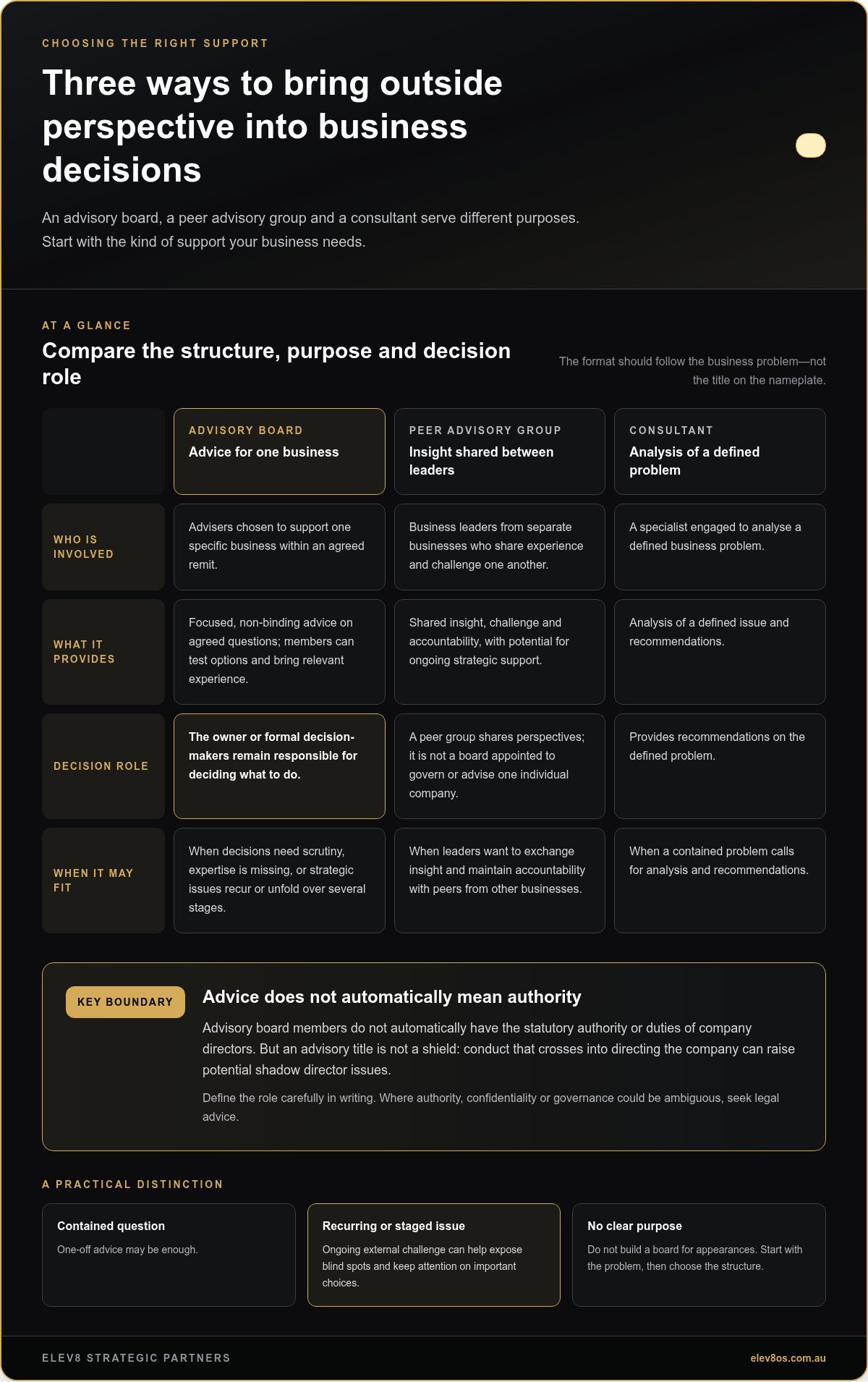
An advisory board is a group of people chosen to advise one specific business within an agreed remit. Members can question assumptions, test options and bring experience the leadership team lacks. The owner or company’s formal decision-makers remain responsible for deciding what to do. The Advisory board overview provides further background on the concept and how it differs from a board of directors.
That difference matters in Australia. Advisory board members don’t automatically have the statutory authority or duties of company directors simply because they have an advisory title. But a title isn’t a shield: if a person’s conduct crosses into directing the company, legal questions can arise, including potential shadow director issues. Define the role carefully in writing and get legal advice on the arrangement where needed.
An advisory board isn’t the same as a consultant engaged to analyse a defined problem and provide recommendations. It also differs from a peer advisory group, where leaders from separate businesses share experience and challenge one another. The Elev8 Boardroom, for example, is an executive peer advisory group, not a board appointed to govern or advise one individual company.
When does an advisory board solve a real business problem?
A board is useful when you can name the decisions that need better scrutiny. You might be weighing expansion into a new market, preparing for succession, changing how the business operates or responding to a major shift in demand. These are decisions with consequences beyond the next week’s workload.
One-off advice may be enough for a contained question. But when the same strategic issues keep returning, or a decision unfolds over several stages, ongoing external challenge can help expose blind spots and keep attention on the choices that matter.
That doesn’t mean every business needs an advisory board. If you can’t identify a recurring decision, a specific expertise gap or a clear purpose for advisers, don’t build a board for appearances. Start with the problem. Choose the structure second.
Define the advisory board’s remit before inviting anyone
Before approaching potential advisers, describe the business need clearly. “Help us grow” is too broad to guide membership or meetings. A stronger remit names the decisions that need scrutiny and the experience required to challenge them.
A clear remit keeps meetings from becoming unfocused status updates. Use this sequence to set the board’s scope before you build it:
- Diagnose the need. Name the recurring decision or capability gap. For example, you may need informed challenge on whether your current leadership structure can support expansion.
- Set boundaries. State what advisers can examine and recommend, and what remains the owner’s or company’s decision. Include expectations for confidentiality and conflict disclosure.
- Choose priorities. Turn broad ambitions into a small set of questions the board can help answer. Focus on issues where outside experience could change the quality of your thinking.
- Define review measures. Decide how you’ll assess usefulness. For example, track whether priority actions are completed, key decisions are made with better evidence, or a known expertise gap is addressed. Advisers can inform progress, but they can’t promise business outcomes.
How do you write an advisory board charter?
Keep the charter short enough to use. Record the board’s purpose and scope, membership expectations, meeting cadence, confidentiality arrangements and the date you’ll review its fit. Spell out what advisers may recommend and what stays with the owner or formal decision-makers. A written boundary is practical, not decorative. If wording around authority, confidentiality or governance could be ambiguous, have it reviewed by a qualified legal or governance professional.
Which business decisions belong on the agenda?
Bring live strategic questions, not routine operational reports. Depending on your business, useful topics might include growth options, leadership capacity, material risks, succession planning or a significant operating change. Don’t add a topic just because it sounds strategic. Frame each item as a decision or question, then agree what progress would look like, such as assessing an expansion option or assigning an owner to address a leadership capability gap.
For established leaders who need support beyond periodic board discussions, ongoing strategic alignment can help connect priorities to execution. Explore structured strategic support as one way to maintain that focus.
Choose advisers for useful challenge, not impressive titles
Good advisers can challenge your thinking without taking ownership of the business away from you. Their role is to test assumptions, expose risks and offer relevant experience. Decisions remain with you and the company’s established decision-makers.
When working out how to set up an advisory board, start selection with the remit, not a list of impressive names. Choose people whose judgement and experience address the gaps you’ve identified. A celebrated title won’t help if the person can’t engage with the decisions on your table.
What experience should advisory board members bring?
Map each priority to the experience, perspective and contribution you need. A business weighing expansion might need someone who has managed growth, alongside a commercial perspective on the numbers and a practical view of operational capacity. Add people or regional knowledge where those factors shape the decision. For a regional NSW business, local market conditions, networks or travel logistics may also matter.
| Board need | Relevant experience | Useful contribution |
|---|---|---|
| Assess expansion | Scaling operations or entering new markets | Test assumptions about capacity, timing and risk |
| Strengthen leadership | People leadership or organisational change | Identify capability gaps and pressure-test role design |
| Plan succession | Business transition or leadership continuity | Surface dependencies and compare transition options |
| Understand local conditions | Relevant regional NSW industry or market experience | Bring context on local networks, customers or operating realities |
Use this as a working comparison, not a checklist of prestigious backgrounds. Balance commercial, operational and people perspectives only where they serve the remit. Look for sound judgement, careful listening and constructive challenge. An adviser who only agrees adds little; one who dominates the room can be just as unhelpful.
How do you approach and assess potential advisers?
Share the board’s purpose, expected contribution and meeting commitment before discussing an appointment. Then hold a structured conversation. Ask how they would approach a live issue, what information they’d need and how they handle disagreement. Notice whether they listen before prescribing and challenge ideas without dismissing the people behind them.
Discuss conflicts of interest, confidentiality expectations and the terms of the relationship directly. Ask how potential conflicts would be disclosed and managed, and what information should remain restricted. Don’t rely on an informal understanding. Record the agreed arrangements and have the wording reviewed by an appropriate legal or governance professional if there’s uncertainty about confidentiality, conflicts or the adviser’s role.
Run advisory board meetings that turn discussion into action
Match the meeting rhythm to the decisions ahead. Meet often enough to keep important issues moving, but give advisers time to consider the material and prepare. A major expansion decision may need a different timetable from a broader review of leadership capacity.
Build each meeting around a clear question. Send relevant pre-reading early enough to be useful, and replace lengthy operational reports with a short update on material changes. Your role is to bring the issue into focus, invite challenge and make clear what decision or advice you need.
What should an advisory board meeting agenda include?
Use a consistent agenda so the conversation moves from progress to the work ahead:
- Check previous actions. Confirm what’s been completed, what’s stalled and what needs a decision.
- Surface material changes. Share developments that could affect current priorities, not a full operational download.
- Work through the priority question. Protect most of the discussion time for the decision or strategic issue that needs the board’s attention.
- Close with clear commitments. Record recommendations, the owner’s decision, each action lead and a follow-up date.
Advice creates value only when decisions and actions are tracked. After the meeting, circulate a concise record of agreed actions and dates, then use it to open the next discussion. Recommendations are not decisions, so record them separately and keep responsibility clear.
As you decide how to set up an advisory board, build follow-through into the process from the start. A useful discussion ends with a next step, an owner and a date to review progress.
How can regional NSW businesses keep the board connected?
Distance affects meeting design. If advisers travel between Tamworth, Newcastle and Armidale, weigh travel time against the urgency and substance of the agenda. For members spread across Coffs Harbour, Port Macquarie or Moree, remote meetings can reduce travel while keeping the group connected.
Whichever format you use, keep the working standards consistent. Share pre-reading through an agreed, secure channel, make sure participants can contribute and send the same action record to everyone. Don’t let a change of format weaken preparation or follow-up.
If your business needs ongoing strategic alignment and accountability beyond periodic board meetings, explore structured strategic support.
Review the board’s value, and choose the right support for the next step
An advisory board shouldn’t keep its place by default. Review whether it’s improving the decisions it was formed to support, helping close priority actions and adding expertise the business didn’t have in-house. Schedule the review in advance and use the original remit as your test.
How do you know whether your advisory board is working?
Compare what’s changed with the purpose you set at the outset. Are decisions better informed? Are agreed actions moving forward? Does discussion add a useful outside perspective, or repeat reporting your leadership team already hears? These questions help reveal whether the board is doing its job.
Review membership, remit and meeting rhythm on a set schedule, and revisit them sooner if business priorities materially change. A shift in direction may call for different experience or a narrower focus. If meetings generate discussion but no clearer decisions or follow-through, adjust the structure rather than accepting drift.
When might structured strategic support be a better fit?
A company-specific advisory board is built to advise one business against its agreed remit. A facilitated peer advisory group works differently: leaders from separate organisations share perspectives and hold one another accountable. Neither replaces the other. Choose based on the kind of challenge you need and how closely it must connect to your company’s decisions.
If the need extends beyond occasional advice, ongoing strategic alignment may help connect priorities to execution. Elev8’s Strategic Business Partner Programme provides structured strategic alignment and leadership support. The Elev8 Boardroom is an executive peer advisory group focused on collaborative insight and accountability. It offers a peer format, not a board appointed to advise one individual company.
As you consider how to set up an advisory board, keep the distinction clear: decide whether your business needs company-specific advice, peer challenge or more continuous strategic support. Then choose the structure that fits the work ahead.
Explore Elev8’s strategic support.
Turn experienced advice into forward movement
Knowing how to set up an advisory board means building more than a room of experienced people. Start with the decisions that need sharper thinking, give the board a clear remit, then choose advisers whose judgement and expertise fit the work. Keep meetings focused, record who owns each action and review whether the board is improving decisions and closing priority gaps.
The right structure depends on the support your business needs. A company-specific advisory board offers advice to one business. For ongoing strategic alignment and leadership support, Elev8’s Strategic Business Partner Programme provides a structured option. The Elev8 Boardroom is different: an executive peer advisory group that brings collaborative insight and accountability to senior executives.
If periodic advice isn’t enough to keep priorities moving, explore Elev8’s strategic support. Set the standard, choose the support that fits and put better decisions to work. Your next step can start with a clearer question and a commitment to act.
Frequently Asked Questions
How do I set up an advisory board for my business?
Start by identifying the decisions that need independent challenge, then define the board’s purpose, scope and decision boundaries in a short charter. Choose advisers for relevant experience and sound judgement, not titles alone. Agree on confidentiality, conflicts, meeting expectations and how recommendations will be recorded. Set a meeting rhythm that suits the decisions ahead, and track actions to assess whether the board is delivering useful input.
How many members should an advisory board have?
There’s no universal number that suits every advisory board. Choose enough members to cover the expertise and perspectives your remit requires, without making discussion cumbersome or duplicating skills. For example, a business reviewing a major operating change may need different experience from one focused on succession. Start with the gaps you need to fill, then review the mix as priorities change. A small, well-matched group can be more useful than a larger group assembled for prestige.
Do advisory board members have legal responsibilities in Australia?
Advisers aren’t automatically company directors, and an advisory title alone doesn’t give them statutory director authority. However, the role’s written terms and the person’s actual conduct matter. If an adviser starts directing the company and its directors are accustomed to acting on their instructions, shadow director issues may arise under the Corporations Act 2001, including potential personal liability. Set clear boundaries and seek legal advice on the specific arrangement, especially where authority could be unclear.
What should an advisory board charter include?
A charter should state the board’s purpose and scope, what advisers may recommend, and which decisions remain with the owner or the company’s formal decision-makers. Set out membership expectations, meeting cadence, confidentiality arrangements, conflict disclosure and a review date. Keep the document practical and consistent with any adviser agreements. If the wording could blur the line between advice and decision-making authority, have the relevant legal or governance terms reviewed before appointments are finalised.
How often should an advisory board meet?
Set meetings according to the decisions the board needs to help address. A live strategic issue may call for a closer discussion rhythm than a longer-term review, while advisers still need time to prepare. There’s no fixed schedule that works for every business. Agree on dates in advance, send relevant pre-reading and use a focused agenda. Review the cadence if priorities shift or meetings stop producing decisions, clear actions and useful follow-up.
Can a small business have an advisory board?
Yes. A business doesn’t need to reach a particular size before an advisory board can be useful. The test is whether there’s a defined need, such as an expertise gap or a recurring strategic decision, and enough capacity to act on advice. For businesses in Tamworth, Newcastle, Armidale, Coffs Harbour, Port Macquarie or Moree, meeting arrangements may also need to account for travel and distance. Keep the structure proportionate to the work.
What happens if an advisory board recommendation is not followed?
An advisory board’s recommendations are generally non-binding, so the business can decide not to follow one. The owner or relevant decision-makers remain responsible for the decision. Record the advice, the decision taken and the reasons, particularly if the issue is significant or may return for review. That creates a useful record for future discussion and helps advisers understand what happened. If advice is repeatedly set aside, examine whether the board’s remit or the information it receives needs to change.