
Governance Framework for a Growing Business: Build Structure That Scales
If every consequential decision still waits for the founder, growth has created a bottleneck, not a business that can scale. A governance framework for growing business operations gives people clear authority to decide, act and escalate without seeking approval at every turn.
You already know what happens when structure doesn’t keep pace: responsibilities blur, risks stay hidden and the founder becomes the default answer to every hard question. Governance can sound like corporate paperwork, but the useful version is practical. It sets decision pathways and accountability so the business can move with control, not guesswork.
This guide explains what governance does and which foundations matter as your business grows. You’ll learn how to clarify roles, make decisions at the right level, surface risks and build accountability beyond the founder. The aim isn’t more process for its own sake. It’s a business that can make sound decisions, keep moving and grow without making one person the permanent approval point.
Key Takeaways
- A governance framework for growing business operations clarifies who can decide, who owns delivery and when issues need to be escalated.
- Connect decision rights, role clarity, information flow, risk oversight and regular review instead of relying on disconnected policies.
- Keep governance distinct from management: set direction and accountability, then let the team handle daily work.
- Use four questions to test your structure: who decides, who owns delivery, what is visible and what gets reviewed?
- Make governance part of how the business operates, so decisions and accountability don’t keep circling back to the founder.
Why a Growing Business Needs a Governance Framework Before the Founder Becomes the Bottleneck
More people means more decisions. More customers add dependencies. More work still lands on the owner’s desk, waiting for a call only they feel authorised to make. That arrangement can hold while the team is small. As the business expands, the founder’s availability can become a limit on everyone else’s progress.
A governance framework for growing business operations is the agreed set of responsibilities, decision pathways and review routines that guides how the business is directed and overseen. In practical terms, it answers who can decide, who is accountable for the result and how important issues reach the right people.
Business governance is the working agreement that puts decisions in the right hands and makes their consequences visible. It isn’t paperwork assembled to look established. Policies and records can support governance, but they don’t create it by themselves. If nobody knows who owns a decision, a polished document won’t stop it bouncing back to the founder.
Governance is a broad concept, covering the processes, functions, structures, rules and norms that shape how an organisation is directed. The overview in What is Governance? provides useful context. A growing business still needs to translate that broad idea into workable decisions and oversight suited to its scale.
What changes when a business grows beyond informal decision-making?
Informal approvals rely on proximity and memory. As teams grow, staff may work across sites, serve different customers or depend on another team’s work before they can deliver. A decision that once took a quick conversation may now wait for the owner to finish a meeting, return from a job or review details only they understand.
Consider an owner-led business in regional NSW. A staff member handling a customer issue may not know whether they can approve a practical fix, adjust a delivery plan or commit another team’s time. They escalate each question. The owner becomes a traffic controller, and similar situations can produce different answers depending on who reaches them first.
That isn’t a character flaw. It’s a design problem. Set decision boundaries, name the person accountable for each outcome and define which exceptions need escalation. The aim isn’t to remove the owner from important calls. It’s to stop routine decisions and preventable confusion from competing for the same attention.
Governance framework versus governance structure: what is the difference?
The framework is the whole operating logic: the principles, roles, processes and oversight routines that shape how decisions are made and checked. It might specify who approves commitments, how emerging risks are raised, what information leaders review and how the business follows up on agreed actions.
The structure is the people and bodies carrying those responsibilities. In one business, that may mean the owner, a leadership team and named role-holders with clear authority. In another, responsibilities may sit with different people. The right arrangement depends on the business, its complexity and the decisions it needs to govern.
A formal board isn’t the automatic starting point. A business can strengthen governance by making existing responsibilities explicit, setting a regular review rhythm and giving decisions a clear route. Start with the work the business must govern, then build only the structure needed to make accountability real. More layers aren’t the goal. Clear ownership is.
The Core Parts of a Business Governance Framework That Supports Growth
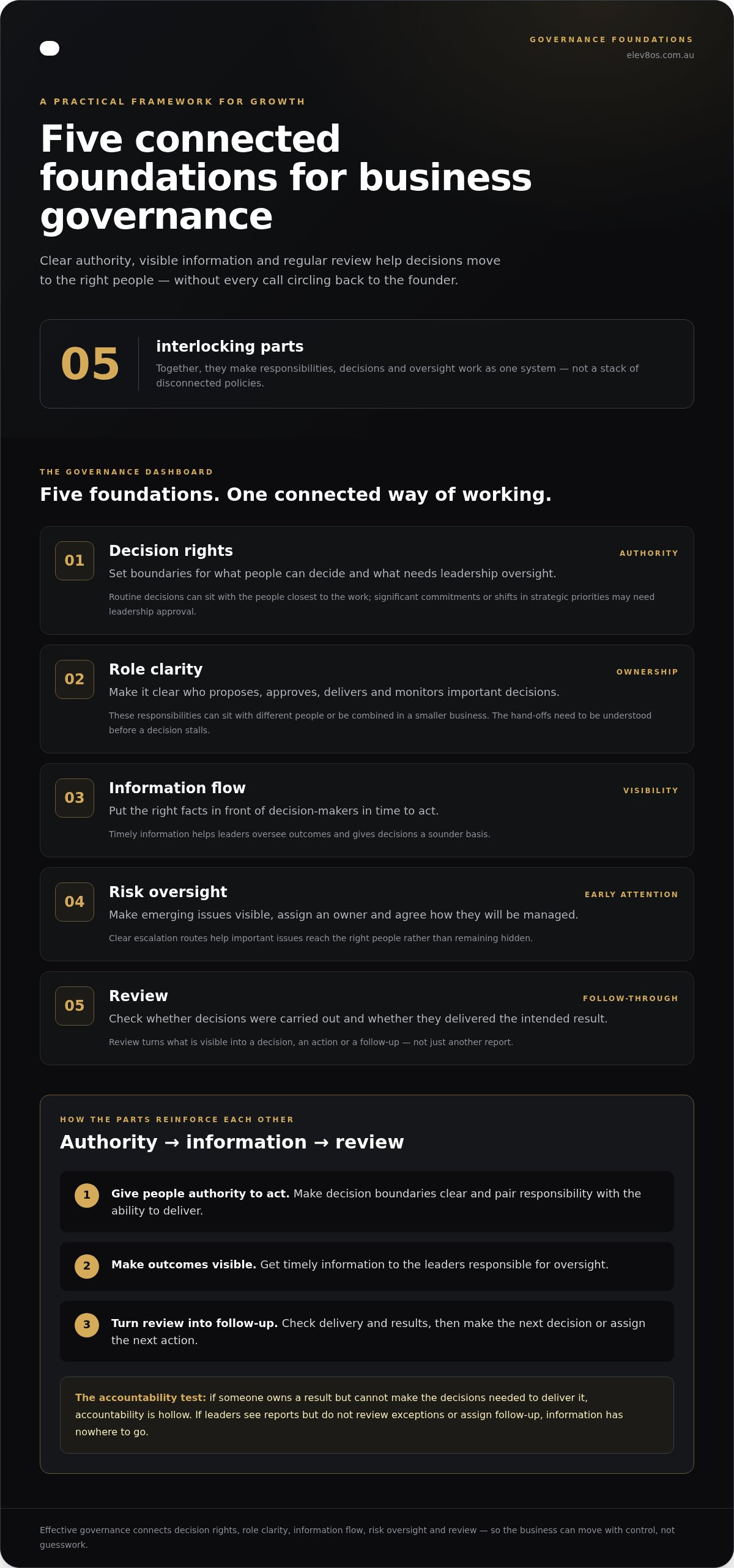
A useful governance framework for growing business operations isn't a stack of separate policies. It's a connected set of decision rights, clear roles, reliable information, risk oversight and regular review. Each part strengthens the others: people need authority to act, leaders need information to oversee outcomes, and review must turn what's visible into a decision or follow-up.
- Decision rights: Set boundaries for what people can decide and what requires leadership oversight.
- Role clarity: Name who proposes, approves, delivers and monitors important decisions.
- Information flow: Put the right facts in front of decision-makers in time to act.
- Risk oversight: Make emerging issues visible, assign an owner and agree how they'll be managed.
- Review: Check whether decisions were carried out and whether they delivered the intended result.
These aren't isolated boxes to tick. If a manager owns a result but can't make the decisions required to deliver it, accountability is hollow. If leaders receive reports but don't review exceptions or assign follow-up, information has nowhere to go. Clear accountability paired with timely information gives leaders a stronger basis for sound decisions.
Decision rights, accountability and leadership roles
For a significant decision, define who proposes it, who has authority to decide, who executes it and who checks progress. These roles can sit with different people, or some may be held by one person in a smaller business. What matters is that the hand-offs are understood before a decision stalls.
For example, a team leader might be authorised to resolve a routine customer issue within agreed boundaries. A decision that changes a major commitment or shifts a strategic priority may need leadership approval. If the team leader is responsible for resolving issues but must seek approval for every practical step, the business has assigned responsibility without authority. Set limits, name the escalation point and make exceptions clear.
Reporting, risk oversight and strategic direction
Build a reporting rhythm around the information leaders need to steer the business: performance against priorities, cash position, emerging risks and decisions requiring attention. Set the interval to suit the pace and complexity of the operation. A review is useful when it prompts action, not simply because a meeting or report exists on the calendar.
Keep reporting focused. Show what has changed, where results have moved off track, what risk is developing and what decision is needed. Activity counts alone can create noise. Pair each exception with an owner, a next step and a date to revisit it. That links oversight to execution and gives the next review a clear starting point.
For businesses ready to build these routines inside day-to-day operations, Elev8 Strategic Partners embeds a Strategic Operations Engineer to build operational systems, structure and accountability. Its approach is Embedded over advisory, Outcomes over tenure, Honest over comfortable and One industry at a time. Elev8 Strategic Partners focuses on agreed outcomes, tells clients what they need to hear, not just what they want to hear, and works with only one active client per industry vertical at any time. Explore embedded operational execution as a practical next step when clearer decision pathways need to become working habits.
Governance Versus Management: Keep Oversight Useful, Not Bureaucratic
Governance and management work together, but they do different jobs. Governance sets direction, boundaries and accountability. Management turns those decisions into day-to-day action. Blur the line and leaders either get pulled into routine work or lose sight of decisions that could materially affect the business.
A practical governance framework for growing business operations doesn’t require corporate layers, long meetings or a policy for every task. It gives the business enough oversight to see what matters, make key decisions at the right level and hold people accountable. The right amount depends on the business’s size, complexity, risks and circumstances.
Governance asks
- Are we pursuing the right strategic direction?
- Are material risks visible and owned?
- Are leaders accountable for agreed outcomes?
- Do we need to change a boundary, priority or decision?
Management asks
- What work needs to happen today?
- Who will complete it, and by when?
- How should the team resolve routine issues?
- What needs to be escalated because it falls outside agreed authority?
The distinction is about the work, not a person’s job title. In a smaller business, the owner may set direction and also manage daily delivery. The useful discipline is to recognise which role they’re playing in each decision. Oversight should guide execution, not take it over.
Which decisions belong at governance level?
Strategic direction, material risk and leadership accountability are useful examples of oversight topics. They aren’t universal legal categories. Routine operational calls, such as assigning work or resolving a customer issue within agreed boundaries, can usually sit with capable team members. Escalate when a decision could shift priorities, materially change exposure or exceed someone’s authority. Set those boundaries for your business rather than routing every choice upwards.
Ask what could change the business’s direction, expose it to a risk it hasn’t agreed to carry, or affect whether leaders deliver on their responsibilities. Those questions help distinguish oversight from daily management without treating every important-sounding issue as a governance matter. A decision’s impact and context matter more than its label.
How do you avoid governance becoming another layer of red tape?
Make every meeting, report and policy earn its place. Link it to a decision, a risk that needs watching or an accountability gap that must be closed. If two approvals perform the same check and the second adds no control or insight, remove the duplication. Keep records proportionate to the decision and useful to the people who must act.
Australian companies’ legal duties depend on their structure and circumstances. Don’t treat this practical distinction as a statement of legal requirements. Check current official guidance relevant to your situation and get appropriate legal advice where needed.
Proportionate governance protects pace. Teams can handle decisions within clear limits, while leaders retain visibility of exceptions and direction. If you’re turning oversight into routines people can use, embedded operational execution can help build that structure inside the business.
How to Tell Whether Your Governance Framework Is Ready for the Next Stage
Governance should match the business you’re running now, not the one you built when every decision fit around a single desk. As the team grows and operations become more connected, informal habits can leave gaps: unclear authority, late warnings or work that stops when the founder is unavailable. A short self-check can show where the structure needs attention. A weak answer doesn’t automatically mean you need a formal board.
Four questions to expose gaps in governance
Answer these against real decisions from recent months, not what you hope happens. If the answers differ depending on who you ask, that’s useful evidence. It points to a process to clarify, rather than a reason to add layers by default.
- Who decides? For key decisions, is there a named decision-maker and an understood approval path, including clear limits on their authority?
- Who owns delivery? Once a decision is made, can you name the person responsible for carrying it through and reporting on progress?
- What is visible? Can leaders see performance issues, emerging risks and pressure on priorities before they become urgent?
- What gets reviewed? Is there a routine for checking whether important decisions were acted on and whether follow-up is needed?
Pay close attention to recurring delays. If a routine decision repeatedly waits for the founder, authority may be too tightly held. If managers are accountable for delivery but lack the authority or information to act, the framework is out of step with the work. A leadership team accountability framework can help clarify how ownership and follow-through should work across the leadership team.
What should trigger a governance review?
Review the framework when the business changes in ways that affect decisions, risk or accountability. Triggers can include a leadership change, new operating complexity, a material risk or repeated delays. A larger team may need clearer delegation. More operational dependencies may call for better information-sharing and escalation. Greater founder involvement in routine approvals may signal that authority hasn’t kept pace with growth.
Check whether current reports and meetings still answer the questions leaders face. If information arrives too late, decisions are routinely deferred or no one follows up, adjust the routine. Set a review cadence that fits the pace and complexity of your business; there’s no universal schedule that suits every company.
Keep the response proportionate. Fix the specific gap first, then reassess whether the change has made ownership and decisions clearer. For businesses ready to put that structure into everyday operations, build accountability inside your business with embedded execution through Elev8.
Make Governance Operational: Build Accountability Inside the Growing Business
A governance framework earns its place when people use it to make decisions, surface issues and follow through. It isn’t a document that sits on a shared drive. Decision rights, reporting and accountability need to show up in daily work: who can act, what they need to report and how leaders respond when results or risks shift.
That takes more than announcing new responsibilities. Leaders need to use agreed decision pathways consistently, managers need authority that matches the outcomes they own, and reporting needs to prompt action. If the founder keeps overriding the process or every exception returns to them, the structure hasn’t become operational yet.
What embedded governance execution looks like
Elev8 embeds a Strategic Operations Engineer inside an established business to build and execute operational structure. The work includes operational infrastructure, leadership accountability and strategic clarity, built into how the business runs rather than left as recommendations for the team to interpret alone.
Engagements are defined-duration and typically run 6-18 months, concluding when agreed outcomes are delivered and the business is positioned to grow without Elev8. Success is measured by outcomes, not time in the engagement. The point is not permanent dependence. It’s to put systems and accountability in place so the business can carry them forward.
The operating principles are direct: Embedded over advisory, Outcomes over tenure, Honest over comfortable and One industry at a time. Elev8 works inside the business, focuses on agreed outcomes rather than time served, and tells clients what they need to hear, not merely what they want to hear. Only one active Elev8 client is allowed per industry vertical at any time.
A practical next step for an owner-led business
If you lead an established business and decision-making still depends too heavily on you, start by identifying where accountability breaks down. Is authority unclear? Does information arrive too late? Are agreed actions not being carried through? Those are practical issues to bring into a diagnostic conversation, not reasons to add process for its own sake.
Josh Lawrence is the direct access point for a Discovery Call. It’s a diagnostic conversation about the business and its operational needs. Bring the decisions, delays or accountability gaps that are getting in the way of growth.
If you’re ready to examine where governance needs to become operational, book a diagnostic Discovery Call.
Build a Business That Can Move Without You
The next test for your governance framework for growing business operations is simple: can the team keep making sound decisions when you’re not in the room? Build towards that standard deliberately. The aim isn’t to step away from leadership. It’s to make the business less dependent on your personal approval for every move.
For established businesses that need hands-on execution, Elev8 embeds a Strategic Operations Engineer inside the business to build systems, structure and accountability. Engagements typically run 6-18 months and conclude when agreed outcomes are delivered, with the business positioned to grow without Elev8. Only one active Elev8 client is allowed per industry vertical at any time.
If you’re ready to examine what’s keeping decisions or accountability tied to you, take a practical next step. A diagnostic Discovery Call is a direct conversation about your business. Learn about embedded operations, then book a diagnostic Discovery Call to start building a business equipped to move forward with greater independence.
Frequently Asked Questions
Is a governance framework only for large companies?
No. A governance framework for growing business operations can be scaled to the decisions and risks the business actually faces, without importing corporate layers. A small team might start by recording who can approve a commitment and when an issue must be escalated. That approach can suit owner-led businesses in Tamworth, Newcastle, Armidale, Coffs Harbour, Port Macquarie or Moree. Check specific Australian legal requirements against the business’s entity and circumstances.
What is the difference between governance and management?
Governance sets the boundaries and checks whether leadership is steering the business responsibly; management organises the work inside those boundaries. For example, leaders might agree the conditions for taking on a major new commitment, while a manager schedules the work and allocates staff. The same owner may do both jobs, but naming which role they’re exercising makes it easier to delegate delivery without losing sight of the bigger decision.
Can a small business have good governance without a formal board?
Yes. A formal board isn’t the only route to practical oversight. An owner and leadership team can use a short decision log, assign an owner to each agreed action and review unresolved issues during an existing leadership meeting. This creates a record of what was decided and what still needs attention without adding a new governing body. Whether a particular structure or duty applies depends on the business’s circumstances.
How often should a business review its governance framework?
There’s no single review interval that suits every business. Choose a cadence that fits how quickly the business changes and how soon leaders need to act on new information. A leadership change or new operating process may warrant a review straight away. In between, note decisions that were delayed or revisited, then use those examples to test whether authority, reporting and follow-up still work as intended.
What happens if every major decision still needs the founder’s approval?
Decisions can queue behind the founder, while managers wait instead of building confidence and taking ownership. Start with a recent approval request: did it genuinely require the founder’s judgement, or could a capable team member have decided within a defined limit? Delegate suitable calls with clear boundaries, and specify which exceptions should come back to the founder. Keep oversight of consequential choices, not every operational step.
Does a governance framework need to include risk management?
Yes, risk oversight helps leaders connect potential disruption to a named response. Keep it grounded in the business: identify a risk that could interrupt a key service, assign someone to watch for early warning signs and agree what would prompt escalation. Revisit the response when operations change. A generic register alone won’t make risk visible or managed. Any applicable obligations depend on the business’s circumstances and should be verified.
Is a governance framework the same as an Australian compliance checklist?
No. A compliance checklist can prompt useful questions, but it doesn’t show how leaders set priorities, delegate decisions or follow through on commitments. For instance, ticking off a required review won’t resolve a recurring hand-off gap unless someone owns fixing it. Treat governance as the way the business directs and oversees its work, with compliance considered where relevant. Verify current requirements through authoritative Australian sources before relying on a checklist.