
Business Operating Rhythm Template for Australian Owners
More meetings won’t fix a business that can’t turn priorities into decisions. A business operating rhythm template should do more than fill the calendar. It should stop reactive weeks from crowding out important work and make it clear who owns the next action.
If leadership meetings repeat updates without resolving blockers, or you’re left guessing whether key actions are moving, the problem isn’t a lack of effort. It’s a lack of structure. You need a cadence that gives you a reliable view of performance, decisions and follow-through.
This guide shows you how to build a practical weekly, monthly and quarterly rhythm your leadership team can maintain. You’ll see what each meeting is for, which measures to review, how to assign accountable owners and how to track actions between sessions. The result is a lightweight operating system that keeps priorities visible, decisions clear and progress measurable, while allowing time to plan for important business deadlines.
Key Takeaways
- Use a business operating rhythm template to connect each priority to a measure, an accountable owner, a next action and a review date.
- Choose weekly, monthly and quarterly reviews based on how quickly decisions are needed, the risks involved and your team’s capacity.
- Separate KPIs from actions: a KPI signals what’s happening, while an action defines the response and who owns it.
- Set each meeting’s purpose, attendees, preparation and decisions before adding it to the calendar.
- When follow-through stalls, name the blockage, agree on the next action and bring it back to the next review.
Business operating rhythm template: what it solves for a growing business
Urgent work can take over the whole week. A customer issue lands, a staff gap needs attention and a supplier delay pushes a priority aside. Then the leadership team meets, shares updates and leaves without deciding who will move the work forward. The same questions return next week.
A business operating rhythm template gives recurring work a place and a purpose. It isn’t a universal list of meetings to copy into every calendar. It’s a management cadence shaped around the decisions your business needs to make, the measures that inform them and the people responsible for acting.
An operating rhythm is the cadence that connects ownership, measures and decisions to consistent follow-through. Its value isn’t the meeting itself. It’s what becomes clearer and moves forward because the right people reviewed the right information and agreed on what happens next.
What belongs in a business operating rhythm?
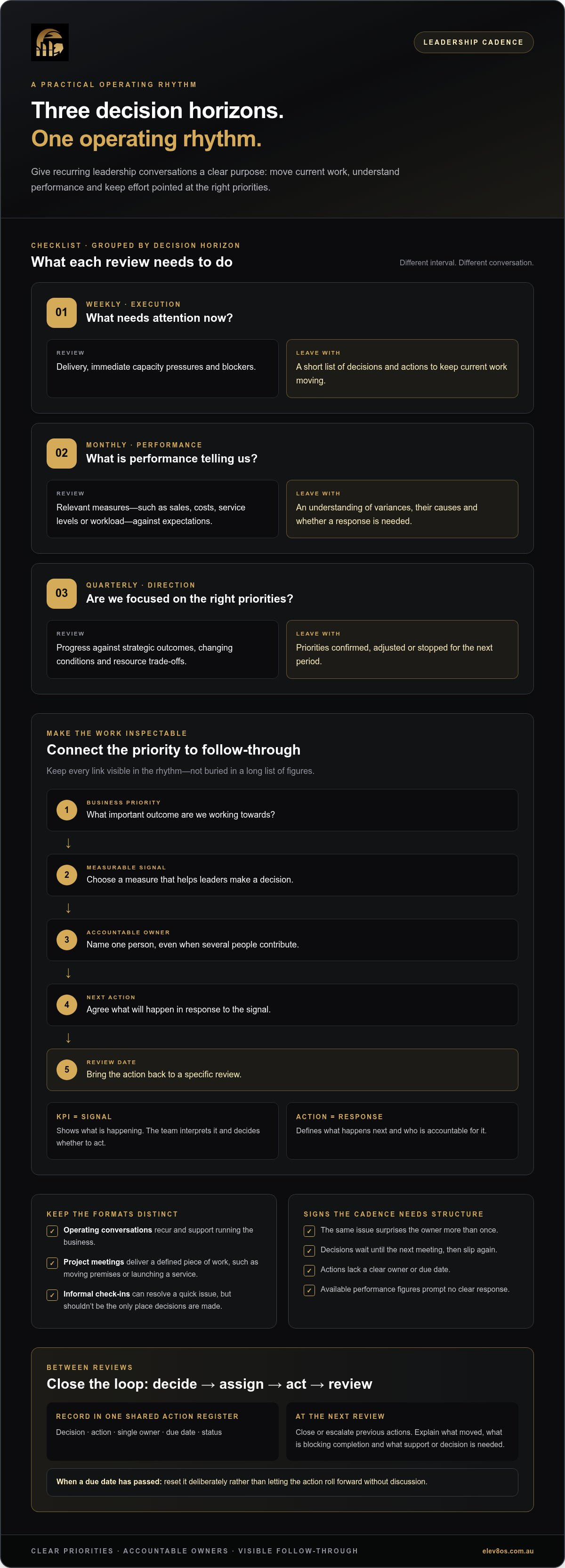
Build the cadence around three decision horizons. Each should answer a different question, not repeat the same conversation at a different interval.
- Weekly execution: What needs attention now? Review delivery, immediate capacity pressures and blockers. The intended outcome is a short list of decisions and actions that keep current work moving.
- Monthly performance: What is the performance telling us? Review relevant measures such as sales, costs, service levels or workload against expectations. Identify variances, understand their causes and decide whether a response is needed.
- Quarterly direction: Are we still putting effort into the right priorities? Review progress against strategic outcomes, changing conditions and resource trade-offs. Confirm, adjust or stop priorities for the next period.
These are operating conversations because they recur and support the running of the business. A one-off project meeting exists to deliver a defined piece of work, such as moving premises or launching a new service. An informal check-in can resolve a quick issue, but it shouldn’t become the only place decisions are made. Keep each format distinct, and don’t turn every conversation into a standing meeting.
When does a business need a more deliberate cadence?
Look for patterns, not isolated hiccups. The same issue surprises the owner more than once. A decision waits until the next meeting, then slips again. Actions are agreed, but nobody can say who owns them or when they’re due. Performance figures are available, yet they don’t prompt a clear response.
A defined rhythm makes these gaps visible. It gives the team a regular point to surface issues, assign ownership and check whether agreed actions happened. It won’t fix weak processes or unclear standards by itself. Those need to be built and reinforced in the work. A practical starting point is to build operational standards in business, so expectations are clear before performance is reviewed.
Keep the cadence proportionate. A growing business doesn’t need more meetings by default. It needs fewer conversations that produce clear decisions, named owners and a return point for unresolved work.
How the operating rhythm connects priorities, measures and decisions
A priority without a measure is hard to inspect. A measure without an owner is easy to ignore. And a meeting without a decision leaves the work where it was.
Connect the pieces in order: business priority → measurable signal → accountable owner → next action → review date. That chain helps leaders see whether important work is moving and what needs to happen if it isn’t. A business operating rhythm template should make each link visible, not bury it in a long list of figures.
Connect business priorities to KPIs and accountable owners
Choose only the measures that help leaders make a decision in that review. A KPI is a signal, not an instruction. It shows what’s happening; the team must interpret it and decide whether to act. Assign one accountable owner to each measure or action, even when several people contribute to delivery.
A KPI review is useful only when its signal leads to a decision or a clearly owned action. The owner should report the status, explain material movement and propose a next step. That keeps the discussion grounded in what the business can do, rather than turning it into a recital of numbers.
Illustrative example: A business sets a priority to improve follow-up on customer quotes. Its signal is whether each open quote has a recorded next step. The sales lead owns the measure, checks the open quotes and proposes follow-up actions where needed. The team records who will contact each customer and sets a review date for the next weekly meeting. No target or result is assumed. The point is to make the priority inspectable and actionable.
Turn a meeting discussion into an execution loop
Capture the result in one shared action register. Keep the record simple enough to use between meetings, with the decision, action, single owner, due date and status. If an action needs several people to deliver it, name one person who remains accountable for coordinating the work and reporting back.
At the next review, start by closing or escalating previous actions. “Still in progress” isn’t an update by itself. The owner should state what has moved, what is blocking completion and what decision or support is needed. If the due date has passed, reset it deliberately rather than letting the action roll forward without discussion.
This loop turns a meeting from a one-off conversation into a working control: decide, assign, act, review. Related planning tools can help owners connect priorities and measures, including these business frameworks and templates for Australian owners.
If you want a self-guided starting point for putting operational tools in place, the Elev8 Toolkit Course and its operational frameworks include tools such as a KPI starter pack.
Choose a business rhythm that avoids meeting overload
A full calendar can create the appearance of control without improving execution. Set meeting frequency according to how quickly decisions are needed, the operational risk involved and the team’s capacity to prepare and act. A time-sensitive delivery issue may need a weekly review. A broader pattern in costs or capacity may only need attention monthly.
Use the table as a starting point, not a rulebook. The right cadence gives each decision a useful review point without pulling people away from the work they need to deliver.
| Cadence | Purpose | Typical output |
|---|---|---|
| Weekly | Manage immediate priorities, blockers and commitments. | Short-cycle actions with owners and due dates. |
| Monthly | Review trends, financial visibility, capacity and recurring issues. | A response to a variance, or a decision to monitor it. |
| Quarterly | Reset priorities and test whether current work still supports the business direction. | Confirmed, adjusted or stopped priorities for the next period. |
Weekly, monthly and quarterly reviews serve different jobs
Weekly reviews keep current work moving. Focus on what’s due, what’s blocked and which commitments need a decision now. Monthly reviews look beyond the latest task list: check performance trends, financial visibility, workload and issues that keep returning. Quarterly reviews step back from immediate delivery to decide whether the business is still backing the right priorities.
Don’t force every topic into every meeting. If a weekly review turns into a detailed discussion of quarterly direction, the team loses its short-cycle focus. If a recurring operational issue needs a lasting fix, assign the work to improve the process rather than reopening the same discussion each week.
How to tell whether a meeting is earning its place
Ask what the meeting must produce. A decision, a resolved blocker or an owned action justifies time together. Repeated updates that could be read beforehand don’t. Replace status-only reporting with concise written preparation where practical, then use the meeting to examine exceptions and decide what happens next.
Review the meeting’s outputs after a few cycles. Are actions being completed? Are leaders resolving issues at the right level? Is the same information being presented without changing any decision? If nothing moves, change the purpose, format or frequency, or remove the meeting.
A smaller rhythm used consistently beats an elaborate calendar that collapses under pressure. Keep the business operating rhythm template lean enough that people can prepare, make decisions and follow through. Where repeated work needs a more reliable process, building scalable business systems can help establish steps the team can use consistently, instead of relying on memory or repeated meeting reminders.
Copy and adapt this business operating rhythm template
Start with the decisions your business needs to make, then build only the meetings that support them. This business operating rhythm template gives each cadence a purpose, preparation standard, accountable owner and follow-up point. Adapt the details to your operation, but keep ownership clear.
A copy-ready weekly, monthly and quarterly rhythm
Set up the rhythm in order. Don’t fill the calendar first and work out the purpose later.
- Choose outcomes. Name the priorities and decisions the rhythm needs to support.
- Set the cadence. Place each conversation weekly, monthly or quarterly according to when a decision is useful.
- Assign owners. Name one accountable owner for each meeting and each action.
- Prepare measures. Decide what information people must bring, and how they’ll present it.
- Review actions. Start each session by checking previous commitments, then record decisions and follow-up.
Copy these editable rows into your working document. Replace role descriptions with names, and adjust attendees to include only people needed for the decisions.
- Weekly: Purpose: manage immediate priorities, blockers and commitments. Attendees: owner and people responsible for current delivery. Preparation: current priorities, exceptions and open actions. Decisions: resolve blockers and agree short-cycle actions. Meeting owner: [name]. Follow-up: [action, owner, due date, status].
- Monthly: Purpose: review performance, capacity and recurring operational issues. Attendees: owner and relevant functional leads. Preparation: selected measures, trends and unresolved issues. Decisions: agree responses, owners and any further investigation. Meeting owner: [name]. Follow-up: [action, owner, due date, status].
- Quarterly: Purpose: confirm direction and reset priorities. Attendees: owner and leadership team. Preparation: progress against priorities, key changes and resource constraints. Decisions: confirm, adjust or stop priorities. Meeting owner: [name]. Follow-up: [action, owner, due date, status].
Illustrative sample entry: Weekly priority: address a delivery blocker. Preparation: the responsible lead brings the issue and its effect on current work. Decision: agree the next step. Meeting owner: [name]. Action register: decision [agreed next step]; owner [name]; due date [date]; status [open]. This is a blank example, not a claimed business result.
Adapt the template without weakening accountability
Remove agenda items that don’t support a priority, decision or measurable follow-up. Keep the rhythm proportionate to the size of your team and the complexity of its work. A small leadership team may combine agenda items, but it still needs one meeting owner and a named owner for every action. For wider framework context, explore the Foundations Toolkit for Business: A Practical Buyer’s Guide.
Trial the cadence for a short, defined period. Then review whether the meetings helped decisions move, whether preparation and attendance created too much workload, and which actions were missed. Change the design based on what happened, not on a preference for more meetings.
To explore Elev8’s operational frameworks, visit the Elev8 website. For a diagnostic conversation about your business, use the Discovery Call link below. It’s a 30-45 minute video call with no pitch deck or slide presentation.
Make the operating rhythm stick: ownership, honest review and next steps
A business rhythm usually breaks in predictable ways. Leaders skip reviews when delivery gets busy. Actions leave the meeting without a named owner. Measures get reported, but nobody decides what to do with the information. The calendar may still look organised, but the operating system has stopped working.
Don’t respond by adding more meetings or more metrics. Reset the work already in front of you. Name the blockage, agree on the next action, assign one owner and set a date to return to it. At the next review, check what happened. If the same blocker remains, decide whether the action needs support, a different approach or escalation. An honest review deals with the work as it stands, not as the team hoped it would be.
- Leadership skips reviews: protect the cadence, or reset it explicitly when priorities change.
- Actions have no owner: name one accountable person, even if delivery relies on a team.
- Metrics prompt no decision: remove them from the meeting or define what response they should inform.
The operating standard behind a sustainable rhythm
Elev8’s Premium Strategic Operations Engagement embeds a Strategic Operations Engineer inside an established, founder-led business to build systems, structure and accountability. The model is embedded over advisory: the work happens inside the business and focuses on execution, not reports alone. Elev8 is honest over comfortable, telling clients what they need to hear, including where blind spots are getting in the way. Success is measured by outcomes over tenure. Engagements typically run 6-18 months and conclude when agreed outcomes are delivered and the business is positioned to grow without Elev8. The engagement is strictly limited, with only one active Tier 1 client per industry vertical at a time. Josh Lawrence provides direct access during the engagement.
A practical next step for owners who need help executing
A template can set the structure, but someone still has to make the system work inside the business. If you’re building the rhythm yourself, keep the action register current, make owners report plainly and adjust the cadence when it isn’t helping decisions move.
For a self-guided starting point, the Elev8 Toolkit Course is a digital resource with operational frameworks and templates, perpetual access and a one-off cost of $97. It can support the work of setting up your own operating structure.
If you need to talk through the operating challenges in your business, a Discovery Call is a 30-45 minute video diagnostic conversation. It is not a sales call, and there’s no pitch deck or slide presentation. Book a Discovery Call.
Put the next decision on the calendar
A rhythm only earns its place when it changes how the business acts. Your next step doesn’t need to be a sweeping restructure. Choose one recurring decision that keeps getting delayed, name who should own it and give it a clear review point. Build from there.
If the harder issue is getting the leadership team to execute consistently, use a Discovery Call to examine what’s happening beneath the calendar. It’s a 30-45 minute video diagnostic conversation about your current state, goals, past attempts, constraints and fit. No pitch deck. No slide presentation. Just a direct discussion about what needs to change.
Book a Discovery Call to discuss the operating pressure points holding your business back. For owner-led businesses in Tamworth, Newcastle, Armidale, Coffs Harbour, Port Macquarie and Moree, a business operating rhythm template is a starting structure. Progress comes from making decisions stick and building a rhythm your team can sustain.
Frequently Asked Questions
What is a business operating rhythm?
A business operating rhythm is the agreed pattern a leadership team uses to revisit important work and make decisions before issues become urgent. It gives routine choices a known place, such as who can approve a change, what needs escalation and which issue can wait. For an owner, the test is whether the pattern reduces decisions relying on memory or informal follow-ups.
What should a business operating rhythm include?
Include recurring decisions, the information needed to make them and a record of what the team agrees. A meeting charter can help: write down its purpose, who needs to attend, what participants bring and what outcome is expected. For example, if a delivery issue needs a leadership decision, the meeting should identify the decision-maker and the information they need, not just report that the issue exists.
How often should a business review its KPIs?
Review each KPI often enough to act on its signal, but not so often that normal variation creates noise. A measure tied to daily delivery may need frequent attention, while a measure that changes gradually may be more useful as a trend. For every KPI, agree what movement warrants investigation and who will raise it. This keeps reviews focused on meaningful changes rather than constant monitoring.
How do I make an operating rhythm template work for a small business?
Start with one business priority that currently depends on the owner remembering to follow up. Build a simple review around it, then add another only when there is a clear need. Keep the business operating rhythm template easy to maintain with the tools the team already uses. This approach can suit owner-led businesses in Tamworth, Newcastle, Armidale, Coffs Harbour, Port Macquarie and Moree, regardless of team size.
Can a business operating rhythm reduce unnecessary meetings?
Yes, if leaders use it to challenge the purpose of each recurring meeting. Ask whether the last few sessions produced a decision, removed a barrier or assigned work that needed discussion. If not, try circulating routine updates beforehand and meeting only when input or a decision is required. Keep a written record of what changed, so the team can tell whether the new approach is working.
What is the difference between an operating rhythm and a business plan?
A business plan sets out the intended destination and the choices behind it. An operating rhythm helps leaders manage the work of putting those choices into practice. For example, a plan might identify a need to expand a service, while the rhythm gives the team a place to review readiness, resolve dependencies and decide what to progress next. One sets direction; the other helps keep decisions connected to delivery.